Cart
0
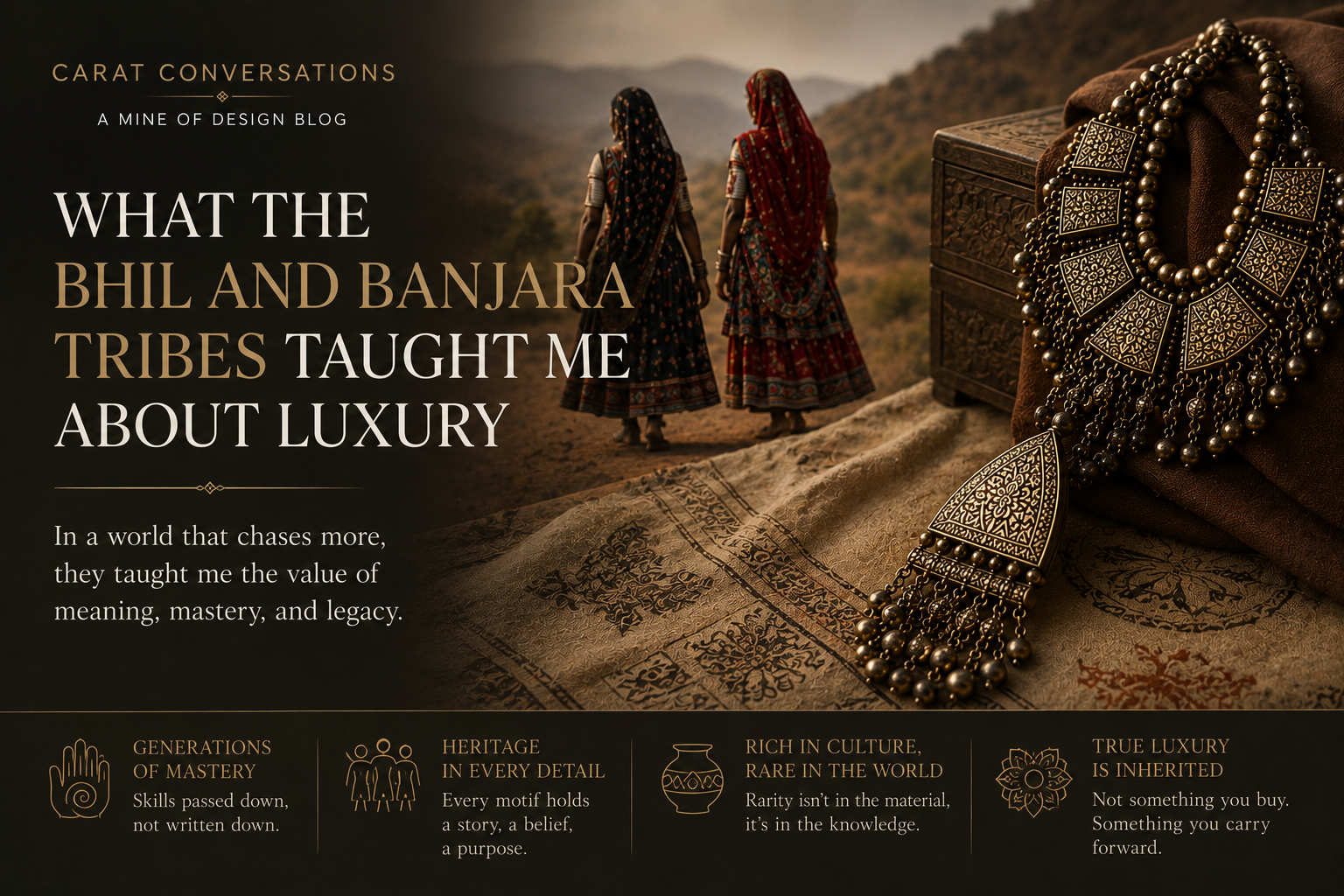
What the Bhil and Banjara Tribes Taught Me About Luxury
There is a word we use so easily. Luxury.
We attach it to price tags, to brand names, to the weight of a box and the rustle of tissue paper. We have been taught by magazines, by marketing, by the relentless pursuit of the aspirational that luxury is something you acquire. Something you wear to signal where you have arrived.
But the Bhil and Banjara tribes of Gujarat and Rajasthan taught me something different. They taught me that luxury, in its truest form, is not something you acquire at all.
It is something you inherit.

I first encountered their metalwork not in a gallery or a design fair, but through the quiet persistence of the pieces themselves. The weight of them. The way each curve seemed to carry intention not the intention of a deadline or a brief, but of something older. Something that had been passed from hand to hand, generation to generation, long before the word design existed.
These communities have been working with metal for centuries. Their techniques are not documented in textbooks. They live in muscle memory, in the spaces between a teacher's hands and a student's, in the particular pressure applied to a tool that no instruction manual can fully describe. The knowledge is embodied. It is alive.
And that, I came to understand, is what true luxury feels like.

We have built an entire industry on the premise that rarity creates value. A diamond is precious because it is scarce. A handbag is desirable because not everyone can have one.
But scarcity of skill of the kind that takes generations to develop, that cannot be replicated by a machine or rushed by a deadline, is a rarity the luxury industry rarely speaks about.
When a Bhil artisan shapes metal, they are not just making an object. They are executing a philosophy. One that sees beauty not as decoration, but as meaning. Every motif has a purpose. Every pattern tells a story of the land, of the community, of the sacred relationship between the maker and the made.
That is not craft. That is wisdom in material form.
Standing at Cannes this May, wearing pieces rooted in these traditions, I felt the weight of that wisdom differently than I ever had before.
Because luxury, I realised, is not about what you wear. It is about what you carry.
And what I carried that day — what every piece of Mine of Design carries — is something no price tag can define. It is the accumulated knowledge of generations. The pride of communities who have never needed a global stage to know their own worth. The quiet confidence of craft that has outlasted empires.
The Bhil and Banjara tribes did not teach me about jewellery.
They taught me about what it means to make something that lasts.
And in a world that moves fast and forgets faster, I can think of nothing more luxurious than that.
Ambar Pariddi Sahai is the founder of Mine of Design and a jewellery revivalist committed to celebrating India's tribal craft heritage on the global stage.