Cart
0
Heritage Is Not What We Leave Behind: Mine of Design at the 79th Cannes Film Festival
I want to tell you something that took me a long time to understand.
Heritage is not a museum. It is not a photograph. It is not something we preserve behind glass and visit on Sundays, nodding respectfully before returning to our ordinary lives.
Heritage is alive. It breathes. It demands something from us.
It demands that we carry it forward.
This is not a comfortable truth. Because carrying something forward requires effort. It requires choosing, again and again, to prioritise what is ancient over what is convenient. To slow down in a world that rewards speed. To invest in craft that takes generations to learn when the market rewards things that can be produced overnight.
It requires, in short, a kind of stubbornness. A refusal to let go.
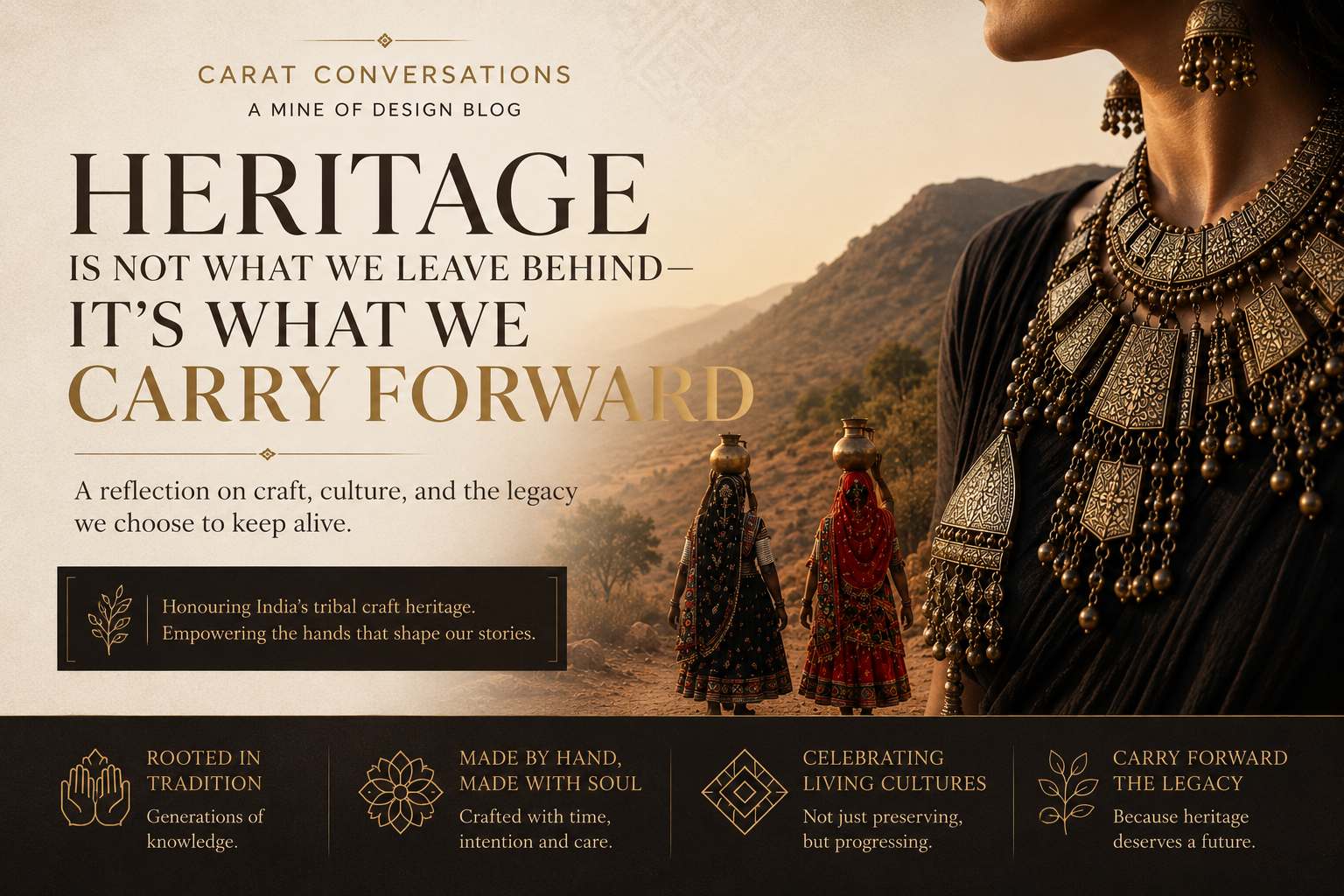
When I, as the founder of Mine of Design, designed the pieces I wore to the 79th Cannes Film Festival this May, I was making that choice. The collection was rooted in the metalworking traditions of the Bhil and Banjara tribes of Gujarat and Rajasthan — communities who have been making this choice for centuries, quietly, without applause, because the alternative was unthinkable.
To let a tradition die is to let a way of seeing the world disappear. And every way of seeing the world — every philosophy of beauty, every cultural language of form and texture and meaning — is irreplaceable once it is gone.
The Bhil and Banjara artisans know this. They have always known it. My role, as a designer, was simply to listen.
But I want to speak to something larger than jewellery here.
We are living in a moment of extraordinary cultural anxiety. Globalisation has brought us closer together in some ways, and further apart in others. In the rush to participate in a global economy, many communities have watched their traditions devalued — their handmade goods undercut by mass production, their knowledge dismissed as quaint, their craft reduced to a tourist category rather than a living, evolving art form.
Make in India, at its best, is a response to this anxiety. Not a nationalist slogan, but a genuine commitment — to say that what is made here, by these hands, in these communities, with this accumulated wisdom, has value. Not in spite of its origins, but because of them.
Carrying that message to Cannes felt important to me not as a personal milestone, but as a statement about what the global design conversation needs more of.
It needs to look beyond Paris and Milan. It needs to recognise that the world's most extraordinary design traditions are not always the loudest ones.
I have been asked, since Cannes, what it felt like to stand on that stage as the first jewellery designer from India to present a tribute to tribal artisans in that space.
The honest answer is that it felt less like an arrival and more like a responsibility.
Because a moment of recognition means nothing if it is not followed by sustained action. If the artisans whose work I wore remain uncredited in the broader conversation. If the traditions that inspired those pieces continue to be under-resourced, undervalued, and at risk.
The red carpet moment was for them. But the real work happens after the cameras move on.
Heritage is not what we leave behind.
It is what we refuse to abandon, even when it would be easier to let go. It is the choice, made every day, to honour the hands that came before ours. To ensure that what was passed to us is passed on — not diminished, not diluted, but enriched by our time with it.
This is what Mine of Design is built on. Not nostalgia. Not aesthetics. But a deep, stubborn belief that the stories embedded in the Bhil and Banjara traditions deserve to be heard — not just in India, but everywhere.
And so we carry them forward.
That is the only kind of legacy worth building.
Ambar Pariddi Sahai is a jewellery revivalist, designer, and founder of Mine of Design. She is committed to celebrating India's tribal craft heritage and empowering the artisan communities whose creativity defines it.
Meta description: Ambar Pariddi Sahai of Mine of Design on carrying Bhil and Banjara tribal heritage to the 79th Cannes Film Festival — and what comes aftera