Cart
0
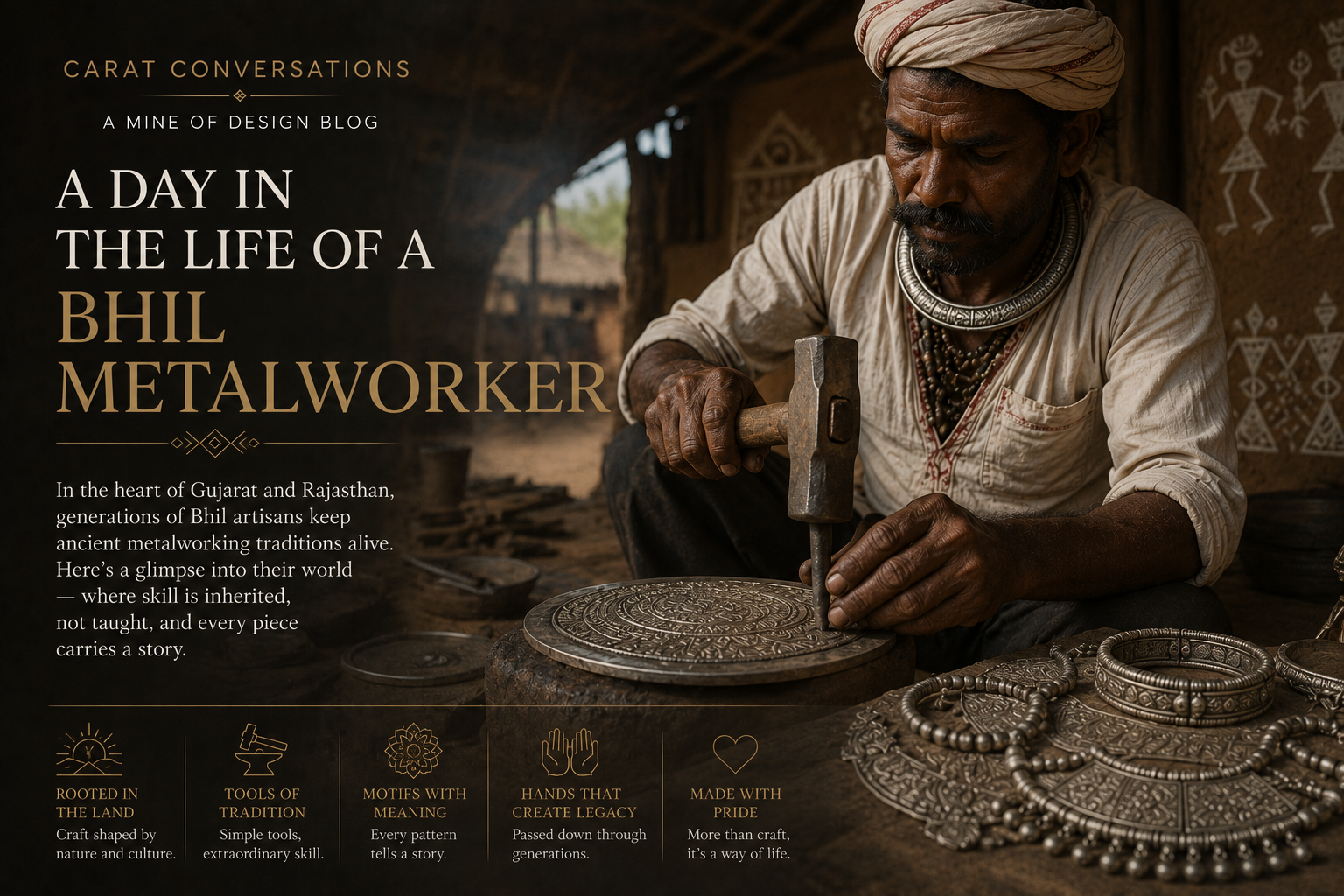
What does tribal jewellery symbolize?
Every piece of jewellery speaks. Most of us just haven't learned to listen.When you hold a piece of Bhil or Banjara metalwork, you are holding a text. Not a text written in any alphabet you learned in school, but one far older — written in curves and angles, in repeating patterns that carry meanings passed down through generations of oral tradition and lived culture.
I have spent years learning to read this language. And the more I learn, the more I understand how much is contained in what the eye first sees simply as decoration.
The Bhil Visual Vocabulary: Sun, Peacock, and Geometric Motifs
The Bhil tribe of Gujarat and Rajasthan are among India's oldest indigenous communities. Their metalwork is not merely aesthetic — it is communicative. Every motif in the Bhil visual vocabulary carries a specific meaning, rooted in their relationship with the natural world, their spiritual beliefs, and their social structures.
The sun motif — appearing frequently as a radiating circle — represents life, energy, and the divine. It is not decoration. It is a prayer made permanent in metal.
Animal motifs, particularly peacocks and horses, speak of freedom, nobility, and the sacred. The peacock, in Bhil tradition, is a messenger between the earthly and the spiritual. To wear it is to carry that bridge with you.
Geometric patterns — diamonds, triangles, interlocking forms — represent the structure of the universe itself. The relationships between shapes mirror the relationships between people, between communities, between the living and the ancestors.
Banjara Jewellery: Identity, Currency, and Protection
The Banjara tribe brings a different visual grammar, shaped by their history as nomadic traders who traversed the length and breadth of the subcontinent. Their metalwork reflects movement — flowing forms, layered textures, designs that seem to carry the memory of roads travelled and lands crossed.
For the Banjara, jewellery was never merely ornamental. It was currency, identity, and protection. A woman's jewellery announced her community, her status, her story, to anyone who knew how to read it. Crossing unfamiliar territories, the Banjara carried their identity on their bodies — a portable statement of belonging in a world that could be hostile to those without roots.
This history gives Banjara metalwork a particular quality. There is a confidence in it. A refusal to be invisible.
Designing With Tribal Motifs: Where Celebration Meets Responsibility
When I design for Mine of Design, I do not simply borrow these motifs. I study them. I sit with them. I ask what they are saying, and whether I have earned the right to carry that message forward.
This is a question every designer working with indigenous visual traditions must ask honestly. There is a fine line between celebration and appropriation, and that line is drawn by relationship, by credit, by compensation, and by humility.
The artisans I work with are not my suppliers. They are my collaborators. Their knowledge is not a resource I extract — it is a conversation I am privileged to be part of.
And the motifs they have shared with me are not design elements. They are sentences in a language that the world needs to hear.
Look Closer
Next time you see a piece of tribal metalwork — whether in a gallery, on a runway, or at a market — look closer. Ask what it is saying.
It has been waiting a long time to be heard.
Ambar Pariddi Sahai is the founder of Mine of Design, a jewellery label rooted in India's tribal craft heritage.
Continue exploring:
- Carat Conversations — more expert discussions on diamonds, gemology, and jewelry value
- Our Story — the philosophy behind Mine of Design
- Explore our fine and festive jewelry collections