Cart
0
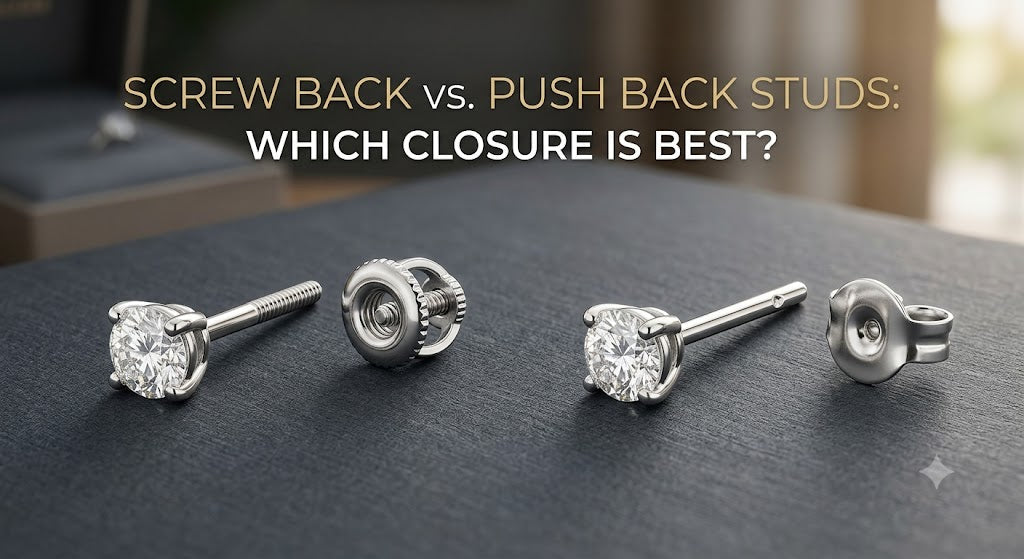

An earring rarely gets lost because the front design failed — it gets lost because the backing did. Push backs and screw backs solve that problem through two genuinely different mechanisms, and the "which is best" answer depends almost entirely on what you're using the earring for: a quick daily stud you'll swap out by evening, or a piece you want to forget you're wearing for days at a time.
How Each Mechanism Actually Works
-
Push backs (also called butterfly or friction backs) use a straight post, often with a small notch or groove near the tip, and a backing that slides on and holds through friction and internal tension against that notch. No twisting or threading is involved — just pressure.
-
Screw backs use a threaded post and a matching backing with an internally threaded hole, so the backing twists onto the post like a nut onto a bolt, creating a mechanical lock rather than relying on friction alone.
This mechanical difference — friction versus threading — is the root of every other difference between the two.
Security Compared
Screw backs are more secure by design, because a mechanical lock doesn't loosen the way friction does. Push backs, relying purely on tension between the notch and the backing, can gradually work looser with repeated movement over the course of a day, which is the more common way a push-back stud actually gets lost — not falling off suddenly, but slowly working its way loose without being noticed. Screw backs don't share this failure mode in the same way, since the threading holds its position regardless of movement, provided it was screwed on correctly in the first place.
Comfort and Ease of Use Compared
Push backs win clearly on speed and simplicity — sliding a backing on and off takes a second, no fine motor coordination required. Screw backs take longer to put on and remove, since the backing needs to be twisted on carefully, and applying uneven pressure while doing so risks cross-threading the post. Once properly fitted, screw backs are generally just as comfortable as push backs for extended wear, but "properly fitted" is doing some work in that sentence: over-tightening a screw back can create a pinching sensation against the earlobe that a push back, which only ever applies as much pressure as the notch requires, doesn't produce in the same way.
Best Use Cases for Each

|
Situation |
Better Choice |
Why |
|
Quick daily wear, changing earrings often |
Push back |
Faster on and off, no risk of stripped threads from repeated use |
|
Sleeping in earrings or wearing for several days straight |
Screw back |
Mechanical lock holds position without loosening from movement |
|
Travel |
Screw back |
Lower risk of a stud working loose and getting lost in transit |
|
Newly pierced ears |
Push back |
Simpler mechanism, less handling and pressure directly at the piercing site |
|
Children's earrings |
Screw back |
Harder for a child to remove independently, and less likely to loosen and fall unnoticed |
|
Larger or heavier statement studs |
Screw back |
Additional security matters more as weight and value increase |
|
Sensitive or easily irritated ears |
Depends on fit |
A well-fitted screw back can reduce unnecessary post movement; an over-tightened one can pinch — see below |
Common Problems and Fixes
-
A push back that keeps loosening. This usually means the notch on the post has worn slightly, or the backing itself has stretched from repeated use. Replacing the backing (a low-cost fix on most studs) is generally more effective than trying to bend or reshape a worn one.
-
A screw back that's difficult to twist on. Forcing a screw back that isn't threading smoothly is the most common cause of stripped threads, after which the backing no longer grips reliably at all. Slowing down and realigning, rather than pushing through resistance, avoids this.
-
A screw back that feels too tight. Back off slightly rather than leaving it at maximum tightness — a screw back doesn't need to be as tight as possible to hold securely, and over-tightening is a common, avoidable source of discomfort.
-
Limited hand dexterity. For anyone who finds small threading motions difficult — a common issue for children handling their own earrings, or for anyone with reduced fine motor control — push backs are generally the more practical daily choice, with screw backs reserved for pieces that are put on and left in place for longer stretches.
A Note for Fashion Jewellery Specifically
Most screw-back-versus-push-back comparisons are written for fine jewellery — diamond studs where the backing's job is protecting a genuinely expensive stone. In accessible, gold-plated fashion jewellery, the stakes are a little different: a screw back isn't primarily about insuring against a costly loss, it's about all-day snugness and not having to think about your earrings once they're on. For pieces you plan to wear daily without swapping — see how many stud earrings should you own for building that kind of rotation — a screw back on your most-worn pair earns its slightly slower on-and-off in exchange for one less thing to check throughout the day.
Other Backing Types Worth Knowing

Push and screw backs are the two most common closures, but they aren't the only options — threaded flat backs and ball backs each solve slightly different problems, covered in more detail in what stud earrings are. If comfort for sensitive or easily irritated ears is your main concern rather than security alone, it's worth reading that comparison alongside this one, and our guide to stud earrings for sensitive ears specifically.
Frequently Asked Questions
Are screw back earrings always more secure than push backs?
Generally yes, because a mechanical lock doesn't loosen with movement the way a friction-based push back can, provided the screw back was threaded on correctly and isn't stripped.
Why do my push-back earrings keep coming loose?
This is usually caused by wear on the post's notch or stretching of the backing itself over repeated use, rather than a fault with how the earring is being worn — replacing the backing typically resolves it.
Are screw backs harder to use than push backs?
Yes, in terms of speed — screw backs take longer to put on and remove and require more careful handling to avoid stripping the threads, though they don't cause discomfort once properly fitted.
Which backing type is safest for children's earrings?
Screw backs are generally recommended for children, since they're harder to remove independently and less likely to loosen and fall out unnoticed compared to a push back.
Studs available in both closure types can be found within the studs collection.