Cart
0
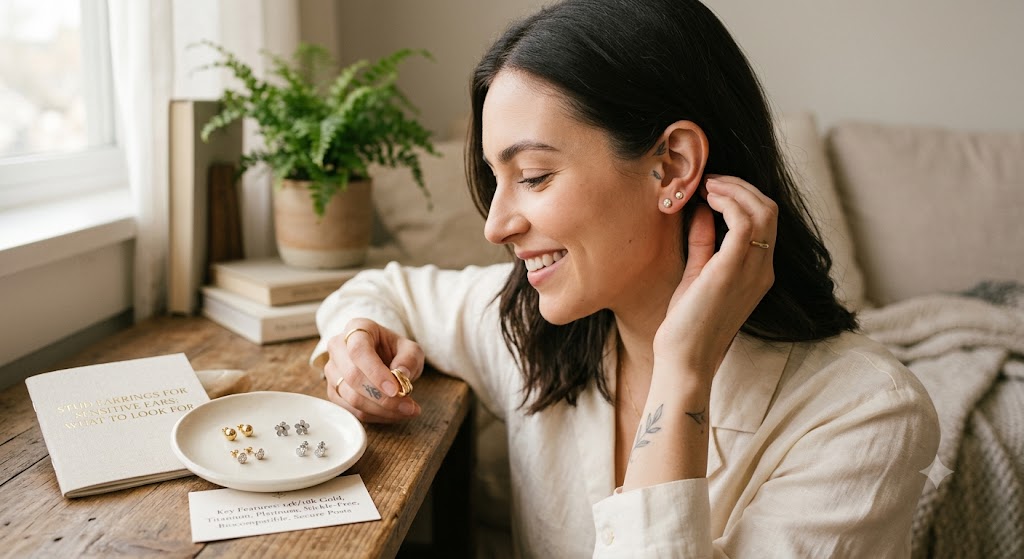

A pair of studs that felt completely fine for the first few months can suddenly start causing irritation later on, without the metal itself ever changing. That's not a contradiction — it's usually the plating wearing through. Most advice on sensitive-ear earrings jumps straight to "buy hypoallergenic metal" without explaining why studs specifically are the earring category most likely to cause a delayed reaction, or what actually happens to a plated post after months of daily wear.
Why Studs Are the Riskiest Category for Sensitive Ears
Every earring style touches skin, but a stud's post does something the others don't: it sits directly inside the piercing channel itself, in sustained contact with pierced tissue, for as long as the earring is worn. Hoops and ear cuffs mostly contact the outer ear; a stud's post is inside the piercing, in constant contact with tissue that's still, in a sense, a healed wound. That's why sensitive-ear reactions show up disproportionately with studs — not because studs are inherently worse-made, but because the contact is more direct and more sustained than with almost any other earring type.
What "Hypoallergenic" and "Nickel-Free" Actually Mean

Both terms get used far more loosely than most buyers assume. As covered in more depth in our guide to nickel-free and hypoallergenic jewellery, "nickel-free" typically means a piece's nickel release rate falls below a recognised threshold, or that no nickel was intentionally added during manufacturing — not that the material contains zero nickel whatsoever. "Hypoallergenic" isn't a regulated term in most markets either, which means it reflects a brand's own standard rather than a guaranteed, independently verified claim. Neither label is meaningless, but neither is an absolute guarantee for every person's skin.
The Plating Wear-Through Problem, Specific to Studs
This is the detail most sensitive-ear buying guides skip entirely, and it matters more for studs than for any other earring type. A stud's post experiences more physical friction than the rest of the earring — it's inserted and removed repeatedly, and it sits against piercing tissue for hours at a stretch. On a gold-plated post, that friction gradually wears the plating thinner at exactly the point of most contact. Once the plating wears through, whatever base metal sits underneath — which may contain nickel or other reactive alloys — becomes directly exposed to piercing tissue, even though the earring looked and felt completely fine when it was new. This is precisely why a pair that caused no issue for the first several months can start irritating skin later: the metal touching your piercing has quietly changed, even though the earring hasn't.
Backing Type and Sensitive Ears
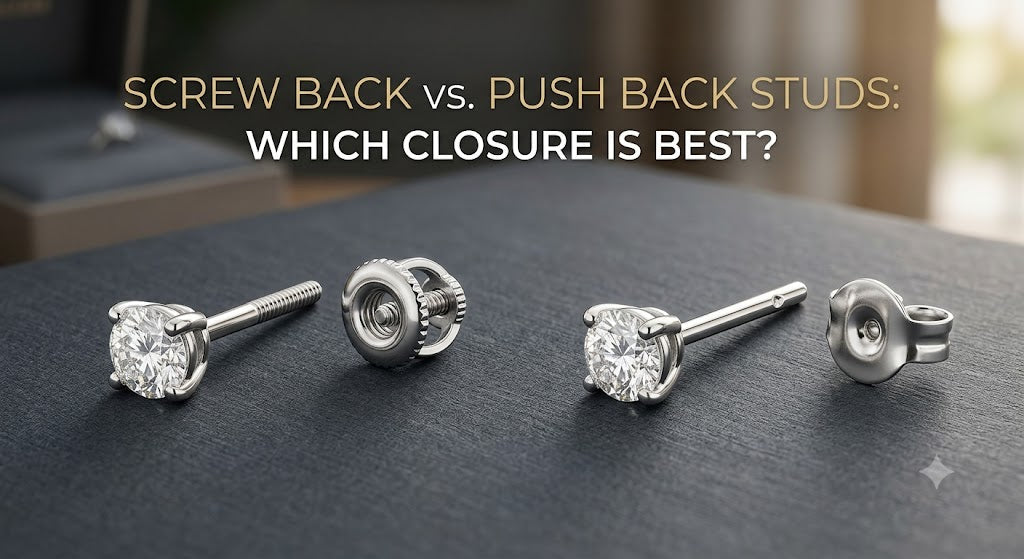
Backing choice affects comfort nearly as much as post material does. Threaded flat backs, which screw into place and sit flush against the back of the ear, tend to be more comfortable for sensitive ears than a protruding butterfly back, since there's less backing material pressing against skin. Whatever backing type you choose, it's worth checking that it's made from the same tolerated material as the post — a well-chosen post paired with a lower-quality backing can still cause irritation, since the backing is in near-constant skin contact too.
Materials Generally Better Tolerated
-
Titanium (implant-grade or commercially pure) is widely considered one of the most consistently well-tolerated options, since it's a single element rather than an alloy and contains no nickel at all.
-
Surgical steel (316L) isn't technically nickel-free, but its composition limits how much nickel actually releases onto skin, making it generally well tolerated by most people, even those with mild sensitivity.
-
Solid gold (14k or higher) contains proportionally less reactive alloy than lower-karat or plated pieces, though it isn't automatically nickel-free — it depends on the specific alloy used.
-
Niobium is another metal frequently recommended for highly reactive skin, similar in profile to titanium.
None of these guarantee a reaction-free experience for everyone — individual sensitivity varies — but they represent meaningfully lower risk than an unspecified base-metal alloy.
A Practical Buying Checklist
-
Ask what the post is made of specifically, not just whether the earring is marketed as "hypoallergenic" — a specific material name (titanium, 316L surgical steel, solid gold) is more informative than a marketing label alone.
-
Check whether the post itself is plated or solid, particularly for gold-toned studs. A solid post in a tolerated metal avoids the plating wear-through issue entirely; a plated post doesn't, regardless of what the surface metal is.
-
Consider backing material alongside post material, since both stay in prolonged skin contact.
-
For daily-wear pieces specifically, prioritise durability of the post material over surface finish, since daily wear is exactly where plating wear-through becomes relevant over time.
Signs Your Studs Are Causing a Reaction

Reactions don't always appear immediately. Redness, itching, swelling, or soreness around the piercing that develops gradually — rather than on first wear — is a common pattern with plated posts specifically, since it tends to coincide with the plating wearing through rather than an immediate reaction to a new material. Persistent irritation that doesn't improve with a few days' rest from wearing earrings is worth taking as a signal to reassess the specific piece, rather than assuming all studs are the problem.
Care Habits That Reduce Irritation Risk
-
Clean posts and backings regularly to remove oil and product buildup that can compound irritation risk even with a well-tolerated metal.
-
Give piercings an occasional break from constant wear, particularly overnight, to reduce prolonged contact time.
-
Dry ears thoroughly after washing or swimming before putting studs back in, since moisture trapped against a piercing can accelerate both irritation and plating wear.
-
Retire a pair once plating visibly wears at the post, rather than continuing to wear it — this is the point where the risk described above actually becomes relevant, regardless of how the earring looked when new.
Frequently Asked Questions
Why did my studs suddenly start irritating my ears after months of no problem?
This is a common pattern with plated posts specifically — the plating gradually wears thin from repeated insertion and removal, eventually exposing the base metal underneath, which may not be as well tolerated as the original surface.
Is "nickel-free" the same as "hypoallergenic"?
Not exactly. Nickel-free generally refers to a specific metal's nickel content or release rate; hypoallergenic is a broader, less regulated claim about general skin tolerance that isn't specific to nickel alone.
Are solid metal studs always safer than plated ones for sensitive ears?
Generally yes, if the solid metal itself is well tolerated, since there's no plating layer to wear through and expose a different underlying metal over time.
What backing type is best for sensitive ears?
Threaded flat backs are often more comfortable, since they sit flush against the ear with less backing material in contact with skin compared to a protruding butterfly back.
Comfortable, everyday-friendly styles are available within the studs collection; see our broader guide to earrings for sensitive ears for guidance across other earring types too.