Cart
0
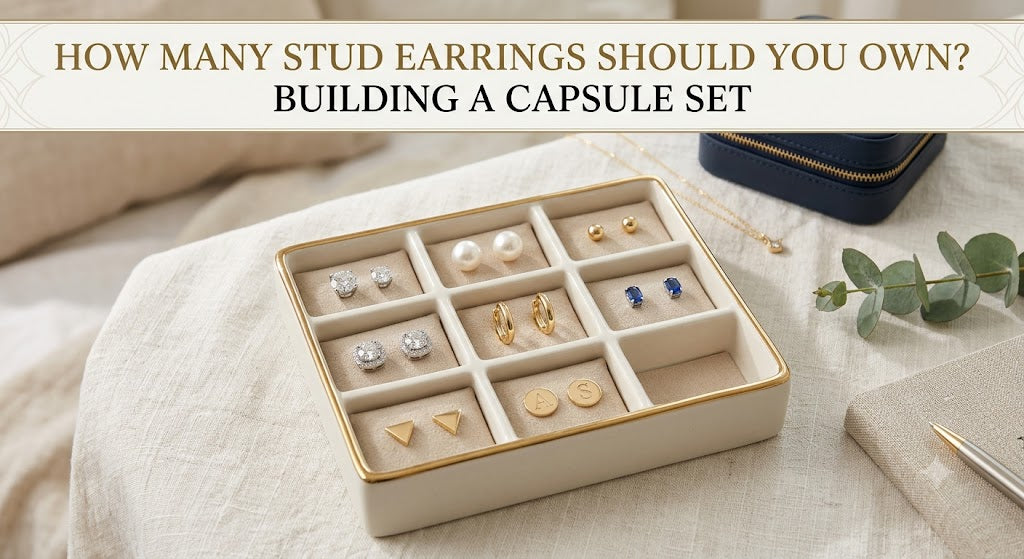

Three near-identical gold studs sitting in a jewellery box aren't a collection — they're one pair with backups. That's the trap most people fall into when building out their stud earrings: buying more of what they already have, rather than filling an actual gap. The better question isn't "how many stud earrings should I own," since there's no single correct number — it's "how many distinct roles do I actually need my studs to cover," because that's what determines the number, not the other way around.
Why "How Many" Is the Wrong First Question
A stud capsule works the same way the broader capsule earring wardrobe does: the goal isn't fewer pairs for their own sake, it's a set where every pair earns its place by covering something the others don't. Most people, once they build a set this way, land somewhere between three and five stud pairs — not because that's a rule, but because that's usually how many genuinely distinct roles studs end up filling in a normal week. Buying by number first, without a clear role for each pair, is exactly how people end up with a drawer full of studs that all get worn on rotation for the same occasion, while other situations go uncovered.
The Core Stud Roles Worth Covering
Rather than a fixed count, think in terms of roles. Most well-built stud capsules cover some version of the following:
-
The daily minimal stud. A small, simple design — a plain metal ball, disc, or geometric shape — worn most days without a second thought. This is the pair that gets the most wear of anything in the entire capsule, and it's worth prioritising before any of the others.
-
The polished, slightly dressier stud. A small pearl or subtle gemstone stud that reads a shade more put-together than the daily default, suited to work meetings, dinners, or days that need a touch more intention without becoming a statement piece.
-
The sparkle or evening stud. A crystal, halo, or slightly larger stone stud, reserved for occasions where a bit more shine is appropriate — the kind of pair that would feel like overkill for a Tuesday but exactly right for an evening out.
-
The personal or colour stud. A birthstone or a favourite gemstone colour, chosen for meaning rather than pure versatility — see our birthstone jewellery guide if you're deciding which stone that might be.
-
A second-metal-tone stud, if the rest of your jewellery isn't consistently one metal. If your rings and everyday chain lean gold but you occasionally wear silver, a stud in each tone avoids the small daily friction of jewellery that doesn't quite match.
Not everyone needs all five roles filled — someone who never dresses up much might skip the evening stud entirely, while someone in a formal workplace might weight more toward the polished role than the minimal one. The point isn't to complete a checklist; it's to notice which roles your actual week calls for.
How Studs Fit Into Your Broader Earring Capsule
It's worth being clear about scope here: a stud capsule isn't the same thing as a full earring capsule. Within the broader wardrobe covered in how to build a capsule earring wardrobe, studs typically cover the daily-wear role and often the slightly-dressier role too, since a simple stud or small huggie is generally the most reliable daily default of any earring type. Hoops, drops, and statement pieces then fill in the remaining roles — travel versatility, occasion wear — that studs aren't necessarily built for. A stud-specific capsule, in other words, is really a closer look at how much internal variety that "daily and slightly-dressier" territory actually needs, rather than a separate wardrobe running alongside it.
Signs You Have Too Many (or Too Few) Stud Pairs

The same audit that applies to a full earring capsule applies here: if a stud pair hasn't been worn in several months and you can't point to a specific role it's meant to fill, it's either duplicating something you already own or it was never solving a real gap. On the other side, if you find yourself repeatedly reaching for the same one or two studs regardless of occasion, and noticing they don't quite suit certain situations — a big meeting, a wedding, a casual weekend — that's a sign a role is genuinely missing, not that you need "more studs" in a general sense.
Building the Set Over Time
There's no need to buy an entire stud capsule in one purchase. Starting with the daily minimal stud, since it will get the most consistent wear of any pair you own, and adding a new role only once you notice an actual gap in an actual week, tends to produce a more accurate set than buying several pairs upfront based on guesswork about what you might need. A capsule built this way, one genuine gap at a time, also naturally avoids the "backups disguised as variety" problem that leads to an overcrowded, under-worn collection.
Frequently Asked Questions
Is there an ideal number of stud earrings to own?
Not a fixed one — most people land between three and five pairs once each pair covers a genuinely distinct role, but the right number depends entirely on how many of those roles your actual routine calls for.
Should my first stud purchase be a plain pair or something with a stone?
A plain, minimal stud is generally the better starting point, since it covers the daily-wear role that gets the most consistent use before any of the more occasion-specific roles matter.
Do I need studs in both gold and silver?
Only if the rest of your jewellery genuinely spans both metal tones. If you consistently wear one metal, a second-tone stud pair isn't solving a real gap and can be skipped.
How do I know if I own too many stud earrings?
If several pairs haven't been worn in months and you can't identify a distinct role each one fills, the set has likely grown past what it needs — a smaller, role-based set generally gets more consistent wear than a large, overlapping one.
Stud pairs for building out each role are available within the studs collection, alongside the everyday earrings collection for daily-wear options specifically.