Cart
0
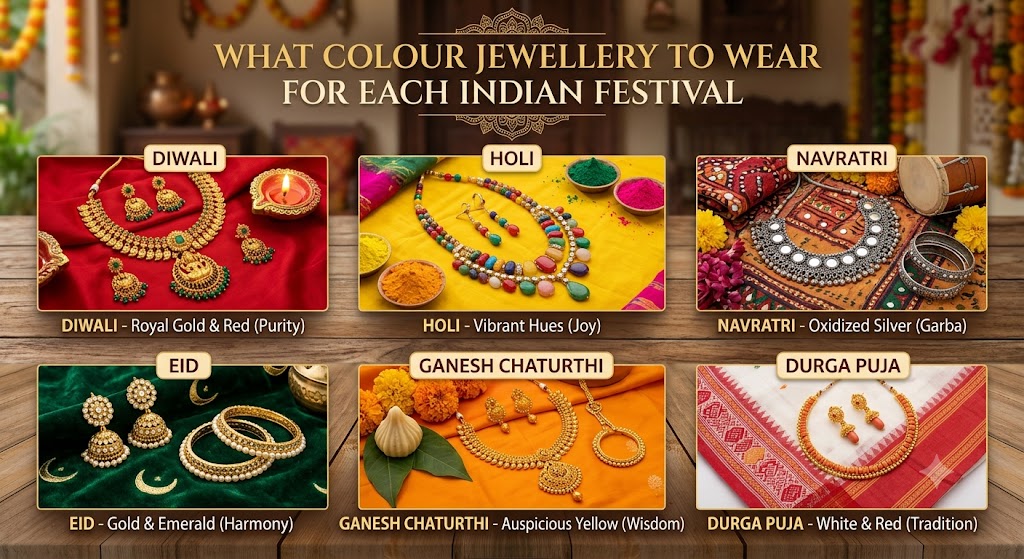

Wear gold-toned jewellery as the base for most Indian festivals, and let the festival's outfit colour decide the accent colour. Red, maroon, gold and yellow suit Diwali. Green suits Teej. White with red suits Durga Puja. Off-white with gold suits Onam. Navratri follows a different colour each day. Jewellery works best when it matches the outfit's colour or contrasts with it on purpose, and when it stays quieter than a heavily coloured outfit.
Festival colour customs vary by region, community and family, so treat the guidance below as common practice, not a fixed rule.
How Colour and Jewellery Work Together
Festive jewellery carries colour in two ways: the metal tone, and any colour in stones, enamel, beads or threadwork. Festival colour guidance mostly concerns the outfit, so the jewellery decision is how to pair with it.
|
Pairing approach |
What it means |
When it suits |
|
Match |
The jewellery's accent colour echoes the outfit |
A cohesive, coordinated look |
|
Contrast |
The jewellery's colour sits opposite or apart from the outfit |
A bold look, with one focal piece |
|
Neutral |
Gold-toned jewellery with no strong colour |
Heavily coloured or embroidered outfits |
Gold-toned jewellery is the usual starting point for festive wear, because it works with red, green, blue, yellow and most other festive colours. Colour then comes from the outfit, or from a single accent such as a gemstone-colour earring.
Festival-by-Festival Colour Guide
|
Festival |
Common outfit colours |
Jewellery pairing |
|
Diwali |
Red, maroon, gold, yellow, orange, deep green, royal blue |
Gold-toned jewellery, jhumkas and traditional necklaces |
|
Navratri |
A different colour for each of the nine days |
Gold-toned or oxidised jewellery, with colourful bangles |
|
Karva Chauth |
Red and maroon, with pink, gold and green also worn |
Jhumkas, chandbalis, kundan sets, red or green glass bangles |
|
Teej |
Green, with yellow, saffron, pink and red |
Green bangles, kundan-style jewellery, maang tikka for formal looks |
|
Durga Puja |
Red and white, with jewel tones and metallics in the evenings |
Jhumkas, bangles and statement earrings |
|
Onam |
Off-white or cream with a gold border |
A simple gold-toned chain and temple-style jewellery |
|
Holi |
White and light colours are popular |
Minimal jewellery |
Diwali: Red, Gold and Warm Colours

Diwali colours are warm and rich. Red, maroon, gold, yellow and orange are the classic choices, and deep green, royal blue and pink are widely worn too. Black was long avoided at Diwali by many families, and is now worn in the evening by many people, so follow your family's custom.
-
Jewellery colour: gold-toned pieces suit every Diwali colour.
-
Heavily embroidered outfits: keep the jewellery lighter, with studs or a single focal piece.
-
Plain or pastel outfits: add richer pieces, such as jhumkas or Mughal kundan pieces.
Navratri: A Colour for Each Day
Navratri has nine days, and each day has its own colour. The colours are traditionally linked to the day of the week, so the list changes from year to year, and published lists can differ. Commonly listed colours include orange, white, red, royal blue, yellow, green, grey, purple and peacock green. Check a panchang for the current year's order.
-
Jewellery colour: keep a gold-toned or oxidised base across the nine days so one set of jewellery works with every colour.
-
Add colour through bangles and small accents, and change them to match the day's outfit.
-
Evening garba and dandiya looks suit bold earrings and stacks of bangles, but keep the jewellery comfortable for dancing.
Karva Chauth: Red and Maroon

Red is the most traditional colour for Karva Chauth, with maroon as a deeper alternative. Pink, gold, yellow and green are also worn.
-
Jewellery colour: gold-toned pieces with red or green glass bangles.
-
Pieces: jhumkas, chandbalis and kundan sets are common, and pearl earrings or simple studs suit a subtler look.
-
Balance: a red outfit takes one rich piece well, so choose either the necklace or the earrings as the focal piece.
Teej: Green and the Monsoon Palette
Green is the defining colour of Teej, linked to the monsoon. Yellow, saffron, pink and red are also worn. Some families avoid black and white for the festival.
-
Jewellery colour: green glass or lac bangles are the traditional accessory, with gold-toned jewellery around them.
-
Pieces: kundan-style jewellery and a maang tikka suit formal celebrations.
Durga Puja: Red and White
Durga Puja looks lean towards red and white, and the colours change through the days. A white saree with a red border is commonly worn on the main ritual days, and jewel tones and metallics are common for evening events.
-
Jewellery colour: gold-toned jewellery works with white and red outfits.
-
Ritual days: keep the jewellery restrained, since the outfit is simple.
-
Evenings: jhumkas and statement earrings suit jewel tones and metallics.
Onam: Off-White and Gold
The traditional Onam outfit is the kasavu saree, an off-white or cream body with a gold border. Green and yellow are also worn.
-
Jewellery colour: gold-toned jewellery matches the border.
-
Pieces: a simple chain and temple-style jewellery suit the outfit, and heavy colourful pieces can compete with the border.
Holi: Light Colours and Minimal Jewellery

White and light colours are popular for Holi, because they show the colours. Holi involves colour powders and water, which can stain or wear jewellery, so wear minimal pieces or none, and keep your better jewellery for after the celebration.
Colour-by-Colour Jewellery Cheat Sheet
These are styling suggestions, not rules, and they apply across festivals.
|
Outfit colour |
Jewellery suggestion |
|
Red or maroon |
Gold-toned jhumkas or kundan-style pieces |
|
Yellow or orange |
Gold-toned pieces, with a touch of red or green as an accent |
|
Green |
Gold-toned jewellery, with pearls or a contrasting red accent |
|
Royal blue or navy |
Gold-toned pieces, or pieces with a turquoise or white accent |
|
Pink |
Gold-toned jewellery, with pearl or ruby-red accents |
|
White, ivory or cream |
Gold-toned pieces, or coloured gemstone jewellery as a single accent |
|
Black |
Gold-toned jewellery, kept simple, since the outfit is dramatic |
|
Purple or grey |
Gold-toned or silver-toned pieces, with one colour accent |
Other Festivals
Many other festivals, such as Raksha Bandhan, Ganesh Chaturthi, Pongal, Baisakhi and Eid, have their own outfit customs that differ by region and community. For these, the same approach works: start with the outfit's colour, keep a gold-toned base, choose one focal piece and follow your family's custom where it exists.
Keeping Festive Jewellery Looking Good
Festival weeks are busy, so build a short routine. Put jewellery on last, after perfume and hairspray. Wipe each piece with a soft, dry cloth when you take it off, and store each piece separately. The jewellery care page has the quick reference. Gold-plated earrings suit festival wear because plating offers detailed designs in both traditional and modern shapes at an accessible price.
Frequently Asked Questions
What colour jewellery goes with a red saree?
Gold-toned jewellery is the classic choice. Jhumkas and kundan-style pieces suit a red saree, and one focal piece keeps the look balanced.
What jewellery should I wear for Navratri?
A gold-toned or oxidised base works across all nine days, with colourful bangles and small accents that change with the day's colour.
Can I wear silver jewellery at Diwali?
Yes. Gold-toned jewellery is the usual choice, but silver-toned and oxidised jewellery are also worn, especially with cooler colours. Follow your family's custom.
What colour is traditional for Karva Chauth?
Red is the most traditional, with maroon as a deeper option. Pink, gold and green are also worn.
What should I wear for Onam?
A kasavu saree, an off-white or cream saree with a gold border, with simple gold-toned jewellery.
Should I wear jewellery for Holi?
Keep it minimal. Colours and water can stain or wear jewellery, so keep your better pieces for after the celebration.
Start with a gold-toned base, let the festival's outfit colour set the accent, and choose one focal piece. Diwali favours red, maroon, gold and yellow, Navratri changes colour each day, Teej favours green, Durga Puja favours red and white, and Onam favours off-white with gold. Customs vary by region and family, so follow yours where it exists. Gold-plated festive earrings and necklaces in a gold-toned base work across all of these colours.