Cart
0
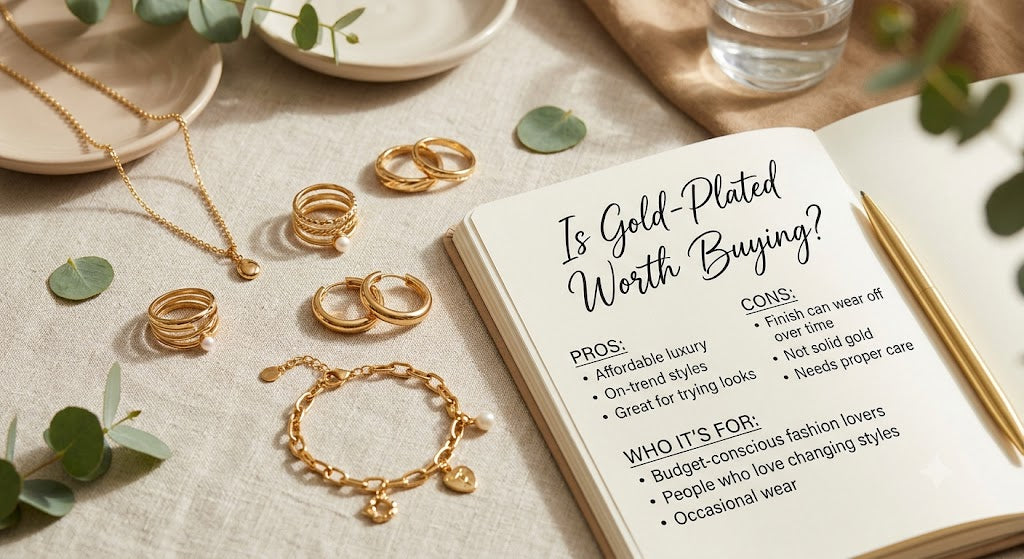

Gold-plated jewellery is worth buying if you want a wide choice of designs at an accessible price and you will care for the piece. It is not worth buying as an investment, and it is a weaker choice for pieces you will wear every day and want to last for years. The value of a gold-plated piece comes from its design and its price, not from the gold on it.
This guide sets out the pros and cons, shows who gets the most from gold plating, and lists what to check before you buy.
What You Are Buying With Gold-Plated Jewellery

Gold plating is a thin layer of gold over a base metal. The base metal gives the piece its shape, and the gold gives it its colour. You pay for the design and the finish, and for a very small amount of gold.
That single fact explains most of the pros and cons below. Plating makes detailed jewellery affordable. The same thin layer is why it wears faster than solid gold and why it does not carry solid gold's resale value.
Pros of Gold-Plated Jewellery
|
Pro |
Why it holds |
|
Lower price |
The piece uses very little gold, so it costs far less than solid gold |
|
Wide design range |
Plating coats intricate shapes, so detailed jhumkas, kundan-style designs and statement pieces are practical to make |
|
Gold look without a gold price |
The surface colour matches gold jewellery |
|
Easy to match to outfits |
A lower price makes it practical to own several pieces for different outfits and occasions |
|
Suits trends |
You can follow a trend without committing a large budget to it |
Cons of Gold-Plated Jewellery
|
Con |
What it means for you |
|
The gold layer wears |
Friction, sweat, perfume and water thin the layer over time, and the base metal can show |
|
Needs care |
Plated pieces last longer when they are kept dry, stored separately and wiped after wear |
|
Not an investment |
The gold content is a thin layer, so a plated piece does not hold value the way solid gold does |
|
Repairs are limited |
Resizing or metalwork can remove the plating, and re-plating adds cost |
|
Rings and bracelets wear fastest |
Constant contact with surfaces removes gold from these pieces first |
How long the finish lasts depends on the thickness of the layer, the base metal, how often you wear the piece and how you care for it. No source gives one number that fits every piece, so the sensible approach is to buy with care in mind rather than expecting a fixed lifespan.
Gold-Plated Jewellery vs Solid Gold: The Value Question
The choice is not "good" against "bad". It is two different products for two different jobs.
|
If you want |
Better fit |
|
Jewellery you will wear for decades and may resell |
Solid gold |
|
A particular design at a lower price |
Gold plating |
|
Several pieces for different outfits and occasions |
Gold plating |
|
Pieces for festivals, weddings and events |
Gold plating |
|
A store of value |
Solid gold |
The full comparison is in gold-plated vs solid gold earrings.
Who Gold-Plated Jewellery Is For
Gold plating suits buyers whose priorities are design, variety and price.
-
Occasion buyers: people who need jewellery for weddings, festivals and parties, and wear each piece on a limited number of days.
-
Trend followers: people who like changing their look and prefer buying several designs to buying one expensive piece.
-
First-time buyers of statement jewellery: people who want to try a bold design before committing to a larger purchase.
-
Careful owners: people who are happy to take pieces off before showering or sleeping, and to wipe and store them after wear.
-
Earring wearers: earrings have fewer contact points than rings or bracelets, so plating tends to suit them better. Gold-plated earrings are the clearest example.
Who Should Choose Something Else
Gold plating is a weaker fit in these cases:
-
You want an investment or an heirloom. Plated jewellery is not made for resale value or inheritance.
-
You want a ring or bracelet to wear every day. These pieces wear fastest, so a thicker finish or solid gold suits them better.
-
You do not want to maintain jewellery. Plating asks for some care to last.
-
You will wear the piece through every shower, workout and swim. Water, sweat and chemicals thin the layer.
If you want a thicker finish without moving to solid gold, gold vermeil is a middle option, with a sterling silver base and a thicker gold layer.
How to Get the Most Value From Gold-Plated Jewellery

Value in plated jewellery comes from wearing it well and looking after it.
-
Rotate your pieces. Wearing a piece on some days and resting it on others slows the wear.
-
Put jewellery on last and take it off first. Perfume, lotion and hairspray act on the gold layer.
-
Keep it dry. Remove it before showering, swimming and exercising.
-
Store each piece separately in a pouch or lined box, away from damp.
-
Follow a care routine. The guide to caring for gold-plated earrings has the steps.
Cost per wear is a useful way to judge value. A plated piece that you wear often for a season, at a modest price, can be good value even if it does not last for decades.
What to Check Before You Buy
-
The description: the seller should call the piece gold-plated and not only "gold finish".
-
The base metal: ask what is under the gold.
-
The design: pick a design you will actually wear, since value comes from use.
-
The care information: a seller who explains care is more likely to describe the piece honestly.
-
The return policy: it protects you if the piece does not match the listing.
Frequently Asked Questions
Is gold-plated jewellery a good investment?
No. The gold is a thin layer over a base metal, so the piece does not hold value the way solid gold does. Buy it for the design, not for resale.
Is gold-plated jewellery worth it for everyday wear?
It can be, with care. Earrings and necklaces suit daily wear better than rings and bracelets. Daily wear shortens the life of the finish, so rotate pieces and avoid water, sweat and perfume.
Is gold-plated jewellery worth it for weddings and festivals?
Yes, for many buyers. Occasion wear means few wears per piece, plating makes detailed designs affordable, and you can match several outfits.
How do I know if a gold-plated piece is good quality?
Look for a clear description, a named base metal, a fair price and care information from the seller. Quality also shows in how the piece is finished and how it wears.
Is gold plating better than gold vermeil?
Neither is better in every case. Vermeil has a sterling silver base and a thicker gold layer and costs more. Plating offers more design variety at a lower price.
Can gold-plated jewellery be restored?
A jeweller can re-plate a piece, but the cost may be high compared with the price of an inexpensive piece.
Gold-plated jewellery is worth buying when design, variety and price matter more than longevity or resale value, and when you are willing to give it basic care. It suits occasion wear, trend pieces and earrings best. For an heirloom, an investment or a ring worn every day, solid gold or a thicker finish is the better choice. Gold-plated designs for festive, wedding and everyday wear are what the gold-plated earrings collection is built around.