Cart
0
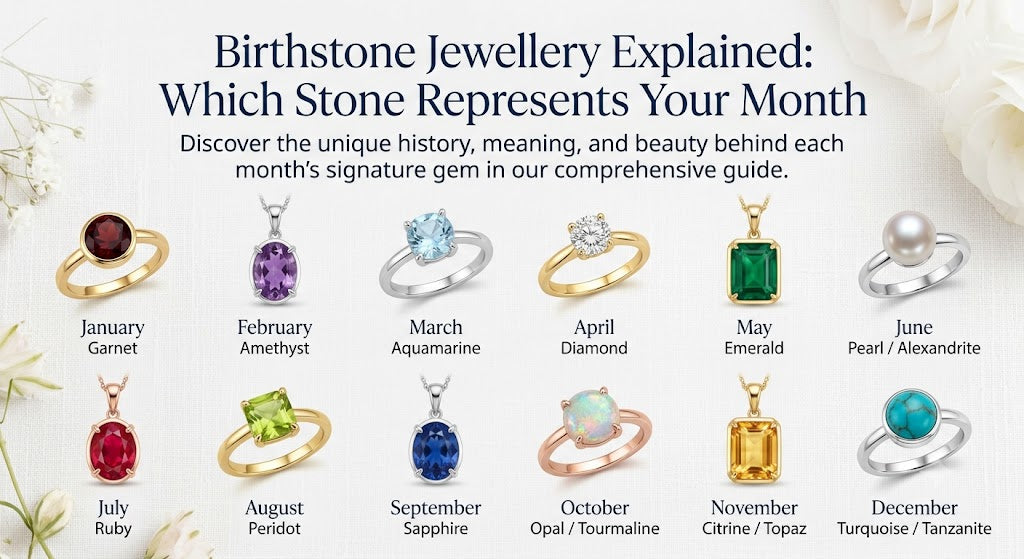

A birthstone is a gemstone traditionally associated with the month a person was born, worn as a piece of personal symbolism rather than for any fixed rule. Most months have both a modern birthstone — following the standardised list published by the National Association of Jewelers (now Jewelers of America) in 1912 and updated since — and a traditional birthstone, reflecting older, more historically rooted associations that predate that standardisation. Several months have more than one accepted stone on the modern list alone, which is exactly why "the" birthstone for a given month often isn't a single, universally agreed answer.
Birthstones by Month: Quick Reference
|
Month |
Modern Birthstone(s) |
Colour |
Meaning |
|
January |
Garnet |
Deep red (occurs in many colours) |
Protection, friendship |
|
February |
Amethyst |
Purple |
Peace, clarity |
|
March |
Aquamarine |
Pale blue-green |
Courage, calm |
|
April |
Diamond |
Colourless (occurs in many colours) |
Strength, eternal love |
|
May |
Emerald |
Green |
Rebirth, wisdom |
|
June |
Pearl, Alexandrite, Moonstone |
White/cream, colour-shifting, glowing sheen |
Purity, balance, intuition |
|
July |
Ruby |
Red |
Passion, vitality |
|
August |
Peridot, Spinel |
Lime green, varies by spinel colour |
Strength, positivity |
|
September |
Sapphire |
Blue (occurs in many colours) |
Wisdom, loyalty |
|
October |
Opal, Tourmaline |
Iridescent, varies widely |
Hope, creativity |
|
November |
Topaz, Citrine |
Golden/orange, yellow |
Warmth, abundance |
|
December |
Tanzanite, Turquoise, Zircon |
Violet-blue, blue-green, varies |
Renewal, protection |
Month-by-Month Guide
January — Garnet. Most associated with deep red tones, though garnet naturally occurs in a wide range of colours. Historically linked to protection for travellers and to friendship, making it a common gifting stone beyond its birth-month association.
February — Amethyst. A purple variety of quartz, ranging from pale lilac to deep violet. Long associated with calm and clarity, and one of the more durable, affordable stones on the birthstone list, which has kept it consistently popular across both modern and traditional charts.
March — Aquamarine. A pale blue-green stone named for its resemblance to seawater. Traditionally associated with courage and calm; bloodstone appears as an alternate traditional stone for March in some regional charts.
April — Diamond. The hardest naturally occurring gemstone, colourless in its most common form though it occurs in other colours as well. Long symbolic of strength and enduring love, which is part of why it's so closely tied to engagement and anniversary jewellery beyond its birth-month role.
May — Emerald. A green variety of beryl, historically associated with rebirth and renewal. Emeralds are commonly treated (typically oiled) to enhance clarity, which is worth knowing if you're shopping for one specifically.
June — Pearl, Alexandrite, or Moonstone. June is one of the more varied months on the list: pearl (organic, not a mineral) represents purity; alexandrite, a rare colour-changing stone, represents balance; moonstone, prized for its glowing sheen (adularescence), is associated with intuition. Traditional charts most often list pearl or moonstone.
July — Ruby. A red variety of corundum, the same mineral family as sapphire. Strongly associated with passion and vitality, and one of the more consistently agreed-upon birthstones across both modern and traditional lists.
August — Peridot or Spinel. Peridot, a lime-green stone, has long been August's primary birthstone; spinel, which occurs in a wide range of colours, was formally added to the modern list in 2016, giving the month a second accepted option.
September — Sapphire. Most associated with deep blue, though sapphire, like ruby's mineral cousin, occurs naturally in nearly every colour except red. Long symbolic of wisdom and loyalty.
October — Opal or Tourmaline. Opal is known for its iridescent play of colour across the stone's surface; tourmaline occurs in an unusually wide colour range, sometimes within a single stone. Both are associated with hope and creativity, and which one a given chart lists as "traditional" varies by source.
November — Topaz or Citrine. Golden topaz and citrine both occupy the warm yellow-to-orange end of the spectrum, associated with warmth and abundance; citrine is generally the more affordable and widely available of the two.
December — Tanzanite, Turquoise, or Zircon. December carries the most variation of any month: tanzanite (a violet-blue stone discovered relatively recently, in the 1960s), turquoise (an opaque blue-green stone with a jewellery history spanning thousands of years), and blue zircon (a naturally brilliant stone sometimes confused with the lab-made simulant cubic zirconia, despite being a genuine, unrelated mineral). All three carry associations with renewal and protection.
Where the Birthstone Tradition Actually Comes From
The idea of assigning specific stones to specific meanings traces back to ancient sources, including the breastplate described in religious texts as bearing twelve gemstones representing the twelve tribes of Israel — a connection later linked by some historical scholars to the twelve months and zodiac signs. The more direct ancestor of today's month-by-month tradition, however, is generally traced to Poland and Germany between the 16th and 18th centuries, where the custom of wearing a single stone tied to one's birth month spread across Europe. The list most jewellers reference today was formally standardised in 1912 by the National Association of Jewelers (now Jewelers of America), and has been revised since — most recently in 2016, when spinel was added alongside peridot for August.
Modern vs. Traditional: Why the Two Lists Disagree

Modern and traditional birthstone lists diverge for a practical reason: the 1912 modern list was partly designed around gemstone availability and durability for contemporary jewellery-making, favouring transparent, easier-to-set stones, while traditional lists preserve older regional and cultural associations that predate that standardisation. Where the two disagree, neither is more "correct" — they simply reflect different eras and priorities behind the same underlying idea.
Zodiac Birthstones: A Separate System
Beyond the birth-month system, a related but distinct tradition assigns birthstones to astrological (zodiac) signs rather than calendar months. Because zodiac sign date ranges don't align neatly with calendar months, a person's zodiac birthstone and their birth-month birthstone are often different stones entirely — worth knowing if you come across a "birthstone" that doesn't match the month-by-month list above.
Choosing Birthstone Jewellery

Since several months carry more than one accepted stone, personal preference around colour, symbolism, and budget generally decides which option to choose — there's no rule requiring the "traditional" over the "modern" stone, or vice versa. It's also worth noting that much of what's sold as birthstone jewellery in the accessible fashion space uses colour-matched stones — natural semi-precious varieties, synthetic stones, or coloured simulants — rather than the specific fine-jewellery-grade stone associated with a month, particularly for months whose official birthstone (diamond, emerald, ruby, sapphire) carries fine-jewellery pricing on its own.
Frequently Asked Questions
Why do some months have more than one birthstone?
Modern lists have been revised and expanded over time — most recently in 2016 — while older traditional lists reflect different regional customs, so several months carry both a long-standing traditional stone and one or more modern alternatives.
Can I wear a birthstone from a month that isn't mine?
Yes — birthstone tradition is a custom, not a rule, so choosing a stone based on colour, meaning, or personal preference rather than strict birth month is common.
What's the difference between a modern and a traditional birthstone?
Modern birthstones follow the standardised 1912 list (and its later updates) published by the jewellery trade; traditional birthstones reflect older, regionally varied customs that predate that standardisation.
Which birthstone is most valuable?
Among the birthstones listed, diamond, emerald, ruby, and sapphire generally carry the highest fine-jewellery value, though value within any stone varies enormously based on quality, size, and treatment.
Colour-matched pieces inspired by monthly birthstones are available within the Stone Age collection.