Cart
0
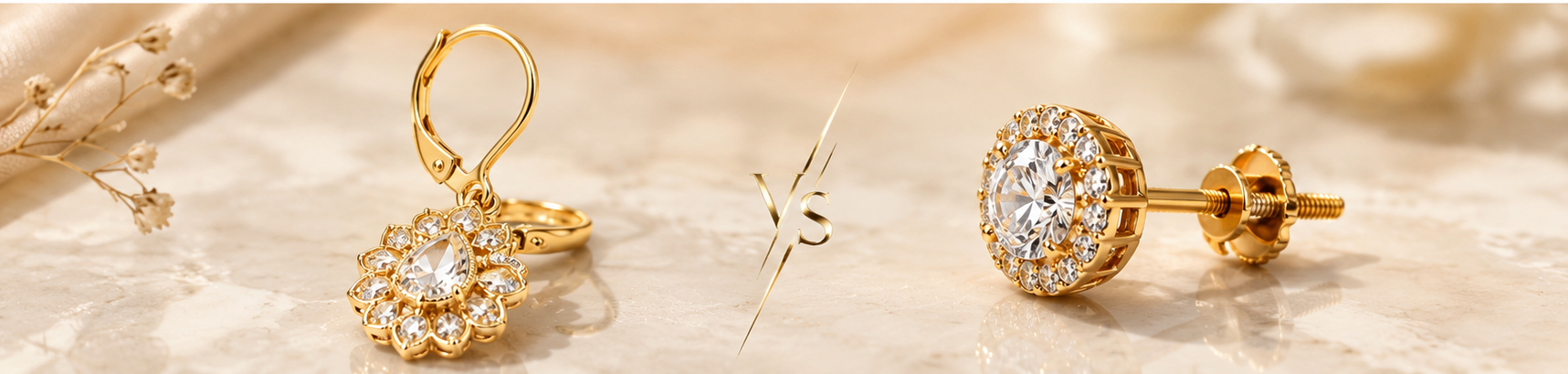

For a small stud, backing type barely matters — almost any closure holds a light piece securely enough. For a larger or heavier earring, backing type is one of the biggest factors in whether the piece feels secure and comfortable or ends up sagging, tilting, or working loose through the day. Two designs that look identical from the front can wear completely differently depending on what's holding them in place from behind.
This guide breaks down the main backing types, compares lever backs and screw backs specifically, and covers which backing suits which earring format.
The Main Backing Types
Butterfly or push backs The most common backing on standard studs — a simple friction-fit disc that pushes onto the post. Fine for lightweight pieces, but generally the weakest option for anything with real weight or length, since there's minimal mechanism holding it beyond friction.

Lever backs A hinged mechanism that clicks into a closed, latched position, commonly used on drop and dangle earrings. The latch mechanism distributes weight more evenly along the post than a simple push back, and is less likely to loosen gradually through wear.
Screw backs A threaded backing that twists onto the post rather than pushing on, creating a tighter, more deliberate seal. Screw backs are generally the most secure of the common backing types, since they can't work loose the way a friction-fit back can over hours of movement.
Dual or hybrid backs A newer format that combines a standard post with an additional clip-style support, spreading the earring's weight across more of the earlobe rather than concentrating it entirely at the piercing point. These are specifically designed for heavier statement pieces where even a screw back alone might not be enough.
Lever Back vs Screw Back: Head to Head
|
Lever Back |
Screw Back |
|
|
Mechanism |
Hinged latch that clicks shut |
Threaded, twists into place |
|
Best suited to |
Drops, danglers, hoops with some movement |
Studs and semi-fixed designs that don't need to swing |
|
Ease of use |
Quick on and off, one motion |
Slightly slower, requires a few full twists |
|
Security |
Very secure once latched |
Very secure, and less likely to loosen from movement |
|
Feel through the day |
Can shift slightly with movement, by design |
Stays fixed in one position |
Neither is universally "better" — the right choice depends on whether the earring is meant to move (drops, danglers) or stay fixed (heavier studs, cluster designs). A lever back on a design meant to swing feels natural; a screw back on the same design would restrict the movement that's part of the piece's appeal.
Which Backing Suits Which Earring Format
-
Drop and dangle earrings: lever backs are the standard choice, since they support the swinging motion these designs are built around while still holding securely
-
Heavier or oversized studs: screw backs generally offer more security than a push back, since there's no natural swinging motion to accommodate and a fixed, twisted-on backing keeps the piece from tilting
-
Hoops and huggies: most use a hinged or latch closure similar in principle to a lever back, designed to open and close around the earlobe rather than push through it
-
Chandelier and heavily tiered designs: this is where dual or hybrid backs earn their place, since the combined weight of multiple tiers often exceeds what a single backing mechanism comfortably supports on its own
How to Tell What Backing a Pair Uses Before Buying

-
Check the product description specifically, rather than assuming from the photo — backing type is often mentioned in the details rather than being visible in a styled shot
-
Look for a close-up image of the back of the earring, not just the front-facing view
-
For anything marketed as a statement or chandelier design, ask directly if the backing isn't specified, since this is exactly the category where backing matters most
-
Don't assume price indicates backing quality — a more expensive design isn't automatically built with a more supportive backing unless stated
Can a Backing Be Changed or Upgraded?
In some cases, a jeweller can swap a basic push back for a screw back or add support elements to an existing pair, though this depends on the specific design and post type. If you already own a heavier pair that's proving uncomfortable, it's worth asking a jeweller directly whether an upgrade is possible before assuming the only option is replacing the piece entirely.
FAQs
What's the difference between a lever back and a screw back?
A lever back uses a hinged latch that clicks into place, suited to designs with some movement like drops and danglers. A screw back threads on and stays fixed, better suited to heavier studs that aren't meant to swing.
Which backing is more secure, lever or screw?
Both are considerably more secure than a basic push back. Screw backs tend to stay fixed in place most reliably, while lever backs are very secure once latched but allow for the natural movement some designs are built around.
What backing is best for heavy statement earrings?
For very heavy or tiered designs, dual or hybrid backs — combining a standard post with additional clip support — generally offer the most comfortable, secure hold.
Can I replace a basic push back with a screw back?
Sometimes, depending on the design and post type. It's worth asking a jeweller directly rather than assuming it isn't possible.
Are screw backs uncomfortable for long wear?
Not inherently — once fitted, a screw back sits fixed rather than moving, which many people find more comfortable for extended wear than a backing that shifts slightly through the day.
Do all hoop earrings use the same type of backing?
No — most use a hinged or latch-style closure, but the specific mechanism and how securely it fastens can vary meaningfully between designs, particularly for larger or chunkier hoops.
Browse bold designs built with wearability in mind in our statement earrings collection at Mine of Design.