Cart
0
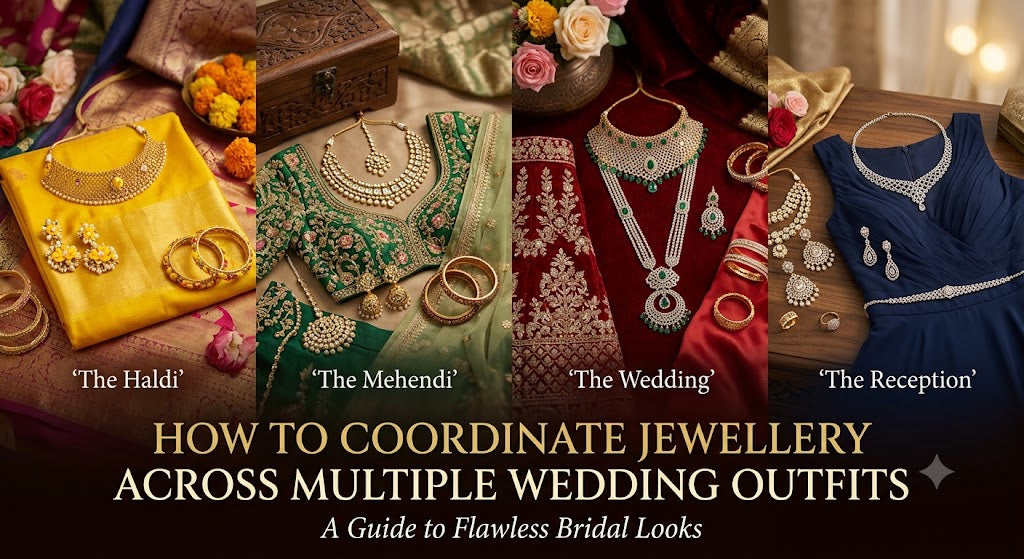

To coordinate jewellery across multiple wedding outfits, choose a small core set that works with several outfits, give each outfit one focal piece, and keep one metal tone across the whole wedding. You do not need a separate full set for every function. Rotating the focal piece, changing the layers and adjusting the scale lets the same core pieces carry several looks.
This guide gives a step-by-step method, a planning grid you can copy, and practical advice on colour, layering and packing for a multi-day wedding.
Why Coordination Matters at a Wedding
A wedding often includes several functions over several days, such as the haldi, mehendi, sangeet, wedding ceremony and reception. Each one usually has its own outfit. Buying a separate set for each outfit is expensive, and it produces pieces that are worn once. Coordination means planning the jewellery as one wardrobe, so the pieces work across outfits and across days.
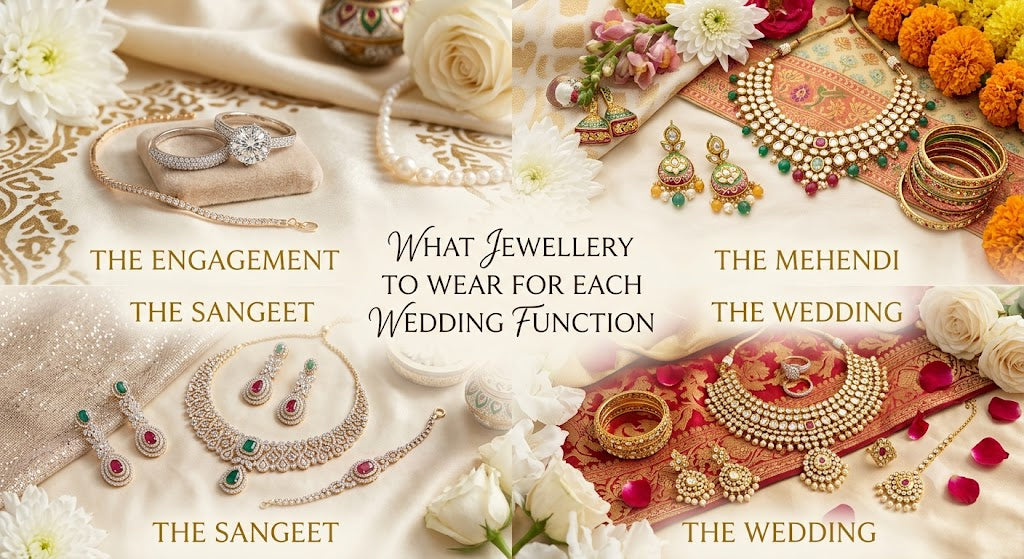
The guide to what to wear for each wedding function explains what each function calls for. This guide shows how to make the same pieces serve several of them.
The Method: Five Steps
-
List every outfit. Write down each function and the outfit for it, with its colour and neckline.
-
Start with the anchor outfit. This is usually the wedding ceremony outfit, which is the most formal and the most detailed. Choose its jewellery first, since the other looks can be built around it. Many planners choose the main jewellery before the finishing details of the outfit.
-
Choose a core set. Pick pieces that can work with more than one outfit, such as a pair of earrings, a necklace and a head ornament.
-
Assign a focal piece to each outfit. One piece leads each look, and the rest support it.
-
Test the pairings. Try each outfit with its jewellery before the wedding, and check comfort as well as appearance.
Planning Grid: Outfits and Jewellery
Copy this grid and fill it in for your own wedding.
|
Function |
Outfit colour |
Focal piece |
Supporting pieces |
Reused from |
|
Haldi |
Yellow or orange |
Floral or light earrings |
Few or none |
New, light |
|
Mehendi |
Green or bright |
Jhumkas or floral earrings |
Hair flowers |
Can reuse at the reception |
|
Sangeet |
Jewel tone or metallic |
Statement earrings or a choker |
One supporting piece |
Choker can return at the reception |
|
Wedding ceremony |
Red, maroon or pink |
Bridal necklace set |
Earrings, head ornament, bangles |
Anchor look |
|
Reception |
Pastel, metallic or jewel tone |
Wedding earrings or a simpler necklace |
Light supporting pieces |
Reuses earlier pieces |
Keep One Metal Tone Across the Wedding
A shared metal tone is the easiest way to make different pieces look like one wardrobe. Gold-toned jewellery works with the colours most common at weddings, including red, maroon, green, pink, jewel tones and many pastels. If you keep one tone across every function, pieces move between outfits without clashing.
Pair Jewellery With the Outfit's Colour

Colour guides which accents suit which outfit. These are styling suggestions, not rules.
|
Outfit colour |
Jewellery that suits it |
|
Red, maroon or rust |
Classic kundan-style or traditional gold-toned pieces |
|
Ivory, beige or champagne |
Gold-toned pieces with a green or coloured accent |
|
Blush and pastels |
Delicate pieces, pearls or subtle gemstone accents |
|
Emerald, navy and jewel tones |
Statement pieces with a gemstone accent |
Kundan jewellery and Mughal kundan pieces are the style most often used for the richer functions.
Build Pieces That Layer and Convert
Some pieces work harder than others because they can be worn in more than one way.
-
A choker that works alone or layered. Worn alone, it suits a lighter look. Layered with a longer necklace, it suits a richer one. The guide to layering necklaces by length shows how to do it without tangling.
-
Earrings that fit several outfits. Wedding earrings can anchor the reception look too. Earrings are often the most reusable piece.
-
A timeless head ornament rather than a trend-driven one, since it can return at other events.
-
Family pieces. Heirloom jewellery can be worn on its own, or mixed with newer pieces. Some families also have heirlooms remade into other forms, and a jeweller can advise on what is possible.
Mixed sets are easier than a single matching set. A necklace from one function can be paired with earrings from another, as long as the metal tone and the scale agree.
Let the Neckline Decide the Necklace
Across several outfits, the neckline changes more than any other detail. A high neckline asks for earrings alone, and a deep one leaves room for a longer necklace. The guide to necklace length for your neckline explains the match, and types of choker necklaces helps if a choker is your core piece.
Balance the Scale Across the Days
Plan the days as a build, from light to rich.
-
Keep the early functions light, so the later ones feel richer.
-
Make the sangeet bold but practical for dancing.
-
Make the wedding ceremony the richest look.
-
Make the reception a change of direction, so it does not repeat the ceremony.
If heavy earrings are part of the plan, see how to wear heavy earrings without pain, since comfort matters more as the days go on. The guide to building a bridal jewellery set explains how the main set comes together.
A Capsule Approach for Guests and Bridesmaids
Guests and bridesmaids face the same challenge with fewer pieces. A small capsule can cover several functions. The guide to a capsule earring wardrobe shows how to choose a few earrings that work across outfits, and studs give a light option for the early functions.
Packing and Managing Jewellery

Multi-day weddings often involve travel and changes, so organise the jewellery before you go:
-
Pack by outfit, with each look's jewellery in its own pouch, labelled.
-
Keep a written list of each function, outfit and jewellery.
-
Carry the main pieces with you rather than packing them in checked luggage.
-
Wipe each piece with a soft, dry cloth after wearing, and store it separately so pieces do not scratch each other.
The jewellery care page has a quick reference. Gold-plated earrings suit this kind of plan, because plating offers detailed designs at an accessible price, so several pieces can cover several outfits.
Common Coordination Mistakes
-
Buying a full set for every outfit. This is the most expensive approach, and each set is worn once.
-
Mixing metal tones without a plan. The wedding wardrobe can look unfinished.
-
Wearing two bold pieces together. Bold earrings and a bold necklace can compete.
-
Ignoring the neckline. The same necklace can suit one outfit and not another.
-
Leaving comfort until the day. Test earrings and necklaces before the event.
Frequently Asked Questions
How many jewellery sets do I need for a multi-day wedding?
Fewer than one per outfit. A core set plus a few extra pieces covers most looks, when you rotate the focal piece.
Can I wear the same earrings to more than one function?
Yes. Change the outfit and the styling around them, and they work at a second function.
Should I choose the outfit or the jewellery first?
Many planners choose the main jewellery first, because it is reused more, and then pick outfits that complement it.
Should all my wedding jewellery be the same metal tone?
Keeping one tone is the simplest way to make different pieces work together.
How do I stop jewellery looking repeated across outfits?
Change the focal piece, change the layers, and change the styling around the core pieces.
What jewellery should bridesmaids wear for several functions?
A small capsule of versatile pieces, with one focal piece for each outfit.
Coordinate wedding jewellery by listing every outfit, choosing a core set, giving each look one focal piece and keeping one metal tone. Pieces that layer, such as a choker, and earrings that suit several outfits do the most work. Build the days from light to rich, test for comfort, and pack by outfit. Wedding jewellery in a gold-toned base makes that wardrobe easier to plan.