Cart
0
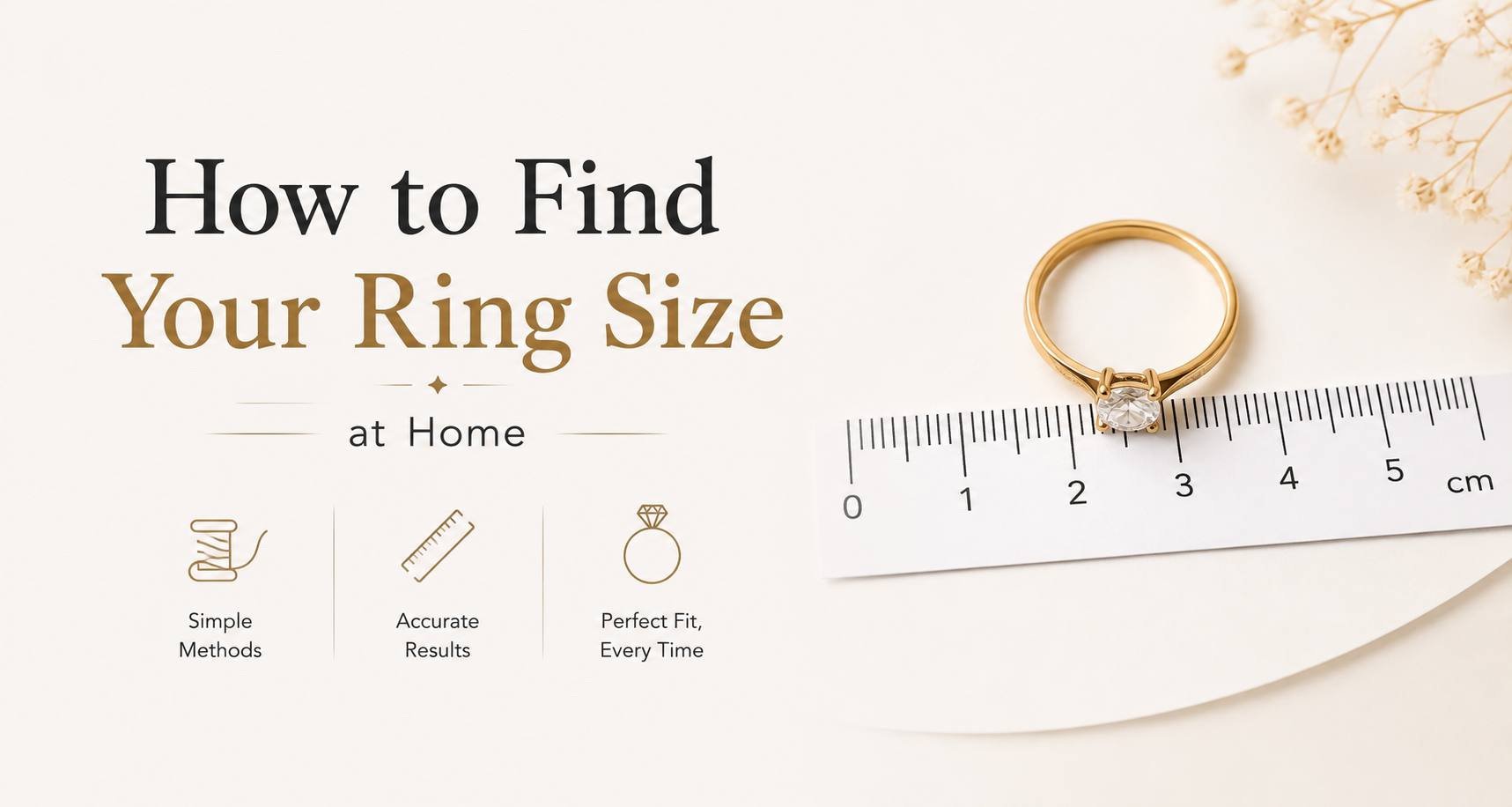
How to Find Your Ring Size at Home
The fastest reliable method: wrap a non-stretchy piece of string or paper around the base of your finger, mark where it overlaps, measure that length in millimetres, then divide by 3.14 to get your finger's diameter and match it to a ring size chart. That's the standard approach, but it's not the only one — depending on what you have on hand, measuring an existing ring, using a printed chart, or even a phone app can all get you a reliable estimate.
This guide covers all four methods, the accuracy factors that actually affect the result, and what to do if you're sizing for someone else as a surprise.
Method 1: The String or Paper Strip Method

- Select the correct finger — measure the actual finger you intend to wear the ring on, not just any finger, since size varies noticeably between fingers and even between hands
- Cut a thin, non-stretchy strip of paper or string, no wider than about 1cm — a standard measuring tape is too thick to wrap accurately around a finger
- Wrap it around the base of your finger, snug but not tight, mimicking how a ring would actually sit
- Mark the point where it overlaps with a thin pen or marker
- Lay it flat against a ruler and measure the length in millimetres from the start to your mark — this gives you your finger's circumference
- Divide that number by 3.14 (pi) to get the diameter, then match either figure to a standard ring size chart
Method 2: Measure a Ring You Already Own
If you have a ring that already fits the intended finger well, this is generally a more reliable method than measuring the finger directly:
- Measure the inner diameter of the ring in millimetres with a ruler, then match it to a ring size chart
- Alternatively, trace the inner edge of the ring onto a piece of paper, then measure the diameter of the traced circle
This method sidesteps some of the accuracy issues that come with wrapping string around a finger, since the ring itself already reflects a fit you know is comfortable.
Method 3: A Printed Ring Size Chart
Print a ring size chart at 100% scale — checking your printer settings carefully, since any scaling adjustment will throw off the measurement. Place an existing ring directly over the printed circles until you find the one where the ring's inner edge lines up exactly with the circle's outer line. This works well as a quick visual check alongside the string method, rather than as a replacement for it.
Method 4: A Ring Sizing App

Several phone apps offer screen-calibrated ring sizing, either by placing a finger against an on-screen guide or by overlaying an existing ring against a calibrated circle on the display. These auto-detect your specific phone model to size the on-screen measurement accurately. This is a reasonably convenient option if you don't have string, a ruler, or a printer on hand, though it's generally considered slightly less precise than the physical measurement methods above.
Factors That Affect Accuracy
Getting a number is the easy part — getting an accurate one depends on a few details most quick guides skip over:
- Time of day and temperature: fingers swell slightly with heat and through the course of the day, and shrink slightly in cold weather. Measuring at the end of the day, rather than first thing in the morning, gives a more realistic everyday fit.
- Dominant hand: the fingers on your dominant hand are typically very slightly larger — often around half a size — due to more frequent use and mild swelling over time. Make sure you're measuring the correct hand, not just the correct finger.
- Band width: a wider band generally fits more snugly than a thin band at the same measured size, since more surface area sits against the finger. If you're ordering a chunky or wide-band ring, it's often worth sizing up half a size from your standard measurement.
- Non-stretchy material only: elastic or stretchy string gives an inaccurate, overly generous measurement — use paper, thread, or a similarly rigid strip instead.
If You're Between Two Sizes
When a measurement falls between two standard sizes, sizing up rather than down is generally the safer choice. A ring that's slightly loose is a minor inconvenience; a ring that's genuinely too tight can be uncomfortable or difficult to remove, particularly for wider bands or warmer weather.
Finding Someone Else's Size as a Surprise
If you're buying for someone else and don't want to ask directly:
- Borrow one of their existing rings briefly and use Method 2 above — this is generally the most reliable option if you can manage it discreetly
- Press the ring gently into a bar of soap to create an impression, then measure the resulting indentation — an old but genuinely effective trick, provided you clean the ring before returning it
- Trace the ring's inner edge on paper if you only have brief access to it, and measure the tracing later rather than trying to measure on the spot
When to Just Visit a Jeweller Instead
At-home methods are reliable enough for most everyday jewellery purchases, but if you're sizing for a ring you plan to wear daily for years, or one that's difficult or costly to resize later, an in-person measurement with a jeweller remains the most accurate option. This is worth weighing against the convenience of an at-home estimate, particularly for a more significant purchase.
Applying This to Handmade and Adjustable Rings
Sizing accuracy matters more for a fixed-size handmade ring than for an adjustable one, since a handmade, individually finished piece is generally harder to resize after the fact than a standard cast ring — we cover this distinction in our guide on what makes a ring handmade. If you're at all unsure of your size, an adjustable design removes most of this risk, since it flexes across a small range rather than requiring one exact measurement.
FAQs
What's the most accurate way to find my ring size at home? Measuring an existing ring that already fits well (its inner diameter or a traced outline) is generally more reliable than wrapping string around your finger, though both work well when done carefully.
Why does the time of day matter for ring sizing? Fingers swell slightly with heat and over the course of the day, and shrink slightly in cold weather. Measuring in the evening generally gives a more realistic everyday fit than measuring first thing in the morning.
Should I size up or down if I'm between two sizes? Size up. A slightly loose ring is a minor inconvenience, while a too-tight ring can be uncomfortable or difficult to remove.
Does the width of the ring band affect sizing? Yes — wider bands generally fit more snugly than thin bands at the same measured size, so it's often worth sizing up half a size for a chunky or wide-band design.
How can I find someone else's ring size without asking them? Borrow one of their existing rings briefly and measure its inner diameter, or press it gently into a bar of soap to create a measurable impression.
Is an at-home ring size measurement reliable enough to shop with? For most everyday jewellery, yes. For a piece you plan to wear daily for years or one that's difficult to resize, an in-person measurement with a jeweller is worth the extra step.
Find your fit in our Handmade Rings collection at Mine of Design.