Cart
0
What Makes a Ring 'Handmade'?
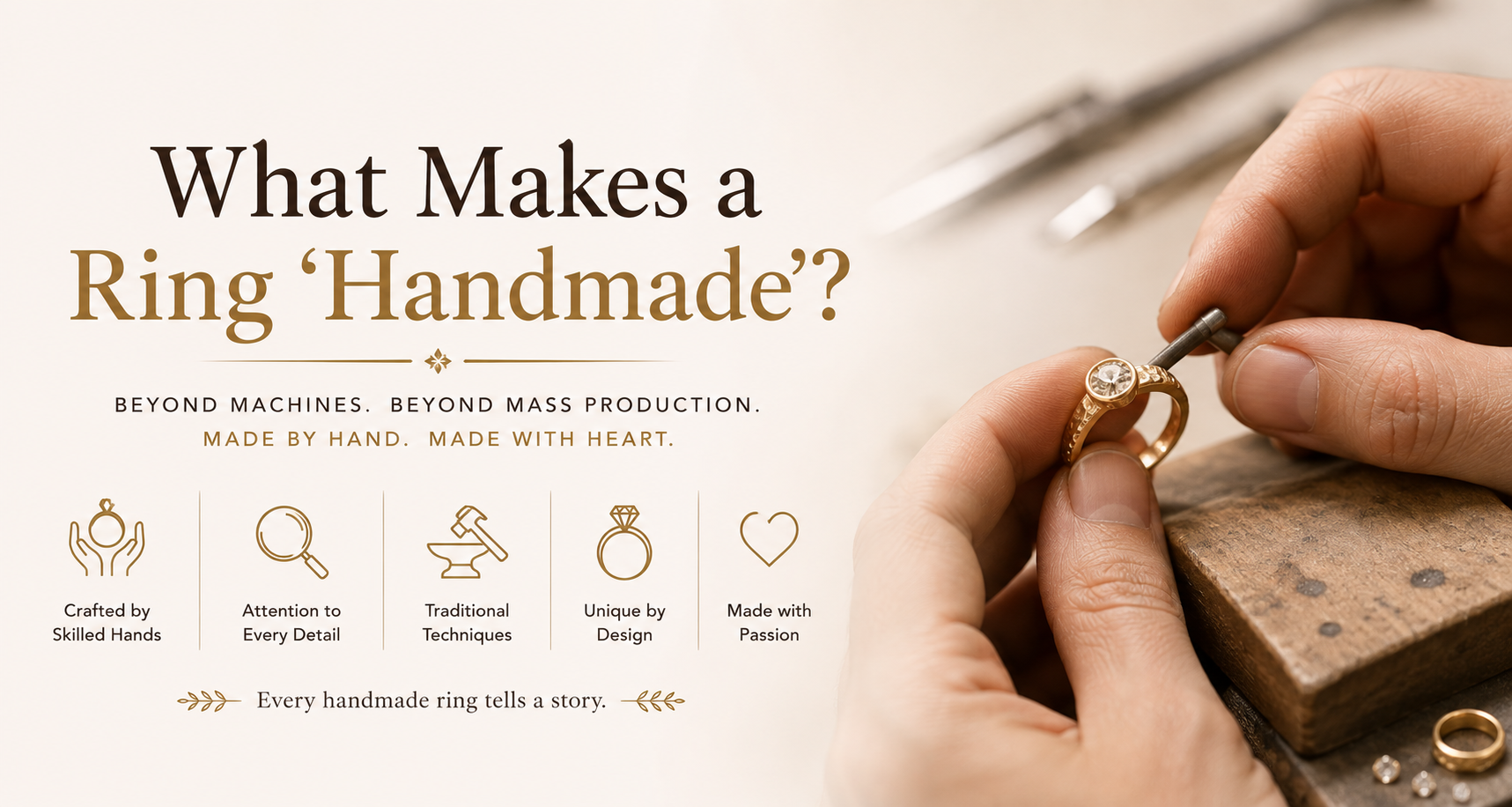
A genuinely handmade ring is shaped entirely by hand from raw material — metal formed, textured, and finished by a maker's hands and hand tools rather than a mould or an automated production line, with any gemstones set individually rather than machine-mounted. That's a stricter definition than the word gets used for in practice, since "handmade," "handcrafted," and "hand-assembled" are frequently used interchangeably even though they describe meaningfully different levels of hand involvement.
This guide covers the real distinction between those three terms, what techniques actually go into a genuinely handmade ring, a nuance about casting that most buying guides get wrong, and the practical checks you can use to verify whether a ring is actually handmade before you buy.
The Terminology Hierarchy

- Handmade: every stage is done by hand, from forming the metal to setting the stone, using hand tools rather than moulds or automated machinery. This is the most skill-intensive and time-consuming category.
- Handcrafted: the design elements — shaping, texturing, detailing — are created by hand, though the piece may incorporate pre-made components like a manufactured chain or clasp rather than every single element being hand-formed.
- Hand-assembled: built from pre-made parts and components that are put together by hand. This still involves genuine hand interaction, but considerably less individual craftsmanship than either of the two categories above.
- Machine-made or mass-produced: shaped by mould, cast at scale, or produced on an automated line, with uniformity and speed as the priority rather than individual craftsmanship.
None of these labels is inherently "bad" — a well-made hand-assembled piece can still be a good product. What matters is knowing which category a specific ring actually falls into, since the terms genuinely aren't interchangeable, whatever a product listing might imply.
Techniques Involved in a Genuinely Handmade Ring
- Forging — shaping metal by hammering and rolling it into form, which also affects the metal's density (more on this below)
- Soldering — joining metal components by hand using heat, rather than a pre-assembled cast structure
- Hand-set stones — gemstones placed and secured individually, which is why stone position can vary slightly between two pieces of the same design
- Hand-applied texture and finish — hammered surfaces, brushed textures, and patinas applied by hand rather than replicated identically across a production run
The Casting Nuance Most Guides Get Wrong

Many buying guides present casting as automatically disqualifying a piece from being genuinely handmade, treating "hand-forged" and "cast" as a strict either/or. That's not quite accurate. The real distinction is in how the casting is used:
- Mass-production casting: a single mould is created once and used to pour dozens or hundreds of identical pieces — this is machine-made in every meaningful sense, regardless of any hand-finishing applied afterward
- Individual lost-wax casting: each piece is individually hand-modelled in wax first, then cast just once from that specific wax model, and hand-finished afterward — this process is still legitimately handmade, since every piece originates from an individually crafted model rather than a reusable mass-production mould
If you're evaluating whether a piece is genuinely handmade, the more useful question isn't "was this cast at any point?" — it's "was the mould used once, from an individually made model, or was it reused across many identical pieces?"
How to Tell If a Ring Is Actually Handmade
- Look for small variations rather than perfect uniformity — a curve that's slightly softer on one side, a stone that sits marginally off-centre, or texture that isn't perfectly identical from piece to piece are signs of genuine hand involvement, not flaws
- Check whether you can find an exact duplicate — if a ring has an identical twin available for purchase with zero variation, that's a strong sign of machine production or hand-assembly rather than true handmade construction
- Try the weight test — hand-forged metal, shaped through hammering and rolling, becomes denser than cast metal of the same apparent size. Mould-cast pieces often contain tiny trapped air bubbles from the pouring process, making them lighter and more prone to scratching or breaking. Holding a genuinely hand-forged piece next to a cast piece of similar size, the handmade one typically feels heavier.
- Check for a maker's mark, usually stamped on the inside of the band — a legitimate maker's mark can often be traced, which adds a layer of verification beyond the seller's own claim
- Ask the seller to explain their process — a jeweller or brand genuinely producing handmade work should be able to describe how a piece is actually made, and ideally show some evidence of the process
- Be cautious of unusually low prices attached to a "handmade" claim — genuine handmade work reflects real time and skill, and a price far below what that labour would reasonably cost is worth questioning
Why Handmade Rings Cost More
The price difference between handmade and mass-produced jewellery isn't arbitrary. A genuinely handmade ring can take anywhere from several days to several weeks to complete, depending on complexity, compared to a production line that can output dozens of identical cast pieces in the same timeframe. That time, along with the skill required to forge, set, and finish a piece entirely by hand, is what the price difference actually reflects.
What This Means When You Shop
If a piece is genuinely handmade, expect the product photo to represent the design rather than the exact piece you'll receive — natural variation in stone placement, texture, or finish is part of what handmade construction means, not a quality issue. Our Carat Conversations piece on why handcrafted jewellery will never be replaced by machines goes further into why that variation is worth valuing rather than treating as a flaw.
FAQs
What's the difference between handmade and handcrafted jewellery?
Handmade means every stage — including forming the metal — is done by hand. Handcrafted means the design elements are hand-made, but the piece may include pre-made components like a manufactured chain or clasp.
Is a cast ring ever considered handmade?
Yes, if each piece is individually hand-modelled in wax and cast just once from that specific model. It's not handmade if a single reusable mould is used to mass-produce many identical pieces.
How can I tell if a ring is genuinely handmade?
Look for small variations rather than perfect uniformity, check whether an identical duplicate exists, compare weight against a similar-looking cast piece, check for a maker's mark, and ask the seller to explain their process.
Why does handmade jewellery cost more than mass-produced jewellery?
It reflects the time and skill involved — a handmade piece can take days to weeks to complete, compared to a production line capable of producing many identical cast pieces in the same time.
Should I expect my handmade ring to look exactly like the product photo?
Close, but not identical. Natural variation in stone placement, texture, or finish is normal and expected with genuinely handmade construction.
Does a maker's mark guarantee a ring is handmade?
It's a useful verification signal, since a legitimate mark can often be traced, but it's worth combining with other checks — weight, variation, and the seller's ability to explain their process — rather than relying on a single indicator alone.
Explore artisan-made pieces in our Handmade Rings, Stone Age, and Mitti of Kutch collections at Mine of Design.