Cart
0
How to Stack Rings the Right Way- Detailed Guide
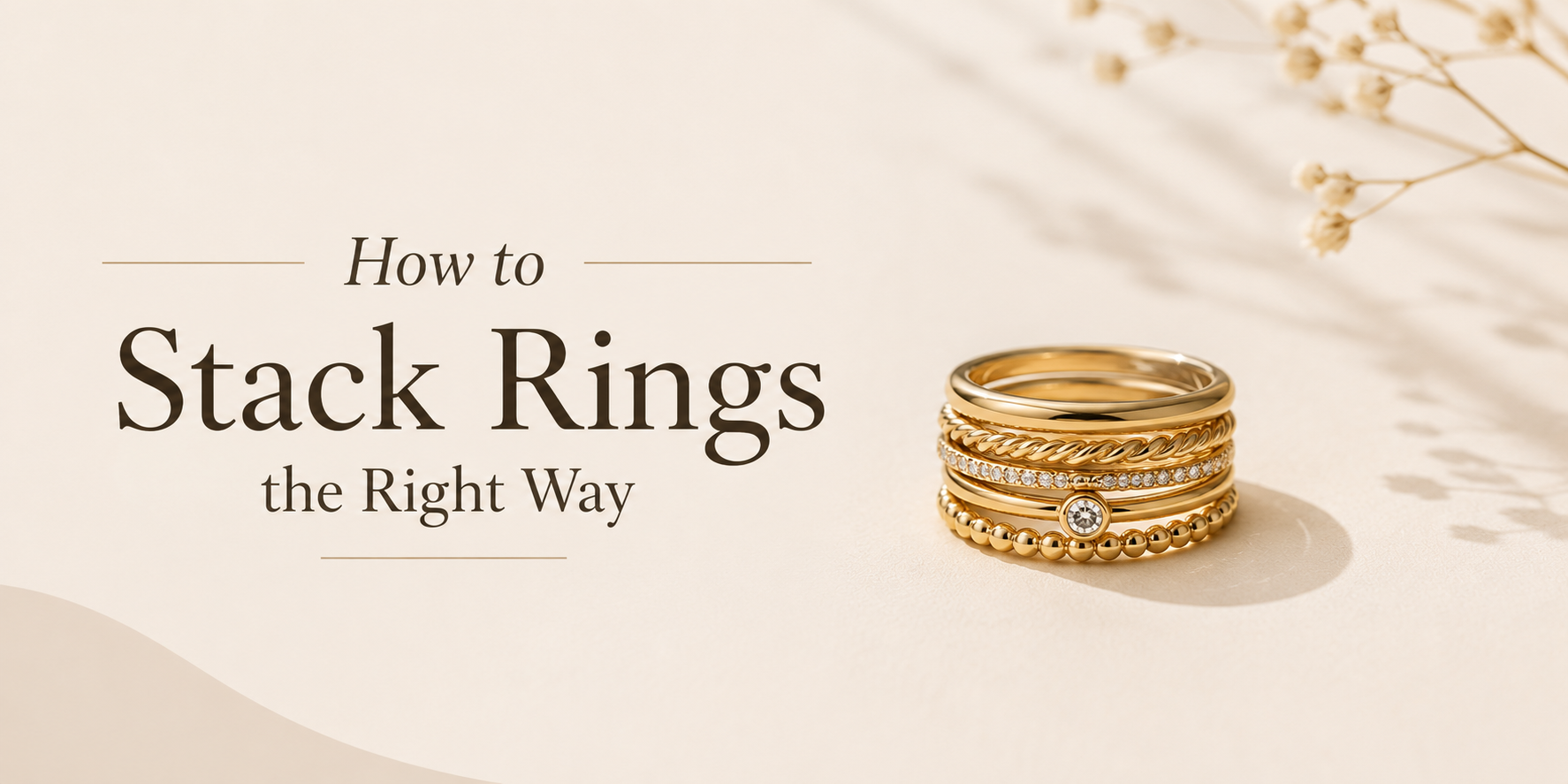
A stack that looks effortless is rarely accidental. It starts with a simple anchor ring, builds outward with pieces that contrast in texture or width, includes one focal piece that draws the eye, and tapers toward thinner, more delicate rings at the edges. Three to five rings per hand is a reasonable general range, though the real limit isn't a fixed number — it's whether the combination still reads as composed rather than cluttered.
This guide covers the actual building method, how to mix metals and textures well, how to arrange rings across multiple fingers, and the comfort and care considerations most styling guides skip over.
Step-by-Step: Building a Stack

- Start with a simple, classic band as your anchor — this grounds the stack and gives everything else something to build around, rather than starting with your boldest piece first
- Add a piece with textural or stylistic contrast — a hammered or textured band next to a smooth one creates visual depth without needing a dramatically different design
- Position one focal piece — a ring with a larger stone or a more distinctive design — near simpler rings, so it reads as the clear point of interest rather than competing with several other bold pieces
- Taper toward thinner, more delicate rings at the edges of the stack, which creates a finished, considered look rather than one that feels evenly weighted throughout
Mixing Metals and Textures
- Mixing metal tones is genuinely fine — rose gold with white gold, or yellow gold with a cooler tone, tends to read as intentional rather than mismatched, particularly if one piece acts as a bridge
- A mixed-metal "bridge" ring — one piece that itself combines two tones — makes it easier to transition between other single-tone pieces in the stack without an abrupt jump
- Vary width, not just design — a stack built entirely from rings of the same thickness tends to look flatter and less dynamic than one mixing thin and substantial bands
Arranging Across Multiple Fingers

- Triangle balance: if you're stacking across several fingers, arranging them so the outer fingers carry a lower stack and the middle carries a higher one (or the reverse) creates a symmetrical, considered shape across the hand
- An odd number of fingers — three, five, or seven out of ten — tends to read as more deliberate than an even distribution, though this is a general tendency rather than a fixed rule
- One "focus finger" with a fuller stack, paired with just one or two simpler rings elsewhere, generally looks more composed than spreading an equal number of rings evenly across every finger
- Leave visible space between rings on the same finger where the design allows — rings don't need to sit flush against each other to read as a cohesive stack
- Many people leave the pinky or thumb bare as a matter of convention, though this is a preference rather than a rule worth following strictly
How Many Rings Is Too Many?
Three to five rings per hand is a commonly cited comfortable range, and stacking a similar number of individual rings across different fingers works well for most people. Where it tends to go too far is stacking too many rings on a single finger at once — that's the point where a look shifts from intentional to cluttered, and where comfort issues are also most likely to start.
Comfort and Circulation

This is worth taking seriously rather than treating purely as a style question:
- Multiple rings stacked on one finger effectively tightens the fit, even if each individual ring measured correctly on its own — if a stack starts to feel restrictive, sizing up slightly or removing a ring is a reasonable adjustment rather than pushing through discomfort
- Watch for rings climbing toward the knuckle or creating visible pressure at the base of the finger — this is a sign the stack needs adjusting, not something to work around
- Finger size shifts slightly through the day and across seasons, so a stack that feels fine in the morning can feel tighter later — this is normal, and worth factoring in in warmer weather especially
Protecting Your Rings From Each Other
Rings of different hardness worn stacked against one another can create friction that scratches or wears the softer piece over time — this is worth keeping in mind for gold-plated pieces specifically, since repeated direct contact accelerates plating wear the same way general handling does. For broader care guidance, see our guide on how often to clean everyday jewellery.
Balancing Both Hands
If one hand is carrying a fuller, more dramatic stack, it's worth giving the other hand at least a little jewellery too — a single simple ring, a bangle, or even just a watch — rather than leaving it completely bare. This keeps the overall look balanced rather than making one hand look overly done and the other forgotten.
Building Around a Piece You Already Own
If you already have a favourite ring — sentimental, an anchor piece, or simply the one you never take off — building a stack around it rather than starting from scratch is often the easiest approach. Choose contrasting textures and widths to add around it, keeping it as the visual centre of the composition rather than introducing a second, competing focal point.
FAQs
Where should I start when building a ring stack? With a simple, classic band as your anchor, then add pieces with textural or stylistic contrast, one focal piece, and thinner rings toward the edges for a tapered finish.
Can I mix different metal tones in a ring stack? Yes — mixing tones like rose gold and white gold generally reads as intentional rather than mismatched, especially with a mixed-metal "bridge" ring to help transition between them.
How many rings should I stack on one hand? Three to five is a commonly comfortable range, though the real limit is whether it still looks composed rather than cluttered — stacking too many rings on a single finger is where problems usually start, more than the total count across the hand.
Is it uncomfortable to stack multiple rings on one finger? It can tighten the effective fit even if each ring measured correctly alone. If a stack starts to feel restrictive, sizing up slightly or removing a ring is a reasonable response.
Do stacked rings scratch each other? Yes, particularly rings of different hardness worn in direct contact — this is worth considering for gold-plated pieces specifically, since friction accelerates plating wear over time.
Should I stack rings on both hands equally? Not necessarily equally, but it's worth giving the other hand at least some jewellery if one hand carries a fuller stack, to keep the overall look balanced.
Build your stack with our Handmade Rings collection at Mine of Design.