Cart
0
Handmade vs Machine-Cast Jewellery: What's the Difference?
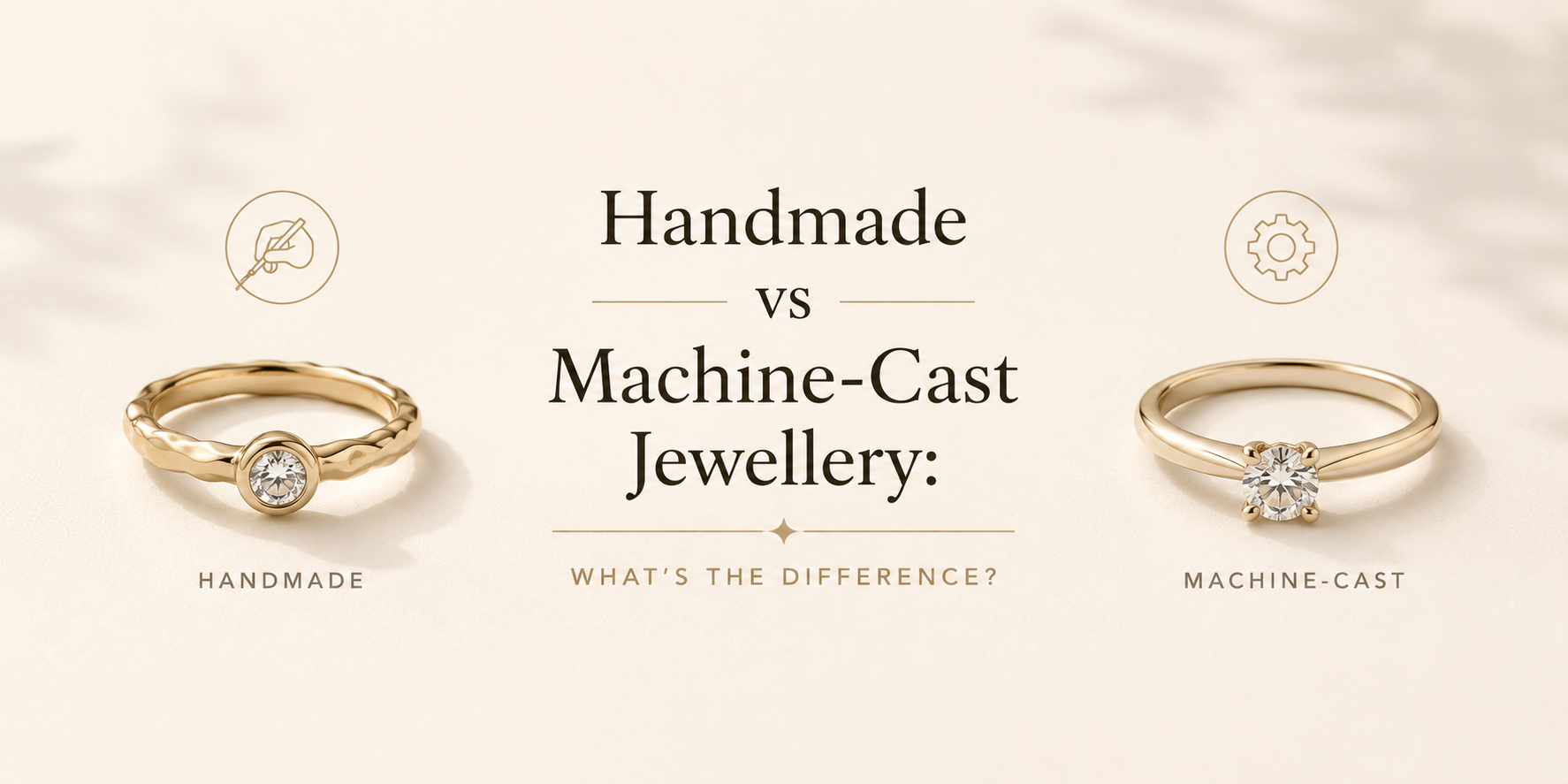
Hand fabrication means working raw metal — wire or sheet — entirely by hand from scratch, with no model, mould, or wax pattern involved at any stage. Machine casting means creating a mould of a design, then pouring molten metal into it to produce a replica, which can be repeated to create multiple identical pieces. These are genuinely different manufacturing processes with different techniques, tools, and outcomes — and neither one automatically means higher quality, despite how often that's assumed.
This guide covers the real techniques involved in each process, an honest look at where quality actually comes from, and a complication worth knowing about before assuming visual irregularity alone proves a piece is genuinely handmade.
What Hand Fabrication Actually Means

In its strictest sense, hand fabrication starts with raw metal in wire or sheet form and builds the entire piece through direct manipulation — no models, no moulds, no wax patterns at any point. This is worth distinguishing from the broader, more common use of "handmade" we cover in our guide on what makes a ring handmade, which also includes pieces individually modelled in wax and cast just once. Some jewellers reserve "handmade" exclusively for pure fabrication with no casting involved at all; the wider market often uses the term more broadly. Neither usage is wrong — it's worth knowing which one a specific seller means.
Techniques Used in Hand Fabrication
- Forging — heating and shaping metal through controlled hammering
- Sawing — cutting metal sheets into precise patterns using a jeweller's saw
- Hand-setting — placing each stone individually and adjusting prongs by hand for an exact fit
- Granulation — an ancient technique fusing tiny metal beads onto a surface for texture and detail
- Oxidizing — chemical treatments applied by hand to create depth and shading in recessed areas of a design
Metal shaped this way through hammering and rolling also becomes denser as a direct result of the process, which is part of why hand-fabricated pieces often feel heavier than a cast piece of similar visual size.
How Modern Machine Casting Actually Works

- CAD-based design — most contemporary casting starts with a computer-aided 3D model, allowing exact specifications and perfect replication across a production run
- Lost-wax casting — a wax model (increasingly 3D-printed from the CAD file) is used to create a mould, then melted out and replaced with molten metal
- Die-striking — metal is pressed into a mould under extreme pressure, an alternative to pouring
- Laser cutting — computer-guided cutting for intricate, repeatable patterns
- Electroforming — metal is deposited onto a form through an electrical current, building up a shape layer by layer
- Mass finishing — multiple pieces are tumbled together for uniform polishing across an entire production run
Modern casting has moved well beyond simple mould-and-pour — CAD design and 3D-printed wax patterns now allow for precision and complexity that would have been genuinely difficult to achieve by hand.
Is One Actually Better Quality?
Not automatically, and it's worth being honest about that rather than assuming handmade always wins. Cast metal can contain microscopic porosity — tiny air pockets formed during the casting process — and poor technique can create weak points, particularly in thin areas like prongs or shanks. But well-calibrated casting equipment using quality materials can produce genuinely durable, well-made pieces. Handmade quality varies too, depending entirely on the skill of the individual maker. The manufacturing method is a real factor in a piece's characteristics, but it isn't a reliable shortcut for judging quality on its own.
Why Irregular Materials Often Favour Hand Fabrication
Some designs are genuinely better suited to one process than the other. A stone with a natural, irregular shape — a raw crystal, a piece with organic, uneven edges — is difficult for a cast or machine-based setting to accommodate well, since casting favours uniform, predictable shapes. Hand fabrication can build a custom setting that follows the stone's actual edge, rather than requiring an artificially calibrated stone or leaving visible gaps in a standard setting. This is part of why our Stone Age collection, built around natural semi-precious stones, leans on hand-finished construction rather than uniform casting.
Multi-metal designs have a related consideration on the casting side: combining different metals in a cast piece generally means casting each component separately and soldering them together afterward, which can create a weaker point at each solder joint compared to a single continuous piece.
A Modern Complication: Machines Can Now Simulate the "Handmade" Look
This is worth knowing before relying purely on visual irregularity as proof of genuine hand construction. Some manufacturers use mechanized punch presses and forges specifically to simulate the slight variation and texture associated with handmade work, applied at production scale. This doesn't mean visual irregularity is worthless as a signal — it's still a reasonable indicator — but it's no longer fully reliable on its own the way it once was. Combining it with the other checks covered in our guide on what makes a ring handmade — weight, maker's marks, and asking the seller directly about their process — gives a more reliable picture than appearance alone.
What This Means for You as a Buyer
Given that visual cues alone aren't fully reliable anymore, the most dependable signal is transparency: a seller who can clearly explain how a specific piece is actually made — fabricated, individually cast, or mass-produced — is giving you real information to work with. A vague "handmade" label without any explanation of process is worth asking more about, regardless of how the piece looks.
FAQs
What's the difference between hand fabrication and casting? Hand fabrication builds a piece entirely by hand from raw wire or sheet metal, with no model or mould involved. Casting creates a mould of a design and pours molten metal into it, allowing multiple identical pieces to be produced.
Is cast jewellery lower quality than handmade jewellery? Not automatically. Poor casting technique can create weak points or microscopic porosity, but well-calibrated casting with quality materials can be genuinely durable. Handmade quality also varies depending on the maker's skill.
Why is hand fabrication better suited to irregular stones? A hand-fabricated setting can be built to follow a stone's actual natural edge, while casting favours uniform, predictable shapes — an irregular stone in a cast setting often needs to be artificially calibrated or ends up with visible gaps.
Can machines make jewellery that looks handmade? Yes — mechanized punch presses and forges are sometimes used specifically to simulate the visual irregularity associated with handmade work, which means appearance alone is no longer a fully reliable way to verify genuine hand construction.
What techniques are used in genuine hand fabrication? Forging, sawing, hand-setting, granulation, and oxidizing are core techniques, all performed with hand tools rather than automated machinery.
How can I verify whether a piece is actually handmade? Combine several checks rather than relying on one — weight, the presence of a maker's mark, whether an identical duplicate exists, and asking the seller directly to explain their manufacturing process.
Explore hand-finished pieces in our Handmade Rings collection at Mine of Design.