Cart
0
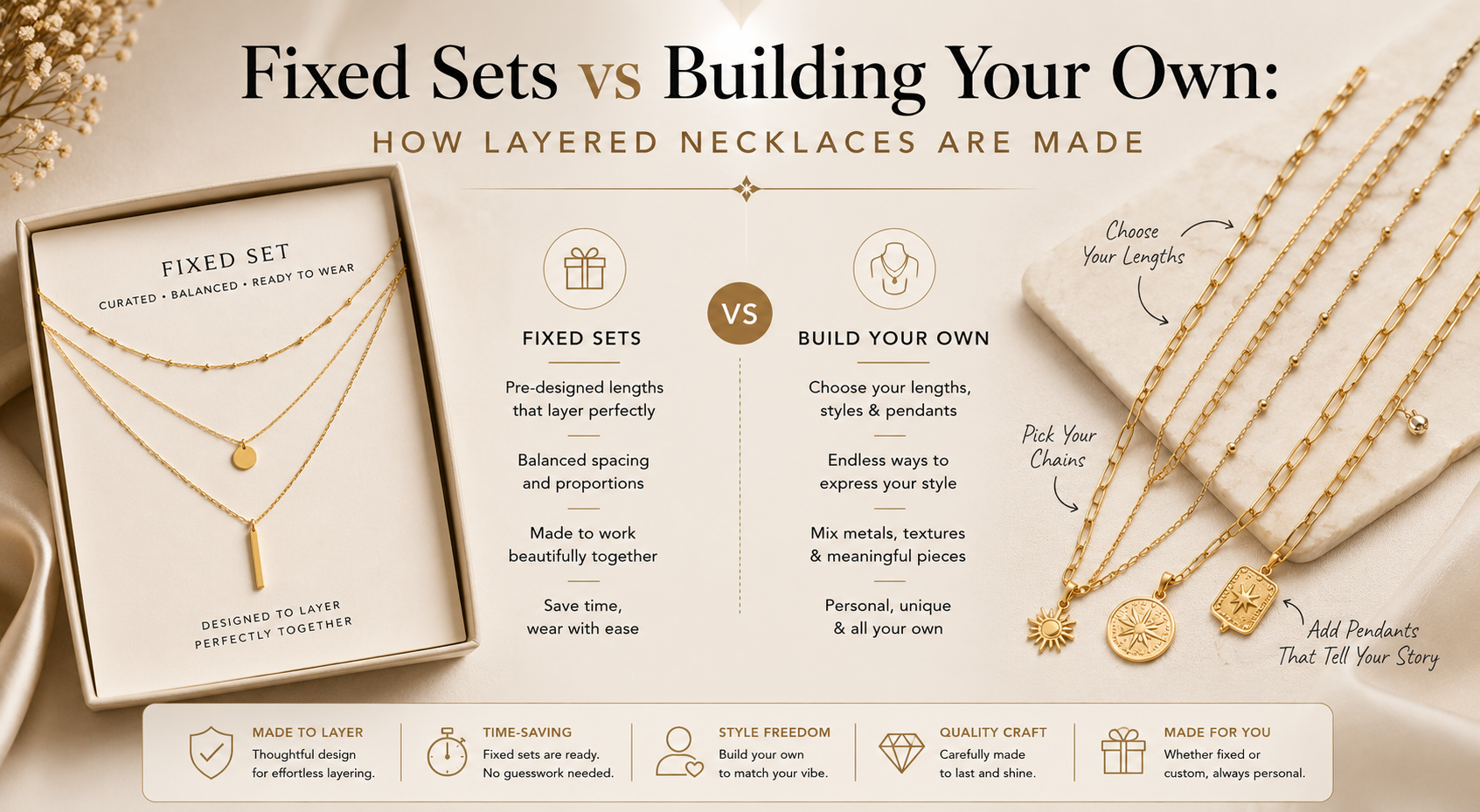
A fixed layered necklace and a hand-built stack solve the exact same styling problem — multiple strands at different lengths — through two genuinely different construction approaches.
A fixed set joins every strand to a single shared clasp point during manufacturing, so the spacing and tangle-resistance are built into the piece itself. A hand-built stack combines separate necklaces, each with its own clasp, which offers more flexibility but shifts the tangle-prevention work onto the wearer.
This is the actual construction distinction behind the two options, and understanding it explains why one approach tangles more easily than the other, and what specific techniques close that gap.
How a Fixed Layered Set Is Constructed

A fixed set is built with multiple strands — chain, beaded, or a mix — attached to one shared clasp, with lengths and spacing calculated during design rather than assembled after purchase. This construction has a specific practical effect: because every strand shares a single attachment point at the back of the neck, the strands can't shift independently or twist around each other the way separate necklaces can. It's designed to look like several individual pieces while functioning, mechanically, as one.
This is also why a fixed set is generally the more tangle-resistant option without any extra technique required — the anti-tangle design is built into the construction itself, not something the wearer has to manage.
How a Hand-Built Stack Is Constructed

A hand-built stack combines separate necklaces, each with its own independent clasp, chosen and assembled by the wearer rather than pre-calculated by a designer. This offers real advantages a fixed set can't match: mixing metals, combining sentimental pieces with new ones, adjusting the combination over time, and choosing exact lengths from pieces you may already own.
The trade-off is tangling. With independent clasps, each strand can rotate and shift on its own, which is what causes chains to twist around each other over the course of a day. This isn't a flaw in the individual pieces — it's simply the mechanical consequence of not having a shared construction point the way a fixed set does.
Side-by-Side Comparison
| Fixed Layered Set | Hand-Built Stack | |
|---|---|---|
| Construction | Multiple strands joined to one shared clasp | Independent pieces, each with its own clasp |
| Spacing | Pre-calculated during design | Determined by the wearer |
| Tangle resistance | Built into the construction | Depends on technique |
| Flexibility | Fixed combination | Fully customisable, can evolve over time |
| Best for | Beginners, low-effort daily wear | Personalisation, mixing sentimental and new pieces |
| Typical cost | One purchase covers the full look | Cost adds up per individual piece |
The Techniques That Make a Hand-Built Stack Work
Since a hand-built stack doesn't have a fixed set's built-in construction advantage, a few specific techniques close most of the gap:
- Clasp every strand at the same point on the back of the neck, rather than letting each necklace's clasp sit wherever it naturally falls — this recreates much of the shared-attachment-point effect a fixed set has by design
- Vary chain style between strands — a smooth snake chain, a textured rope chain, and a fine cable chain tangle with each other far less than three identical chain types, since uniform chains catch on each other more easily
- Anchor the stack with a slightly heavier piece, generally in the lowest position, which helps reduce how much the lighter strands above it can shift and twist
- Consider a necklace spacer — a small clip-style connector that holds multiple chains at fixed spacing — for a stack you build the same way regularly
None of these techniques are complicated, but skipping all of them is the most common reason a hand-built stack tangles more than expected.
Which Construction Suits You
- New to layering? A fixed set removes the guesswork entirely — spacing, tangle resistance, and combination are already resolved
- Want to mix sentimental pieces with new ones, or adjust your combination over time? A hand-built stack is the only construction that allows this
- Want the lowest-effort daily option? A fixed set, worn as a single piece, is simpler to put on and take off than managing multiple independent clasps
- Already own pieces at complementary lengths? Building your own may cost less than buying an entirely new fixed set, and lets you use what you already have
Many people end up using both — a fixed set for effortless daily wear, and an evolving hand-built stack for pieces with more personal meaning. For the fuller picture on how many strands to combine either way, see our guide on how many necklaces you should layer together.
Storage Differs by Construction Too
A fixed set generally stores more simply, since its strands are already joined and won't tangle with each other the way independent pieces can. A hand-built stack needs more deliberate storage: unclasp each piece before putting it away, and store separately rather than in a single pile, where independent clasps and chains are far more likely to knot together in storage than while actually being worn. For general care and cleaning frequency, see our guide on how often to clean everyday jewellery.
FAQs
What's the difference between a fixed layered necklace and building my own?
A fixed set joins multiple strands to a single shared clasp during manufacturing, with spacing pre-calculated. Building your own means combining separate necklaces, each with an independent clasp, assembled and adjusted by the wearer.
Which is more likely to tangle, a fixed set or a hand-built stack?
A hand-built stack tangles more easily by default, since each strand has its own independent clasp. A fixed set's shared attachment point is specifically designed to prevent this.
How do I stop a hand-built necklace stack from tangling?
Clasp every strand at the same point on the back of the neck, use varied chain styles rather than identical ones, and anchor the stack with a slightly heavier piece in the lowest position.
Is a fixed layered set a good option for beginners?
Yes — it removes the need to calculate spacing or manage multiple clasps, making it the simplest way to wear a layered look correctly on the first try.
Can I combine a fixed set with additional individual pieces?
Yes — many people use a fixed set as their base and add one or two individual pieces on top, which combines the tangle-resistance of the fixed set with some of the flexibility of building your own.
Should I store a hand-built stack differently than a fixed set?
Yes — unclasp each piece and store them separately rather than in a pile, since independent clasps are more prone to tangling in storage than a fixed set's joined construction.
Explore ready-to-wear fixed sets in our layered necklaces collection at Mine of Design.