Cart
0
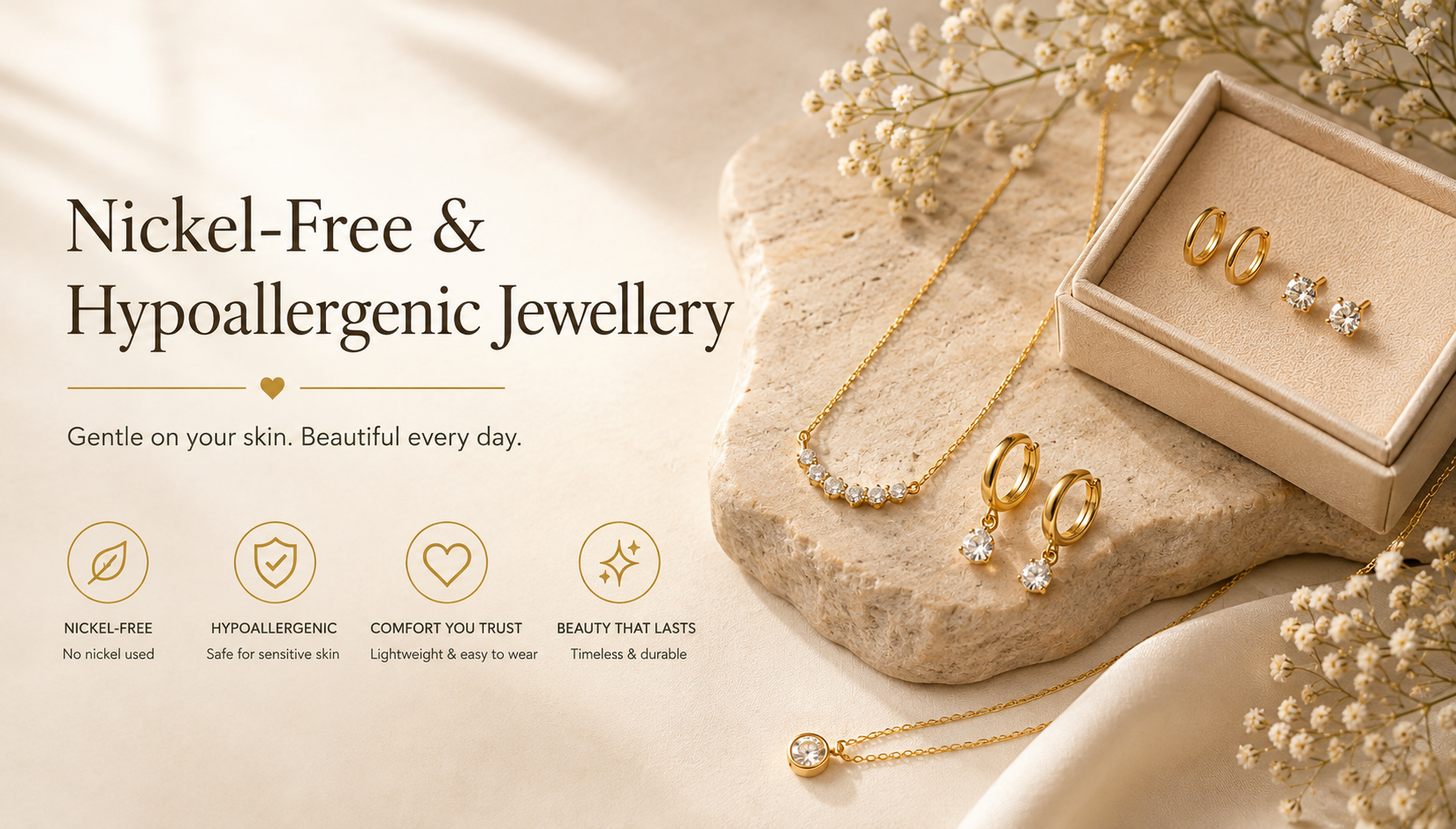

Nickel-free" and "hypoallergenic are not legally regulated terms in the United States they're marketing claims, not certified product categories, and there's no government agency that defines or enforces them for jewellery. The European Union has a genuine, testable regulatory standard instead: under REACH regulation, jewellery meant for skin contact must release less nickel than 0.5 micrograms per square centimetre per week, and jewellery inserted into piercings — earrings specifically — must meet an even stricter threshold of 0.2. Knowing this distinction is the single most useful thing to understand before trusting either label on a product listing.
This guide covers what these terms actually mean, why "nickel-free" doesn't mean zero nickel, why earrings face a stricter bar than rings or necklaces, and what actually to check before relying on either claim.
What "Hypoallergenic" Actually Means
The term originated in the cosmetics industry in the 1950s and was later adopted broadly by jewellery marketing. Its literal meaning is "below the normal level" of allergenic potential — but it has no legal or medical definition specific to jewellery in the US. A product can be labelled hypoallergenic without meeting any enforced standard, which means the term tells you a seller's intention more than it guarantees an outcome.
What "Nickel-Free" Actually Means
This is the more precise-sounding of the two terms, and it's worth being exact about what it actually guarantees: "nickel-free" does not mean zero nickel content. In practice, it usually means one of two things — either the nickel release rate falls below a recognised threshold (such as the EU's REACH standard), or simply that no nickel was intentionally added during manufacturing, which doesn't rule out trace amounts present in an alloy.
The EU standard, specifically:
- General skin-contact jewellery (rings, necklaces, bracelets): nickel release must not exceed 0.5 micrograms per square centimetre per week
- Body-piercing jewellery (earrings and other pierced pieces): a stricter limit of 0.2 micrograms per square centimetre per week
This distinction matters beyond Europe too, since it's the clearest testable definition that exists anywhere for these terms — in markets without an equivalent regulation, including the US, "nickel-free" is only as reliable as the seller's own substantiation.
The Base Metal Loophole
This is the mechanism most buyers don't know about, and it's genuinely important. Some manufacturers define "nickel-free" narrowly — meaning the visible plating or overlay contains no nickel — while the base metal underneath still uses a nickel alloy for cost and durability. When that plating wears down, even microscopically, the nickel-containing base metal beneath becomes exposed and can trigger a reaction in someone who was previously comfortable wearing the piece.
This is exactly why a plated piece's true skin-safety depends on the base metal, not the surface finish alone — a detail we've covered specifically for gold-plated earrings in our guide on choosing earrings for sensitive ears.
Materials Commonly Marketed as Hypoallergenic

- Titanium — 99.9% pure titanium is genuinely nickel-free and biocompatible enough for medical implants, making it one of the most reliably tolerated materials available
- Niobium — naturally nickel-free, and can be anodized to produce a range of colours, making it a less common but genuinely hypoallergenic option
- Fine silver (99.9% pure) — completely nickel-free, though rarely used alone in jewellery due to its softness
- Sterling silver (92.5% silver, typically 7.5% copper) — generally low-nickel and well-tolerated, though some manufacturers include trace nickel in the alloy mix, so it isn't automatically guaranteed nickel-free
- High-karat gold (18k and above) — more reliably hypoallergenic than lower-karat gold, which uses more alloy metals, potentially including nickel, for added strength
- Surgical-grade stainless steel — worth a specific technical note here: 316L stainless steel actually contains a slightly higher raw nickel percentage than 304 stainless steel, but is still considered more hypoallergenic, because it also contains molybdenum, which binds nickel within the alloy and significantly limits how much actually releases onto the skin. This is a case where the raw percentage of nickel present is less important than the release rate — a nuance worth knowing, since "less nickel by weight" and "less nickel released onto skin" aren't the same thing.
Why Earrings Face a Stricter Bar Than Rings or Necklaces
This is a genuinely useful cross-category distinction: because earrings sit inside a piercing rather than just against the skin's surface, they're held to a stricter regulated threshold (0.2 vs. 0.5 micrograms per square centimetre per week under REACH) than rings or necklaces, which only contact skin externally. This is part of why sensitive-ear guidance tends to be more cautious and specific than general jewellery sensitivity advice — the exposure is genuinely more direct and sustained.
What to Actually Check Before Trusting Either Label

Ask what the base metal is specifically, not just whether the surface is labelled nickel-free — this is the detail that actually determines long-term skin safety as plating wears
Look for a named material (titanium, niobium, 316L stainless steel, 18k gold) rather than the word "hypoallergenic" alone, since a specific material claim is more verifiable than a vague marketing term
Check for regulatory references like REACH or the EU Nickel Directive, which — even if you're not shopping in the EU — indicate the seller is working from an actual tested standard rather than an unsubstantiated claim
Remember that "nickel-free" doesn't mean zero nickel, even when the claim is genuinely made in good faith — it typically means the release rate is low enough to fall under a recognised threshold, not that none exists at all
Our Position on This
To be direct about our own products: Mine of Design's collection uses gold-plated construction, and we don't have confirmed, tested data on base metal composition or nickel release rates to make a hypoallergenic or nickel-free claim responsibly. Rather than use those terms as unverified marketing language, we'd rather be upfront that anyone with a known, significant nickel sensitivity should ask directly about base metal composition before purchasing any plated jewellery — from us or any other seller — for exactly the reasons covered in this guide.
FAQs
Does "nickel-free" mean a piece contains zero nickel?
No — it typically means the nickel release rate falls below a recognised threshold, or that no nickel was intentionally added, not that the material is entirely free of trace nickel.
Is "hypoallergenic" a regulated term for jewellery?
No, not in the US. It has no legal or medical definition specific to jewellery and functions as a marketing claim rather than a certified category.
Why do some "nickel-free" pieces still cause reactions?
Often because the label refers only to the surface plating, while the base metal underneath contains a nickel alloy. Once the plating wears down, the nickel-containing base becomes exposed.
Why is the nickel standard stricter for earrings than for rings or necklaces?
Because earrings sit inside a piercing rather than just against the skin's surface, exposure is more direct and sustained, which is why regulated thresholds (where they exist) set a lower limit for pierced jewellery specifically.
Is stainless steel jewellery nickel-free?
Not entirely — most stainless steel contains some nickel, though certain grades like 316L limit how much actually releases onto the skin due to other elements in the alloy, making it generally well tolerated even though it isn't technically nickel-free.
What's the most reliable way to check if a piece is safe for sensitive skin?
Ask the seller directly what the base metal is, look for named materials rather than vague marketing terms, and check for reference to an actual tested standard like REACH or the EU Nickel Directive.
For more on choosing comfortable, sensitive-ear-friendly styles, see our guide on earrings for sensitive ears, and browse our lightweight earrings collection at Mine of Design.