Cart
0
What Is Kundan Jewellery?
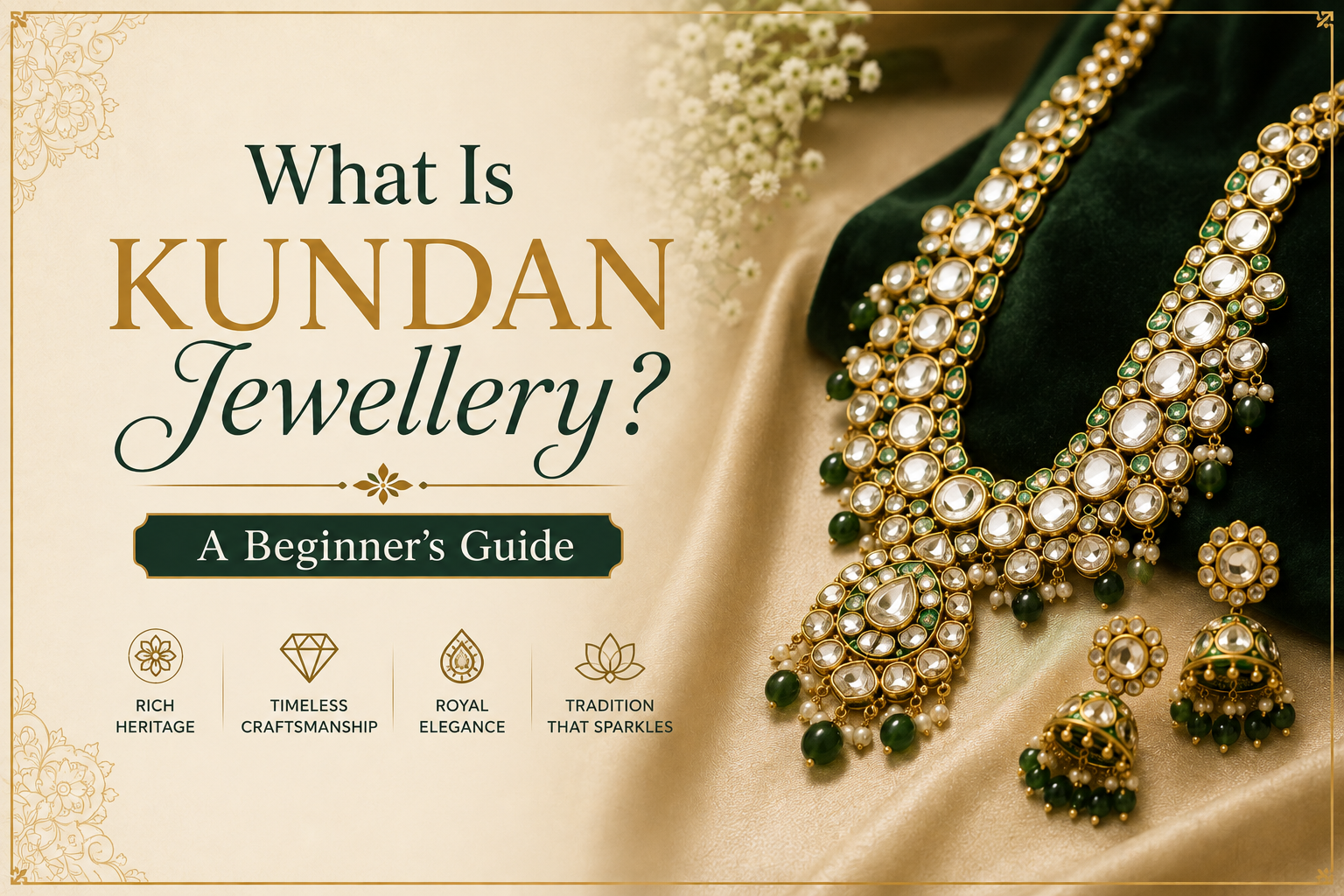
Kundan is a traditional Indian technique for setting gemstones into gold foil so pure and soft that it can be pressed and moulded around each stone by hand, without heat and without prongs. The name itself comes from the Sanskrit word for refined, pure gold — Kundan technically refers to the gold, not the stones, though the term has come to describe the entire jewellery style built around it.
This guide covers how traditional Kundan is actually made, where the technique comes from, how it differs from the closely related Polki style, and an honest look at how the traditional craft relates to the Kundan-style fashion jewellery widely available today.
What "Kundan" Actually Refers To

The word comes from the Sanskrit root "kundana," meaning highly refined or purified gold. This is a specific technical detail worth understanding: the gold used in genuine Kundan work is purified to an exceptionally soft state — typically near 24 karat — which is precisely what allows a goldsmith to press it around a gemstone by hand rather than needing a soldered or pronged setting. The softness of the gold is the mechanical foundation the entire technique depends on.
How Traditional Kundan Is Made
The traditional process follows several distinct stages, each with its own name in the craft:
- Ghat (or gadhayi) — thin strips of gold are cut, coiled, and shaped into the base framework of the piece, establishing its overall structure
- Khudayi — the surface is engraved with the intended pattern, often with the framework filled with lac (a natural resin) to support the design during this stage
- Jadai — the actual stone-setting: gemstones are carefully placed and pressed into the refined gold foil, which moulds around each stone to hold it securely without prongs
- Meenakari (often, though not always, included) — enamel colour work applied to the reverse side of the piece, adding a hidden layer of detail and colour not visible from the front
This multi-stage process, carried out by hand, is part of why traditional Kundan work is labour-intensive and time-consuming compared to prong-set or cast jewellery techniques.
Kundan vs. Polki: Clearing Up a Common Confusion

Kundan and Polki are closely related, and the terms are sometimes used loosely enough that the distinction gets blurred in casual usage. The clearest technical distinction:
- Polki uses uncut, natural-form diamonds set into gold foil, giving a rustic, more antique-looking brilliance
- Kundan uses polished, faceted, symmetrical stones — rubies, emeralds, sapphires, or high-quality coloured glass — set using the same foil technique, giving a more refined, uniform glow
Both use essentially the same gold-foil-setting method, and the two are frequently combined in a single piece. Where the confusion comes in: some sources use "Kundan" as a broader umbrella term covering both styles, since the setting technique is shared, while others treat them as genuinely distinct categories based on the stone type. If you're shopping and see the terms used interchangeably, it's worth asking specifically which stone treatment a piece actually uses rather than assuming based on the name alone.
A Brief History
Kundan is among the oldest stone-setting traditions in Indian jewellery, with roots that some historical accounts trace back over two millennia. Its most well-documented flourishing came under Mughal patronage, particularly during the reign of Akbar, with some historical records suggesting the technique was significant enough to the royal court to be recorded in official Mughal-era documentation. As royal artisans and their techniques moved into Rajasthan, Jaipur became the centre of Kundan craftsmanship — a position it has held for generations, supported by established artisan communities and access to gemstone markets. Jaipur remains closely associated with Kundan work today.
Traditional Kundan Necklace Styles
Several necklace formats are strongly associated with Kundan craftsmanship specifically:
- Kundan chokers — close-fitting pieces at the base of the neck; see our guide on choker necklaces for the broader category
- Har or layered Kundan necklaces — cascading, multi-strand designs
- Kundan rani haar — the most elaborate format, a multi-stranded, ceremonial-length piece specifically associated with North Indian bridal tradition; see our guide on long necklace vs. rani haar for the full distinction
Traditional Kundan vs. Kundan-Style Fashion Jewellery
This distinction matters, and it's worth being direct about it. Genuine, traditional Kundan work — 24-karat gold foil, hand-set gemstones, hours of skilled artisan labour — sits firmly in the fine jewellery category, priced accordingly. What's widely available today under the "Kundan" name in fashion and everyday jewellery is often Kundan-style: pieces that replicate the visual aesthetic of Kundan — the gold-foil-look setting, the faceted coloured stones, the layered silhouettes — using more accessible materials, such as a gold-plated base metal and glass or cubic zirconia stones, rather than the traditional 24-karat gold and precious gemstone construction.
Neither version is more "legitimate" than the other for its own purpose — traditional Kundan is a heritage craft investment; Kundan-style fashion jewellery makes the aesthetic accessible for everyday and festive wear without the cost of fine jewellery. What matters is knowing which one you're buying, since the price, durability, and care needs differ substantially between the two. Our Mughal Kundan collection reflects this aesthetic tradition in accessible, gold-plated fashion jewellery construction, rather than traditional 24-karat gold-foil craftsmanship.
How to Style Kundan and Kundan-Style Pieces
- Festive and ethnic occasions are the natural home for Kundan-style designs, particularly paired with sarees, lehengas, and other traditional outfits
- Weddings are where the fullest, most elaborate Kundan pieces — chokers layered with a rani haar — traditionally appear
- Pairing with earrings: jhumka or chandbali-style earrings in a matching stone treatment complete the traditional look most effectively
FAQs
What does "Kundan" mean?
It comes from the Sanskrit word for highly refined, pure gold — technically referring to the gold used in the setting, not the gemstones themselves, though the term now describes the entire jewellery style.
How is Kundan jewellery traditionally made?
Through several hand stages: shaping a gold base framework (ghat), engraving the design (khudayi), setting gemstones into the soft gold foil (jadai), and often finishing with enamel work on the reverse (meenakari).
What's the difference between Kundan and Polki?
Polki uses uncut, natural-form diamonds for a rustic look; Kundan uses polished, faceted stones for a more refined, uniform glow. Both use the same gold-foil setting technique, and the terms are sometimes used loosely to cover both.
Is all "Kundan" jewellery made from real gold and gemstones?
No — much of what's sold as Kundan-style jewellery today uses gold-plated base metal and glass or cubic zirconia stones to replicate the traditional aesthetic at a more accessible price point, rather than genuine 24-karat gold and precious stones.
Where does Kundan jewellery come from?
Its roots trace back over two millennia, with its most documented flourishing under Mughal patronage. Jaipur, Rajasthan became the historic centre of the craft and remains closely associated with it today.
What necklace styles are traditionally made with Kundan work?
Chokers, layered or har-style necklaces, and the rani haar — a multi-stranded, ceremonial-length piece central to North Indian bridal tradition — are the styles most strongly associated with Kundan craftsmanship.
Explore the aesthetic in our Mughal Kundan collection at Mine of Design.