Cart
0
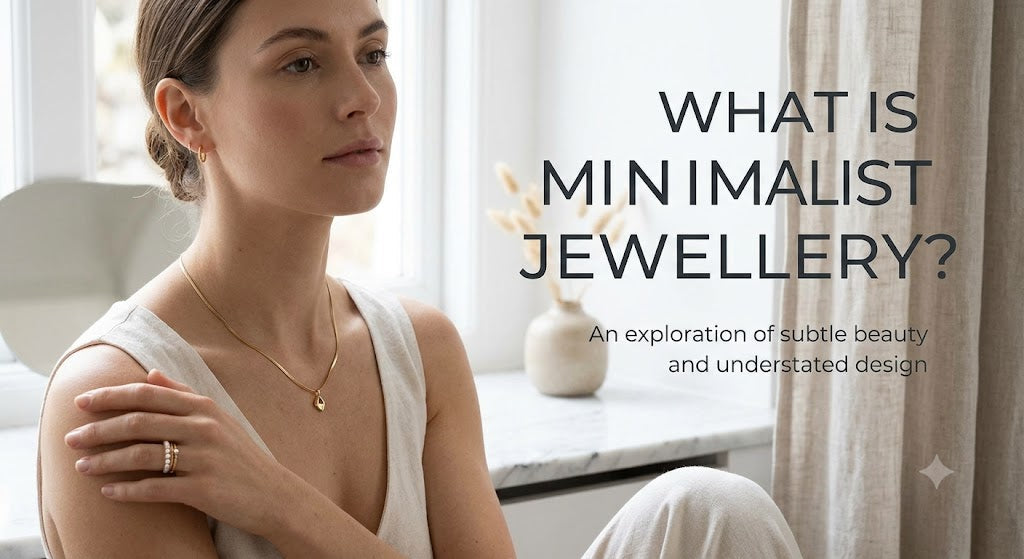

Most jewellery collections grow by addition — more detail, more stones, more visual information competing for attention. Minimalist jewellery works in the opposite direction: it's defined by what's deliberately left out. That distinction matters, because most descriptions of minimalist jewellery stop at "simple" or "clean lines" without explaining what's actually being simplified, or why. Minimalist jewellery is a design philosophy built around reducing a piece to its essential geometric form — removing ornamentation until only the function and shape remain — not merely a size category for smaller, lighter pieces.
Where Minimalism as a Design Philosophy Comes From
Minimalism didn't originate in jewellery. It emerged as a broader design and art movement in the mid-20th century, most closely associated with modernist architecture and visual art. Architect Ludwig Mies van der Rohe's principle "less is more" became something close to the movement's founding statement, capturing the idea that removing unnecessary elements from a design makes the essential elements more powerful, not less. Around the same period, the Bauhaus movement in design and architecture championed the idea that form should follow function — that a design's shape should be determined by its purpose rather than decorative tradition. In the visual arts, artists like Donald Judd pushed this further in the 1960s, creating work built from pure geometric forms with no representational or decorative content at all.
Jewellery design absorbed this philosophy directly. Where earlier jewellery traditions — Victorian, Baroque, and much of traditional Indian jewellery among them — built value and beauty through density of detail, minimalist jewellery design took the opposite position: that a single, well-proportioned geometric line or shape could carry as much visual weight as an elaborately embellished piece, simply through precision of form.
The Core Characteristics of Minimalist Jewellery
A piece doesn't become "minimalist" just by being smaller or plainer than average. Several specific design characteristics define the category:
-
Geometric form. Minimalist jewellery is built around deliberate, often mathematically clean shapes — circles, straight bars, simple ovals, precise angles — rather than organic, decorative, or figurative forms.
-
Negative space as a design element. What's absent from a minimalist piece is treated as intentionally as what's present. An open circle, a gap in a bar, or empty space within a pendant's outline is doing design work, not simply saving material.
-
Absence, or near-absence, of ornamentation. Engraving, filigree, layered texture, and dense stone-setting are the opposite of minimalist design. Where a stone or texture does appear, it's typically a single, restrained accent rather than a decorative field.
-
A restrained, often monochromatic metal palette. Minimalist pieces are usually built in a single metal tone per piece — solid gold-toned, or solid silver-toned — rather than mixing several finishes or metal colours within one design.
-
Smooth, continuous surfaces. Minimalist jewellery favours polished or matte continuous surfaces over raised texture, carving, or multi-layered construction.
Taken together, these characteristics describe a design language, not a size. A large, bold geometric cuff can still be minimalist if it follows these principles; a tiny, densely detailed stud is not minimalist just because it's small.
What Minimalist Jewellery Is Not
Because the word gets used loosely, it's worth being precise about what minimalist jewellery isn't:
-
It isn't automatically "lightweight." Weight is a physical property of materials and construction; minimalism is a design philosophy about form. A minimalist piece is often lightweight as a side effect of having less material and detail, but the two aren't the same thing — a solid, substantial geometric cuff can be entirely minimalist in design while still having real heft.
-
It isn't the same as "basic." Minimalist design requires deliberate proportion and precision; a plain, unconsidered shape isn't minimalist by default, it's just simple. The geometric discipline is what separates the two.
-
It isn't inherently boring or low-effort. The restraint in minimalist design is the effort — getting a single clean line or shape to carry visual weight on its own is a harder design problem than adding detail to compensate for a weaker underlying form.
Minimalist Jewellery vs. Other Related Styles

Minimalist jewellery sits at one end of a spectrum that includes statement jewellery at the other — statement pieces are built to draw attention through scale, detail, or embellishment, while minimalist pieces are built to recede into an outfit while still reading as intentional. It also overlaps significantly, but isn't identical, with lightweight jewellery, which is defined by physical weight and comfort for extended wear rather than by design philosophy — plenty of lightweight jewellery isn't minimalist in form, and, less commonly, some minimalist pieces aren't especially light.
Materials and Construction
Minimalist jewellery is commonly built in solid gold, gold-plated or gold vermeil finishes, and sterling silver — metals chosen partly because their clean, consistent surface supports the style's emphasis on smooth, uninterrupted form. Accessible, gold-plated fashion jewellery has made the minimalist aesthetic considerably more available than it would be in solid gold alone, bringing the same geometric design language into everyday-wear pricing rather than fine-jewellery pricing specifically.
Why Minimalist Jewellery Has Endured

Unlike most jewellery aesthetics, which tend to track visible fashion cycles, minimalist design has remained consistently popular for decades rather than resurging periodically. Two structural reasons explain this better than "it's timeless" on its own: first, geometric, single-metal-tone pieces are inherently easier to layer and combine with other jewellery than detailed or multi-toned pieces are, since there's less visual information for a new piece to clash with. Second, because minimalist design derives its value from proportion and form rather than embellishment, it's less tied to any specific decade's decorative trends — a well-proportioned geometric line looks much the same, and reads much the same way, regardless of what year it was made.
Frequently Asked Questions
Is minimalist jewellery the same as lightweight jewellery?
No — lightweight refers to physical weight, while minimalist refers to a design philosophy built around geometric form and the absence of ornamentation. The two overlap often but aren't interchangeable terms.
Does minimalist jewellery have to be plain metal with no stones?
Not entirely, though minimalist pieces that do include stones typically use a single, restrained accent rather than dense or clustered stone-setting, keeping the geometric form as the primary visual element.
Where did the minimalist jewellery aesthetic come from?
It traces back to the broader mid-20th-century minimalism movement in architecture and art, particularly the "less is more" principle associated with architect Ludwig Mies van der Rohe and the Bauhaus movement's focus on form following function.
Is minimalist jewellery only for casual or everyday wear?
No — the same geometric restraint that makes minimalist jewellery work for daily wear also makes it suitable for formal settings, since it complements rather than competes with an outfit regardless of occasion.
Pieces built around this design language are available within the minimal earrings collection.