Cart
0
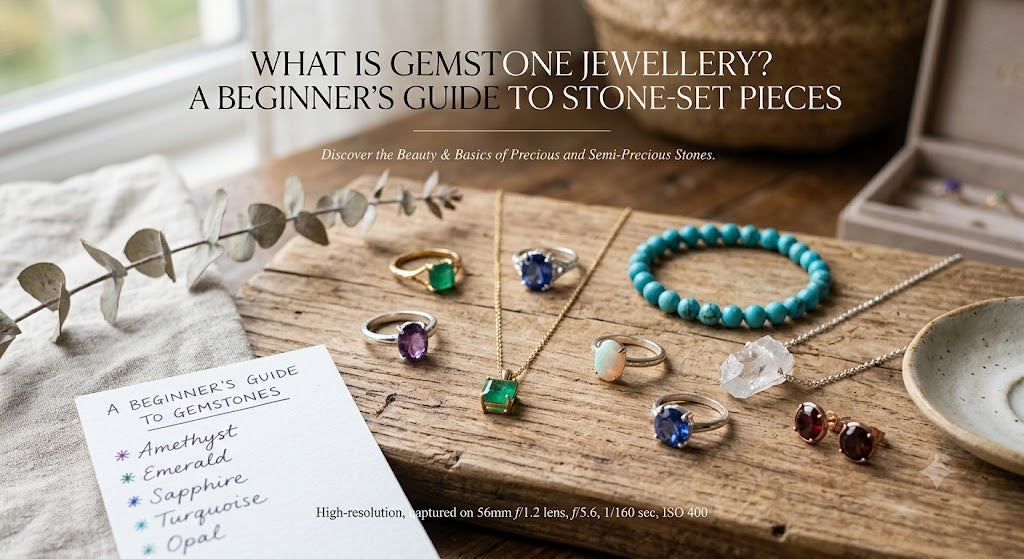
 Pick up ten different pieces marketed as "gemstone jewellery" and there's a real chance you're holding ten different things: a couple of genuine mined minerals, one lab-grown stone that's chemically identical to its natural counterpart, and several pieces of coloured glass or crystal doing a convincing impression of all three. Nobody explains this at the point of sale, and it's a big part of why gemstone jewellery confuses first-time buyers more than almost any other jewellery category. This guide untangles it: what actually counts as a gemstone, how the natural-vs-synthetic-vs-simulant distinction works, and how all of this plays out differently depending on whether you're shopping for fine jewellery or fashion jewellery.
What Actually Counts as a "Gemstone"
A gemstone is a mineral, rock, or organic material that's been cut and polished specifically because of its beauty, durability, and relative rarity, then set into a piece of jewellery. That definition covers a lot of ground: traditional minerals like amethyst and garnet, organic materials like pearl and amber that aren't minerals at all but are still classified as gemstones, and even certain rocks, like lapis lazuli, that are made of multiple minerals combined rather than a single crystal type. What unites all of them isn't chemistry — it's that they're durable and attractive enough to be worn, and rare or distinctive enough to be valued.
Gemstone jewellery, then, is simply jewellery built around this category of material as its central feature, rather than treating the metal setting as the main visual element. A gold ring is metal jewellery; a gold ring with an amethyst set into it is gemstone jewellery, because the stone is doing the visual work the metal is supporting.
Precious vs. Semi-Precious: A Distinction Worth Understanding (and Questioning)

Traditionally, gemstones are divided into two categories: precious stones — diamond, ruby, sapphire, and emerald — and semi-precious stones, a much larger category covering everything else: amethyst, citrine, garnet, topaz, aquamarine, peridot, moonstone, turquoise, and dozens more.
This distinction is worth knowing because you'll see it everywhere, but it's also worth understanding its limits. The precious/semi-precious split is a historical convention rather than a strict measure of value or quality — some stones classified as "semi-precious," like tanzanite or fine Paraiba tourmaline, can be significantly rarer and more expensive than lower-quality examples of the four "precious" stones. Many gemologists today treat the distinction as more marketing shorthand than a meaningful technical category, even though it remains the term most buyers encounter.
Natural, Synthetic, and Simulant: The Category Buyers Actually Need to Understand
This is the distinction that matters far more than precious-versus-semi-precious when you're actually buying gemstone jewellery, and it's covered in full depth in our guide to natural versus synthetic gemstones. In brief:
-
Natural gemstones are mined from the earth, formed by geological processes over long periods of time, with no human involvement in their creation.
-
Synthetic (lab-grown) gemstones are chemically and structurally identical to their natural counterparts, but grown in a controlled laboratory environment rather than the earth — a lab-grown ruby is still genuinely a ruby, just not a mined one.
-
Simulants are materials designed to visually resemble a gemstone without sharing its chemical composition — coloured glass, cubic zirconia, or crystal used to imitate the look of a genuine stone at a fraction of the cost.
All three can look convincing to the untrained eye, which is exactly why understanding this distinction matters before you buy, not after.
How Gemstones Are Set
The way a stone is secured into a piece affects both how it looks and how durable that setting is over time:
-
Prong settings hold a stone with small metal claws, leaving most of the stone visible and allowing maximum light to pass through it — the standard for fine jewellery centre stones.
-
Bezel settings surround the stone with a continuous metal rim, offering more protection for softer or more fragile stones at the cost of slightly less visible surface area.
-
Pavé settings use many small stones set closely together with minimal metal showing between them, creating a continuous sparkle effect.
-
Glue-set or bonded settings, common in accessible fashion jewellery, secure a stone using adhesive rather than a mechanical clasp — a faster, less expensive method that works well for lighter daily-wear pieces but generally isn't intended to hold up to the same physical stress as a prong or bezel setting.
Gemstone Jewellery: Fine Jewellery vs. Fashion Jewellery

This is worth being direct about, in the same spirit as our guides to Kundan and Mughal Kundan jewellery: genuine, natural-gemstone fine jewellery — set in solid gold, using prong or bezel settings built to last generations — sits at a price point that reflects the rarity of the stone and the metal itself. What's widely available under the "gemstone jewellery" name in the fashion and everyday jewellery space is often a different thing entirely: pieces built around semi-precious natural stones, synthetic stones, or glass and crystal simulants, set in gold-plated base metal rather than solid gold, designed to bring the colour and character of gemstones into everyday and festive wear at a fraction of fine-jewellery pricing.
Neither category is more "legitimate" than the other for its own purpose. Fine gemstone jewellery is a long-term investment piece; fashion gemstone jewellery makes colour, variety, and the visual appeal of natural stone tones accessible without that price tag. What matters is knowing which one you're shopping for, since durability, care requirements, and resale expectations differ substantially between the two.
Popular Gemstones in Fashion Jewellery Today
Certain stones show up disproportionately often in accessible, everyday gemstone jewellery, largely because their colour and character read well without needing flawless clarity or investment-grade size:
-
Rose quartz — a soft pink stone associated with warmth and simplicity, one of the most widely used stones in everyday fashion pieces.
-
Amethyst — a purple quartz variety ranging from pale lilac to deep violet, popular for both its colour range and relative affordability.
-
Citrine — a warm yellow-to-amber stone, often used as an accessible alternative to yellow sapphire or topaz.
-
Garnet — most commonly seen in deep red tones, though it occurs naturally in a wide range of colours beyond red.
-
Moonstone — prized for its subtle, glowing sheen (known as adularescence) rather than a single fixed colour.
-
Labradorite — a grey-toned stone known for flashes of blue, green, or gold that shift depending on the angle it's viewed from.
-
Turquoise — an opaque blue-green stone with a long history across multiple cultures' jewellery traditions.
-
Agate — a banded, often multicoloured stone frequently sliced to show its natural layered pattern, popular in more contemporary, nature-inspired jewellery design.
This range of texture and colour is part of what makes gemstone jewellery distinct from plain metal or Kundan-style pieces — the stone itself, not just the setting, carries the design.
What to Consider When Choosing Gemstone Jewellery
A few factors are worth weighing before buying a specific piece:
-
Colour against skin tone. Certain stone tones read differently depending on skin undertone — a topic covered in full in our guide to choosing gemstone jewellery for your skin tone.
-
Personal or birth-month significance. Many buyers choose a stone tied to their birth month or a personal milestone — covered separately in our birthstone jewellery guide.
-
Occasion and durability needs. A piece meant for daily wear benefits from a more durable stone and setting than one reserved for occasional festive use.
Basic Care Overview
Gemstone jewellery generally needs more careful handling than plain metal pieces, since many stones are softer or more prone to clouding than gold or silver. Keeping pieces away from direct perfume or lotion contact, storing them separately to avoid scratching, and wiping them down after wear all go a long way — full guidance is available in how to care for gemstone jewellery and our existing gemstone ring care guide.
Frequently Asked Questions
What's the difference between a gemstone and a crystal?
In casual use, the terms overlap significantly. Technically, "gemstone" implies a mineral (or organic material) that's been cut and polished for jewellery use, while "crystal" can refer more broadly to a mineral's natural structure, whether or not it's ever set into jewellery.
Is semi-precious jewellery lower quality than precious jewellery?
Not necessarily. The precious/semi-precious split is a traditional category rather than a strict quality measure — some semi-precious stones are rarer and more valuable than lower-grade examples of the four traditionally "precious" stones.
How can I tell if a gemstone is natural, synthetic, or a simulant?
Without professional testing, it's genuinely difficult to tell by eye alone, especially with high-quality synthetics. Price, seller transparency, and documentation are generally more reliable indicators than visual inspection for anything beyond an obvious simulant.
Is fashion gemstone jewellery "fake" gemstone jewellery?
Not in a deceptive sense, as long as it's marketed honestly. Much of it uses genuine semi-precious stones set in gold-plated metal rather than solid gold — a more accessible category built for everyday wear rather than an attempt to pass as fine jewellery.
Gemstone-set pieces are available within the Stone Age collection.