Cart
0
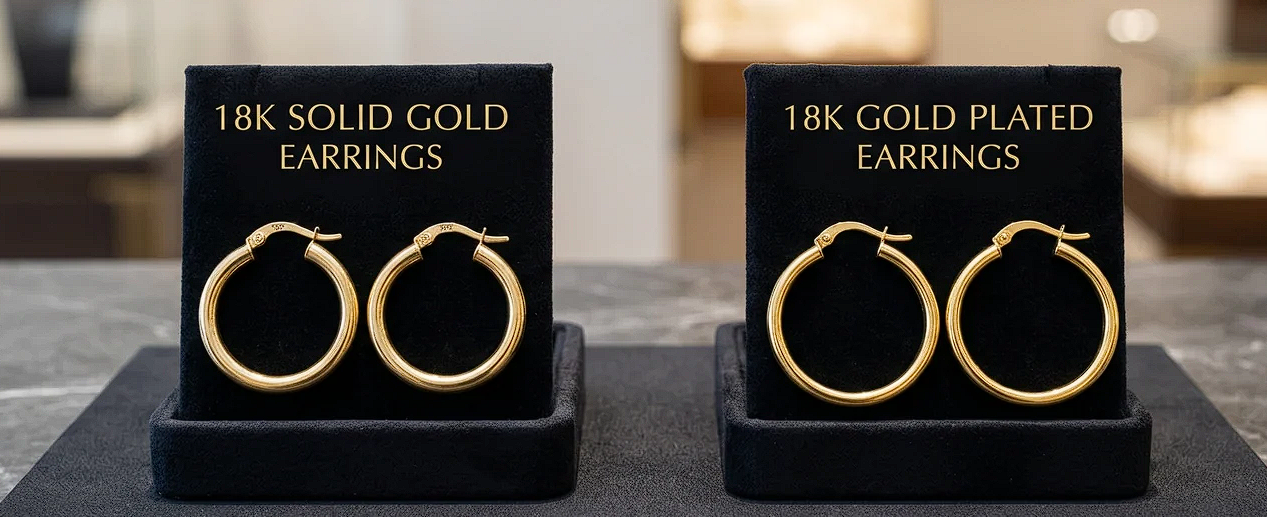
Neither option is objectively "better" — that framing is more useful to whoever is selling you the more expensive one than it is to you. The actual question worth asking is which one fits how you actually wear earrings: how often, for how long, and whether you want one investment piece or a rotation of several.

This guide compares gold-plated and solid gold earrings honestly, across the factors that actually affect the buying decision — durability, cost, weight, and skin comfort — so you can match the choice to your own habits rather than to a general assumption that one is always the right answer.
Quick Definitions
-
Gold-plated: a base metal — typically brass or a lightweight alloy — coated with a layer of gold through electroplating. For the full breakdown of how this process works and what affects its durability, see our guide on what gold plating is.
-
Solid gold: a piece made entirely from a gold alloy, with no base metal underneath. Solid gold jewellery is virtually never pure 24-karat gold, since pure gold is too soft for daily wear — 14k and 18k are the most common alloys, mixing gold with metals like copper, silver, or zinc for added strength.
-
Gold vermeil and gold-filled: two terms you may come across while shopping, worth knowing even if they're not the two options being compared here. Gold vermeil uses a sterling silver base rather than brass, coated in a gold layer. Gold-filled jewellery uses a thicker, pressure-bonded gold layer rather than an electroplated one. Both sit somewhere between plated and solid gold in terms of cost and durability.
Side-by-Side Comparison

|
Gold-Plated |
Solid Gold |
|
|
Composition |
Base metal with a gold-plated surface layer |
Gold alloy throughout |
|
Typical weight |
Lighter |
Heavier at equivalent size |
|
Upfront cost |
Lower |
Significantly higher |
|
Durability over years |
Plating wears with exposure and handling |
Doesn't wear through, since there's no surface layer to lose |
|
Care requirements |
Keep dry, avoid prolonged chemical contact |
More tolerant of daily conditions, though still benefits from basic care |
|
Best suited to |
Building a varied, frequently-changing collection |
A long-term piece worn selectively or as an investment |
|
Resale/heirloom value |
Minimal |
Retains material value over time |
Durability: What Actually Happens Over Time
This is the area where the difference is real and worth being direct about. Gold plating is a surface finish — over time, especially with frequent wear, exposure to moisture, and contact with skincare or perfume, the plating gradually thins and can eventually reveal the base metal underneath. How quickly this happens varies significantly based on the thickness of the plating, the base metal used, and how the piece is cared for — there's no single fixed timeline that applies to every gold-plated piece.
Solid gold doesn't have this issue, since there's no plated layer to wear through. A solid gold piece can show scratches or need occasional polishing over decades of wear, but it won't reveal a different metal underneath the way a plated piece eventually can.
Where this matters most is in how a piece is actually used. A ring worn every single day for years puts sustained pressure on any plated surface. An earring worn a few times a week, rotated with other pairs, experiences meaningfully less cumulative wear — which is part of why plated jewellery performs differently across categories, not just across brands.
Cost: Why the Price Gap Exists
The price difference between gold-plated and solid gold isn't arbitrary — it reflects the actual amount of gold used. A solid gold piece uses a gold alloy for its entire structure; a gold-plated piece uses a thin surface layer over a base metal that costs a fraction as much. With gold prices what they are, that difference compounds significantly across a full piece of jewellery, which is exactly why gold-plated fashion jewellery exists as a category: it makes the gold aesthetic accessible without the full material cost.
This isn't a compromise dressed up as a feature — it's a legitimate value proposition for anyone who wants variety, current styles, or a piece for occasional wear, rather than a single, precious, decades-long investment.
Weight and Comfort
This is where gold-plated construction has a genuine practical advantage, not just a cost one. A gold-plated earring is generally lighter than a solid gold piece of the same size, since the base metal underneath the plating is less dense than a gold alloy. This is part of why larger, bolder designs are more comfortable to wear in gold-plated construction than they would be in solid gold — the visual scale doesn't come with equivalent weight. Our lightweight earrings collection is built specifically around this advantage.
Skin Sensitivity Considerations

Skin reactions to jewellery usually come down to the base metal rather than the gold itself. Solid gold, being a single alloy throughout, has a more predictable and generally well-tolerated composition. Gold-plated jewellery's skin tolerance depends on the base metal underneath the plating, which varies by product — if you have known metal sensitivities, checking the specific base metal before buying any plated piece is worth doing regardless of brand.
Which Should You Actually Buy?
-
If you want one piece to last decades and don't mind the higher upfront cost, solid gold is the more straightforward choice — there's no plating to maintain or eventually replace.
-
If you want to build a varied earring rotation across different styles, occasions, and trends, gold-plated makes that realistic in a way that buying multiple solid gold pieces generally doesn't, budget-wise.
-
If comfort and lightness matter more than material permanence, gold-plated construction has a real practical edge, particularly for larger or bolder designs.
-
If you're buying for occasional or seasonal wear rather than daily rotation, gold-plated pieces see proportionally less cumulative wear, which narrows the practical durability gap for that specific use case.
Neither answer is universally correct — it depends on whether you're optimising for longevity of a single piece or versatility across many.
Common Myths, Addressed

"Gold-plated isn't real gold." It is — just a thinner layer of it, on top of a different metal. The gold used in plating is real; there's simply less of it than in a solid piece.
"Solid gold never needs any care." It needs less specific care than plated jewellery, but it still benefits from occasional cleaning and thoughtful storage. "Low maintenance" isn't the same as "no maintenance."
"Plated jewellery is always low quality." Quality varies enormously within the plated category, based on the thickness of the gold layer, the base metal, and the plating process — the same way quality varies across price points in almost any product category.
FAQs
Is gold-plated jewellery real gold?
Yes — it uses genuine gold, applied as a thinner surface layer over a base metal, rather than gold running through the entire piece.
How long does gold-plated jewellery last?
It varies significantly based on plating thickness, base metal, and how the piece is worn and cared for. There's no single fixed timeline that applies across all gold-plated jewellery.
Is solid gold worth the extra cost?
For a piece you plan to wear for years or decades without replacing, generally yes. For a varied, frequently rotated collection, the cost difference is harder to justify per piece.
Which is better for sensitive skin, gold-plated or solid gold?
Solid gold tends to be more predictably tolerated, since it's a single alloy throughout. Gold-plated jewellery's skin tolerance depends on the specific base metal used, which varies by product.
Can gold-plated earrings look as good as solid gold ones?
Visually, yes — a well-made gold-plated piece is difficult to distinguish from solid gold by appearance alone. The difference shows up over time, in how the surface wears, not in initial appearance.
Should I buy gold-plated or solid gold for daily wear?
This depends more on the specific piece and how it's cared for than on a blanket rule. A well-made, well-cared-for gold-plated piece can perform well in daily rotation, particularly when it's one of several pairs rather than worn continuously without a break.
Explore the full range built around this construction in our lightweight earrings and gold-plated earrings collections at Mine of Design.