Cart
0

Handmade rings benefit from slightly more deliberate care than mass-produced pieces, for a specific reason: hand-set stones and hand-finished joints vary from piece to piece rather than being uniformly reinforced the way a machine-cast ring's construction is. A quick visual check before wearing, gentle cleaning, and material-aware handling all matter more here than they would for a standard, identically-produced ring.
This guide covers what's actually different about caring for handmade construction, how to clean a handmade ring safely, and how to handle pieces that combine multiple materials in one design.
Why Handmade Rings Need Slightly Different Care
Hand-set stones are more delicate than machine-mounted ones — a stone individually pressed and secured by hand can be more prone to loosening from an impact than one mounted by a calibrated machine setting
Joints and connection points vary piece to piece — since each ring is finished individually, the strength of a solder joint or a set stone isn't uniform the way it is across a production run of identical cast pieces
A single piece often combines multiple materials — metal, a semi-precious stone, sometimes pearl or moti detailing — each of which has different care needs, meaning one ring can genuinely require more than one type of attention
The Pre-Wear Inspection Habit
This is worth building into your routine, and it's the detail most jewellery care guides skip entirely: before putting on a handmade ring, take a quick look at the setting and any connection points for signs of stress — a slightly shifted stone, a joint that looks different than it did last time you wore it. Catching this early, before the piece is worn through a full day of activity, meaningfully reduces the risk of losing a stone or damaging a joint further.
Cleaning a Handmade Ring Safely

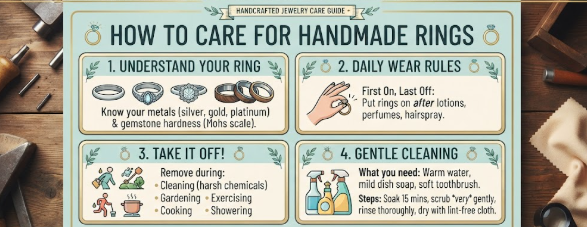
Use a soft, dry or barely damp cloth for routine cleaning — sufficient for most day-to-day maintenance
Avoid vinegar-based cleaning, despite it being a commonly recommended household trick for brass and metal jewellery — it's genuinely unsuitable for gold-plated pieces or anything with a set stone, and can damage the finish
Avoid ultrasonic cleaners for two separate reasons specific to handmade rings: the vibration can loosen a hand-set stone, and the process can accelerate wear on any gold-plated surface — a combination that makes ultrasonic cleaning a particularly poor fit for handmade, gold-plated, stone-set pieces specifically. We cover this in more general terms in our guide on how to care for gold-plated earrings, and the same logic applies here.
Skip harsh soaps and chemical jewellery cleaners — lukewarm water and a soft cloth, followed by thorough drying, is the safer approach
Caring for Hand-Set Stones Specifically
Avoid knocking the stone against hard surfaces — a hand-set stone can loosen more easily than a machine-mounted one after repeated impact
Remove the ring before activities involving repeated hand contact with hard surfaces heavy manual work, certain sports, or anything that puts the setting at risk
Check the setting periodically, particularly after any noticeable knock, rather than waiting until a stone is visibly loose or missing
If Your Ring Includes Pearl or Moti Elements
Pearls are considerably softer than most metals and stones — roughly a 2.5 to 4.5 on the Mohs hardness scale, compared to most metals and gemstones — which makes them vulnerable to scratching from harder materials worn or stored alongside them. Store pearl-detailed rings separately from other pieces, and avoid submerging them in water. Our guide on moti and pearl jewellery covers this in more depth.
Storage: Environment Matters More Than Expected
Avoid direct sunlight and extreme temperature swings in your storage area — both can affect metal and stone finishes over time
Let a ring acclimate to room temperature before handling if it's been stored somewhere notably colder or warmer, since sudden temperature shifts can stress certain stone settings
Store separately from other jewellery to prevent scratching, particularly important for textured or hand-finished surfaces that show scratches more visibly than a smooth, polished one
Natural Patina and Variation: Character, Not a Flaw

Handmade pieces, particularly those using brass or similar metals, often develop a natural patina over time — a subtle darkening or shift in tone that comes from genuine wear and handling. This is expected with handmade construction, not a defect, and it's part of what gives a handmade piece its individual character over years of wear. If you prefer a brighter, more uniform look, a gentle polishing cloth can restore the original finish; if you like the character it adds, there's no need to do anything at all.
When to Take It to a Jeweller
If a stone feels loose, a joint looks visibly different from when you bought the piece, or a clasp or connection point seems weaker than it should, it's worth removing the ring and having it checked rather than continuing to wear it and risking further damage or loss. This is a reasonable, normal part of owning handmade jewellery over time, not a sign that something was wrong with the piece from the start.
FAQs
Do handmade rings need different care than machine-made rings?
Yes, slightly — hand-set stones and hand-finished joints vary piece to piece, so a bit more deliberate handling and periodic inspection helps more than it would with a uniformly machine-cast ring.
Can I use vinegar to clean a handmade ring?
It's best avoided, particularly for gold-plated pieces or anything with a set stone — vinegar can damage the finish despite being a commonly recommended household cleaning trick for plain metal.
Are ultrasonic cleaners safe for handmade rings?
Generally not recommended — the vibration can loosen a hand-set stone, and it can also accelerate wear on any gold-plated surface.
Why does my handmade ring look different than when I bought it?
Some natural patina or tone shift over time is expected with handmade pieces, particularly in brass or similar metals, and is generally considered character rather than damage. It can be polished away if you prefer a brighter finish.
How should I store a ring with pearl or moti detailing?
Store it separately from other jewellery, since pearls are considerably softer than most metals and stones and can scratch easily from contact with harder materials.
When should I take a handmade ring to a jeweller?
If a stone feels loose, a joint looks different than it used to, or a setting seems weaker than expected — it's worth having it checked before continuing to wear it.
Explore artisan pieces built to last in our Handmade Rings collection at Mine of Design.