Cart
0
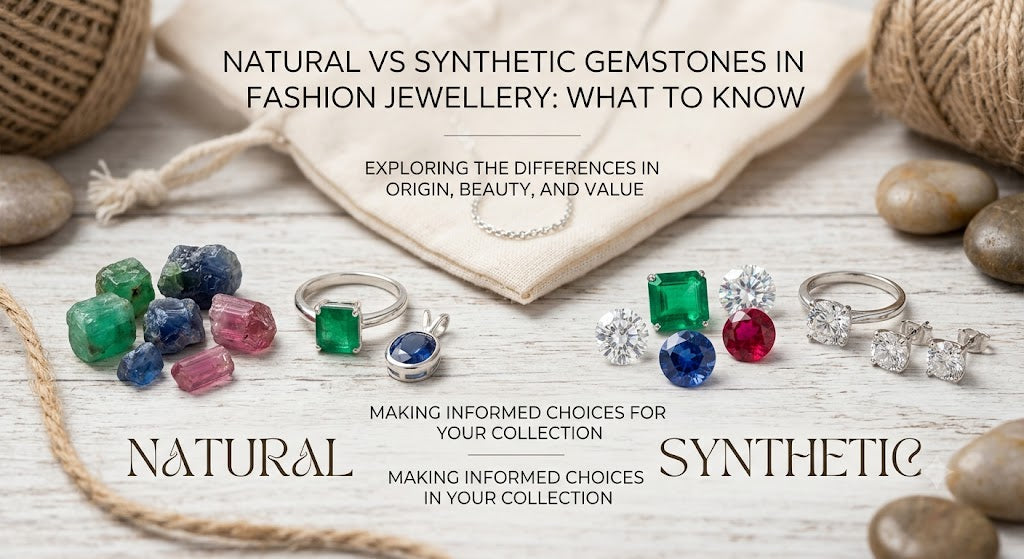
 The word "gemstone" on a product listing tells you almost nothing about what's actually in the piece. It could be a genuinely mined mineral, a lab-grown stone with the exact same chemistry, or a piece of coloured glass shaped to look the part — and at fashion-jewellery prices, all three show up constantly, often without much distinction made between them. Understanding the difference isn't about chasing investment value the way a fine-jewellery buyer might; it's about knowing what you're actually paying for, how durable it's likely to be, and how to read a listing that doesn't spell it out.
The Three Categories, Defined Simply
-
Natural gemstones are minerals (or organic materials, in the case of pearl or amber) formed by geological or biological processes with no human involvement, then cut and polished for use in jewellery.
-
Synthetic gemstones — also called lab-grown or lab-created — share the exact same chemical composition and crystal structure as their natural counterpart. A lab-grown ruby is still, chemically and structurally, a ruby; it's simply grown in a controlled laboratory environment instead of formed underground over geological time.
-
Simulants are materials that imitate a gemstone's appearance without sharing its composition at all — glass, crystal, acrylic, or cubic zirconia shaped and coloured to resemble a specific stone.
The distinction that trips people up most often is natural versus synthetic, since both are genuinely the real mineral — the difference is entirely about origin, not authenticity of material.
Natural Gemstones in Fashion Jewellery

Certain natural stones are common even in accessible, everyday fashion jewellery, precisely because they're abundant enough to be affordable without needing lab cultivation: rose quartz, amethyst, citrine, garnet, and agate are among the more frequently used natural stones at fashion price points. These stones typically show small natural variations — slight differences in tone, minor inclusions, subtle asymmetry — that are a normal feature of a genuinely mined stone rather than a flaw.
Synthetic Gemstones in Fashion Jewellery
 Lab-grown stones show up less often at the most accessible end of fashion jewellery, largely because the stones most commonly synthesised — sapphire, ruby, emerald — are naturally pricier to begin with, so a lab-grown version still sits at a higher production cost than a common natural stone like quartz or garnet. When synthetic stones do appear in fashion jewellery, they're usually chosen specifically to bring a more expensive-looking stone (a rich sapphire blue, for instance) into a lower price bracket than a natural stone of that type would allow, while still being the genuine mineral rather than an imitation.
Simulants in Fashion Jewellery
This is the category most common at the lower end of the fashion jewellery price range: glass, crystal, and cubic zirconia are widely used to replicate the look of natural or synthetic stones at a fraction of the cost. This isn't inherently deceptive — a simulant marketed honestly as "crystal" or "stone-effect" is doing exactly what it claims to do — but it becomes a problem when a simulant is marketed using language that implies genuine mineral content without actually stating it.
Why This Distinction Matters for Fashion Jewellery Specifically
Unlike fine jewellery, where natural-versus-synthetic often comes down to investment value and resale, the practical stakes in fashion jewellery are more immediate:
-
Durability. Natural and synthetic gemstones generally hold up better to daily wear than glass or acrylic simulants, which are more prone to scratching and clouding over time.
-
Price expectations. Knowing which category a stone falls into helps calibrate what a fair price actually looks like — a "gemstone" piece priced like a simulant probably is one, regardless of how the listing describes it.
-
Care requirements. Natural and synthetic stones typically need the same basic care; simulants, especially glass and acrylic ones, are often more sensitive to moisture, heat, and rough handling.
How to Tell What You're Actually Buying
A few practical checks help clarify what's in a piece before you buy:
-
Read the listing language closely. Terms like "natural stone," "genuine gemstone," or a specific mineral name (amethyst, garnet, rose quartz) generally indicate a real mineral. Vaguer terms like "crystal," "stone-effect," or "gem-inspired" more often signal a simulant.
-
Check the price against the stone claimed. A "genuine sapphire" priced at a few hundred rupees is a red flag; natural or synthetic sapphire, even in fashion jewellery, carries a materials cost that doesn't disappear at scale.
-
Look for natural variation in listing photos. Slight colour or clarity differences between photographed pieces of the "same" stone often indicate natural material, since natural stones vary piece to piece in a way manufactured simulants typically don't.
-
When in doubt, ask the seller directly. A seller confident in their materials will generally answer a direct question about whether a stone is natural, synthetic, or a simulant without hedging.
A Note on Ethics and Sourcing
Natural gemstone mining carries environmental and social considerations that vary significantly by stone, mine, and region — a topic too broad to summarise briefly and honestly here. Lab-grown and simulant stones are generally associated with a lower environmental footprint than mined stones, simply by avoiding large-scale extraction, though the manufacturing processes involved carry their own resource costs. This is worth factoring into a purchase decision alongside price and durability, particularly for buyers who weigh sourcing as part of what they're willing to pay for.
Frequently Asked Questions
Is a synthetic gemstone "fake"?
No — a synthetic gemstone is the genuine mineral, chemically and structurally identical to its natural counterpart, just grown in a lab rather than mined. A simulant, which imitates the look using an entirely different material, is the closer fit for what most people mean by "fake."
Can you tell a synthetic gemstone from a natural one by looking at it?
Usually not reliably without professional equipment. Because synthetic stones share the same physical and optical properties as natural ones, the difference is typically identified through inclusions and growth patterns under magnification rather than the naked eye.
Are simulants always bad value?
Not necessarily — a simulant marketed honestly, at a price that reflects what it actually is, can be a reasonable, affordable way to get a colour or look without paying for genuine mineral content. The issue is only when a simulant is priced or described as though it's natural or synthetic.
Does fashion jewellery mostly use natural or synthetic gemstones?
It varies, but common, affordable natural stones (rose quartz, amethyst, garnet, citrine) and simulants (glass, crystal, cubic zirconia) are both more common than lab-grown synthetics at the most accessible fashion price points, since synthetics are typically used to replicate pricier natural stones.
Gemstone-set pieces are available within the Stone Age collection.