Cart
0
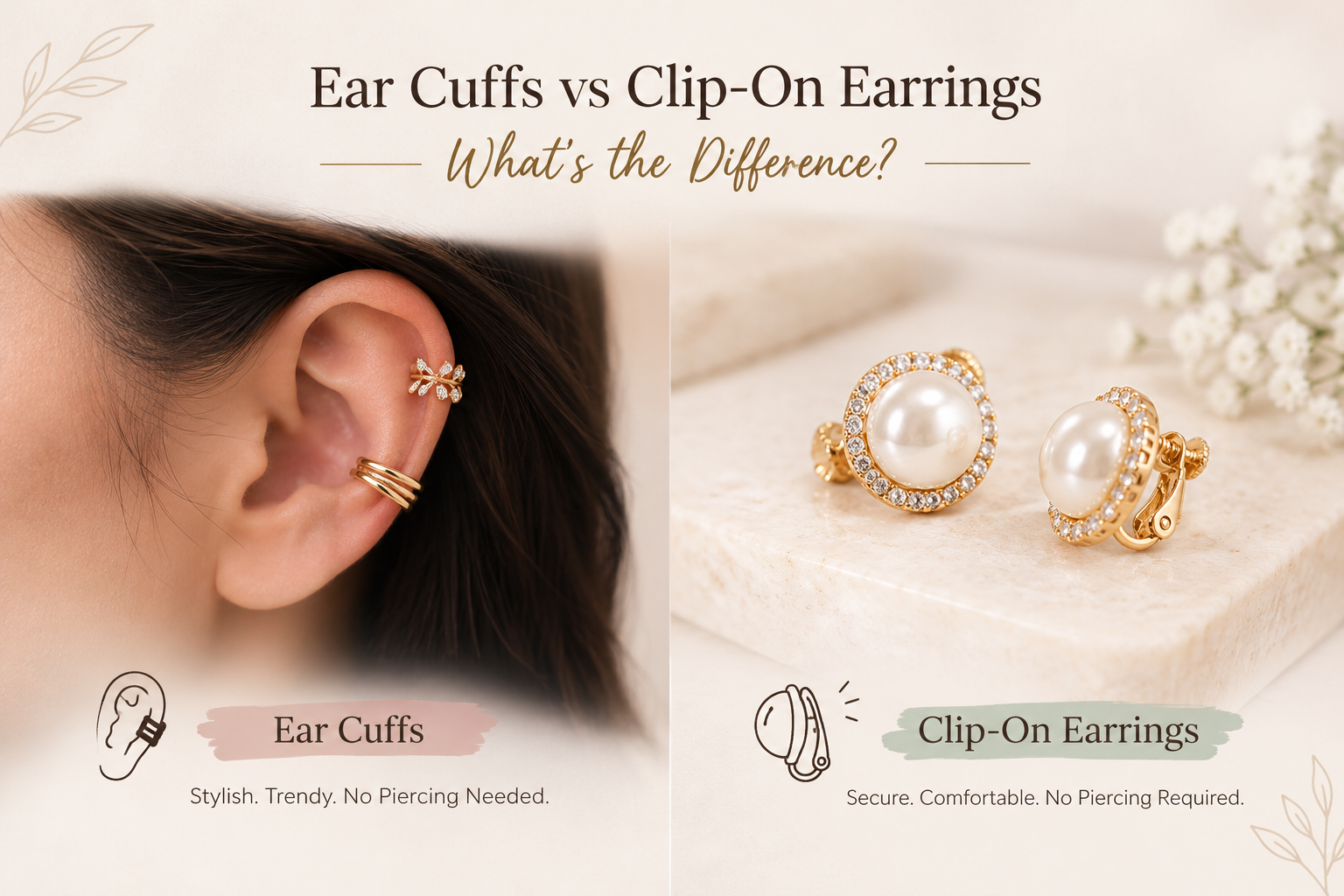

An ear cuff grips the cartilage on the outer ear using open-band tension; a clip-on earring clamps onto the soft earlobe using a hinge, screw-back, or spring clip. Both are piercing-free ways to wear earrings, but they solve the problem on two different parts of the ear using two different mechanisms — and that mechanism difference is what drives every other distinction between them: comfort, how long they stay secure, and what they actually look like on.
The Core Mechanism Difference
An ear cuff has a small open gap in its band. That gap is squeezed slightly onto the cartilage, and the metal's own spring-back tension holds it there — no clamp, no hinge, just fit against a firmer part of the ear.
A clip-on earring works differently: it's a separate mechanical piece — typically a spring hinge, a screw-back, or an omega-style clip — that closes around the soft, pinchable part of the lobe. The earring's entire weight hangs from that pinched fold of skin, rather than resting against a stiffer cartilage structure.
A Naming Overlap Worth Clarifying
You'll sometimes see tension-based ear cuffs marketed as "clip-on ear cuffs." That's a naming overlap, not a shared mechanism — a cuff described this way still works through cartilage tension, not through the hinge-and-clamp mechanism a true clip-on earring uses on the lobe. If a product description calls something a "clip-on" but shows it worn on the upper ear rather than the lobe, it's almost certainly a cuff using loose terminology rather than an actual clip-on.
Comfort Compared
Cartilage is firmer and less sensitive to pressure than the soft tissue of the lobe, which generally makes a well-fitted ear cuff more comfortable over several hours than a clip-on of equivalent weight. A clip-on's comfort depends heavily on two things working together — the strength of its clip and how much the earring weighs — because the entire piece hangs from pinched skin rather than resting against firmer cartilage. A heavier clip-on needs a stronger clip to stay comfortable, while a lightweight ear cuff has more room for error on tension alone.
Security Compared
Neither style is automatically more secure than the other — both come down to fit. A clip-on's hinge or screw mechanism, once adjusted correctly, tends to hold consistently because it's a fixed closing force rather than variable tension. An ear cuff's security depends on matching band tension to that specific ear's cartilage thickness, which is why cuffs occasionally need adjustment after the first wear — the placement and fit techniques covered in how to wear an ear cuff without it slipping off apply directly here.
Placement and Look
This is the most visible difference between the two. A clip-on sits exactly where a traditional pierced earring would — on the lobe — and is built to look identical to pierced jewellery from a distance. An ear cuff sits higher, on the helix or conch, and creates the look of a cartilage piercing rather than a lobe one. This placement difference is also why the two aren't really interchangeable for the same look: choosing between them isn't just a comfort or mechanism decision, it's a decision about which part of the ear you want jewellery on.
Which to Choose

-
Want the classic look of a pierced lobe earring, without a piercing: a clip-on is the direct equivalent — same placement, same visual effect as a traditional stud or drop.
-
Want the look of a cartilage or helix piercing: an ear cuff is the only option of the two that sits in that position.
-
Want a fuller, layered "curated ear" look: ear cuffs are generally easier to stack or combine with existing lobe piercings, since multiple cuffs can sit at different points along the cartilage.
-
Prioritising all-day comfort for a heavier design: an ear cuff of equivalent weight is usually the more comfortable option, since it rests against cartilage rather than pinching lobe skin.
Can They Be Worn Together?

Yes—a single ear cuff on the cartilage paired with a clip-on or a genuine stud in the lobe is one of the more common ways to build a fuller ear look without a single piercing anywhere. Because the two sit on different parts of the ear and use different mechanisms, wearing both at once doesn't create the fit conflict that, say, stacking two lobe clip-ons would.
Quick Comparison
|
Ear Cuff |
Clip-On Earring |
|
|
Mechanism |
Open-band tension |
Hinge, screw-back, or spring clip |
|
Placement |
Cartilage (helix, conch) |
Earlobe |
|
Comfort over time |
Generally better for lighter to medium weight |
Depends on clip strength vs. earring weight |
|
Look |
Mimics a cartilage piercing |
Mimics a lobe piercing |
|
Layering |
Easy to stack or combine with lobe jewellery |
Can be combined with a cartilage cuff |
Frequently Asked Questions
Is an ear cuff the same as a clip-on earring?
No — they use different mechanisms on different parts of the ear. An ear cuff grips the cartilage through band tension; a clip-on clamps onto the earlobe using a hinge or screw mechanism.
Which is more comfortable for all-day wear?
Generally, a well-fitted ear cuff, since it rests against firmer cartilage rather than pinching the softer skin of the lobe — though a lightweight, well-adjusted clip-on can be just as comfortable.
Can I wear an ear cuff and a clip-on at the same time?
Yes—since they sit on different parts of the ear and use different mechanisms, the two can be layered together without interfering with each other.
Why do some ear cuffs get called "clip-on ear cuffs"?
It's a naming overlap rather than a shared mechanism — the product is still a tension-based cuff worn on the cartilage, not a hinge-based clip-on worn on the lobe.
Both cartilage-friendly and lobe-style piercing-free options sit within the ear cuffs collection.