Cart
0
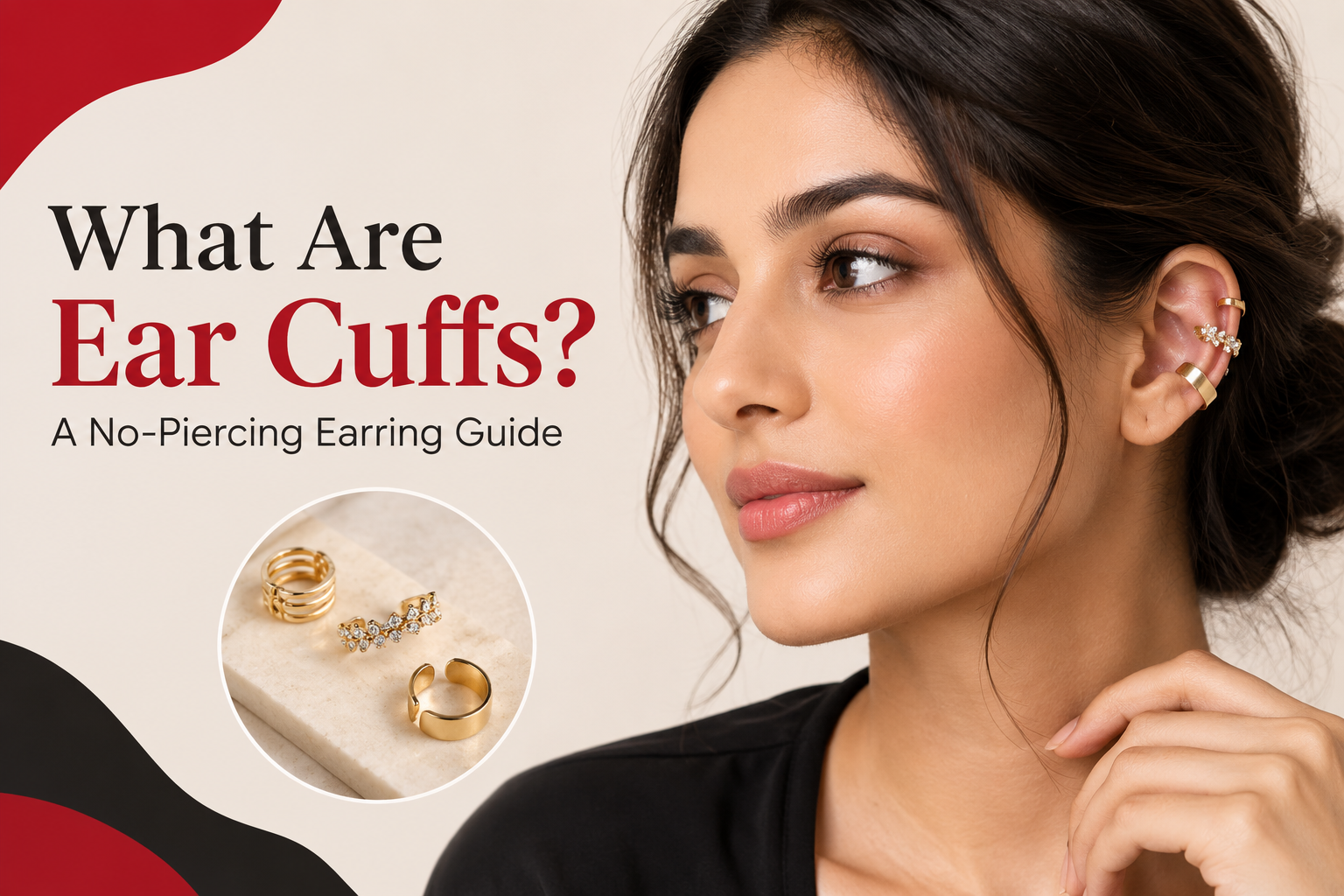

An ear cuff is a piece of jewellery that wraps or clips onto the outer ear using gentle pressure, rather than passing through a pierced hole. It has no post and doesn't require a piercing to wear — the cuff's own tension against the cartilage or lobe is what holds it in place. This is the feature that separates an ear cuff from every other earring category: studs, hoops, and drops all rely on a piercing; an ear cuff relies on fit.
How Ear Cuffs Work
Most ear cuffs are built around a small open gap in the metal band. That gap is squeezed slightly to slide the cuff onto the ear, and the band's own spring-back tension is what grips the cartilage or lobe once it's in position — the same basic mechanism as a spring clip, scaled down to fit the shape of an ear. No hole, adhesive, or piercing is involved; the cuff stays on purely through fit and pressure.
This tension-based design is different from a clip-on earring, which uses a hinged clip mechanism rather than open-band tension, and different again from a chained connector cuff, which does rely on an existing lobe piercing to anchor one end of the piece. The cuffs covered in this guide are the fully piercing-free kind.
Types of Ear Cuffs

Ear cuffs are generally classified by where on the ear they sit and how they're structured:
-
Helix or cartilage cuffs — the most common type, worn on the upper-outer rim of the ear (the helix). These sit highest on the ear and are usually the easiest entry point for a first ear cuff.
-
Conch cuffs — worn on the wider, mid-ear cartilage (the conch). Because this part of the ear is broader, conch cuffs tend to be thicker and more ornate than helix cuffs, and read as more of a statement piece.
-
Wrap-around cuffs — a single band that hugs the outer curve of the ear, distributing pressure evenly along its length rather than at one point.
-
Double-band cuffs — two connected bands worn together for a fuller, more layered look on the ear without stacking multiple separate pieces.
-
Crawler cuffs — designed to travel up the helix in a line, giving the visual effect of several piercings along the ear's edge from a single piece.
-
Lobe cuffs — wrap around or cover the earlobe itself rather than the cartilage, built for anyone who wants ear jewellery without a lobe piercing specifically.
-
Chained connector cuffs — a cartilage cuff linked by a fine chain to a stud or drop worn in the lobe; unlike the styles above, this type does require an existing lobe piercing to anchor the connected end.
Who Ear Cuffs Are For
Ear cuffs solve a specific problem: wanting the look of a cartilage or extra-ear piercing without committing to one. That makes them a practical option for a few overlapping groups — anyone with unpierced ears who still wants ear jewellery, anyone with a healing piercing who wants to wear something in the meantime without irritating it, and anyone who simply wants to test a placement or style before deciding whether to get it pierced for real.
Ear Cuffs vs. Traditional Earrings

Because an ear cuff doesn't rely on a piercing, it can be repositioned, swapped, or removed without any of the healing time or commitment that comes with hoop or stud placements. That flexibility is also what makes ear cuffs popular for layered "ear party" looks — a cuff worn on the helix alongside a small hoop or stud in the lobe builds a fuller, more curated look on one ear without adding a single new piercing.
What to Look for When Buying
-
Band tension. The gap should be snug enough to grip without pinching — too loose and the cuff slides, too tight and it becomes uncomfortable over a few hours.
-
Weight. A lighter cuff is generally more comfortable for extended wear, particularly on thinner or more sensitive cartilage.
-
Finish. Gold-plated and oxidised finishes are the most common for ear cuffs and follow the same care principles as any other plated jewellery — see caring for gold-plated earrings for general upkeep.
Anyone with a history of reacting to certain metals should review general guidance on earrings for sensitive ears before choosing a cuff, since the cartilage stays in prolonged contact with the metal even without a piercing.
Frequently Asked Questions
Do ear cuffs require a piercing?
No—tension-based ear cuffs grip the cartilage or lobe through pressure alone. The exception is a chained connector cuff, which needs an existing lobe piercing to anchor its stud or drop end.
Do ear cuffs hurt to wear?
A properly fitted ear cuff shouldn't hurt. Discomfort usually means the band is too tight for that spot on the ear or worn for longer than is comfortable for that particular fit.
Can ear cuffs fall off easily?
A well-fitted cuff with the right band tension for its placement generally stays in place through normal movement; a cuff that's too loose for the ear's cartilage thickness is the most common reason one slips.
What's the easiest type of ear cuff to start with?
A simple helix or wrap-around cuff is generally the easiest first choice, since the helix is the most accessible part of the ear to fit and adjust.
The full range of styles described above is available within the ear cuffs collection.