Cart
0
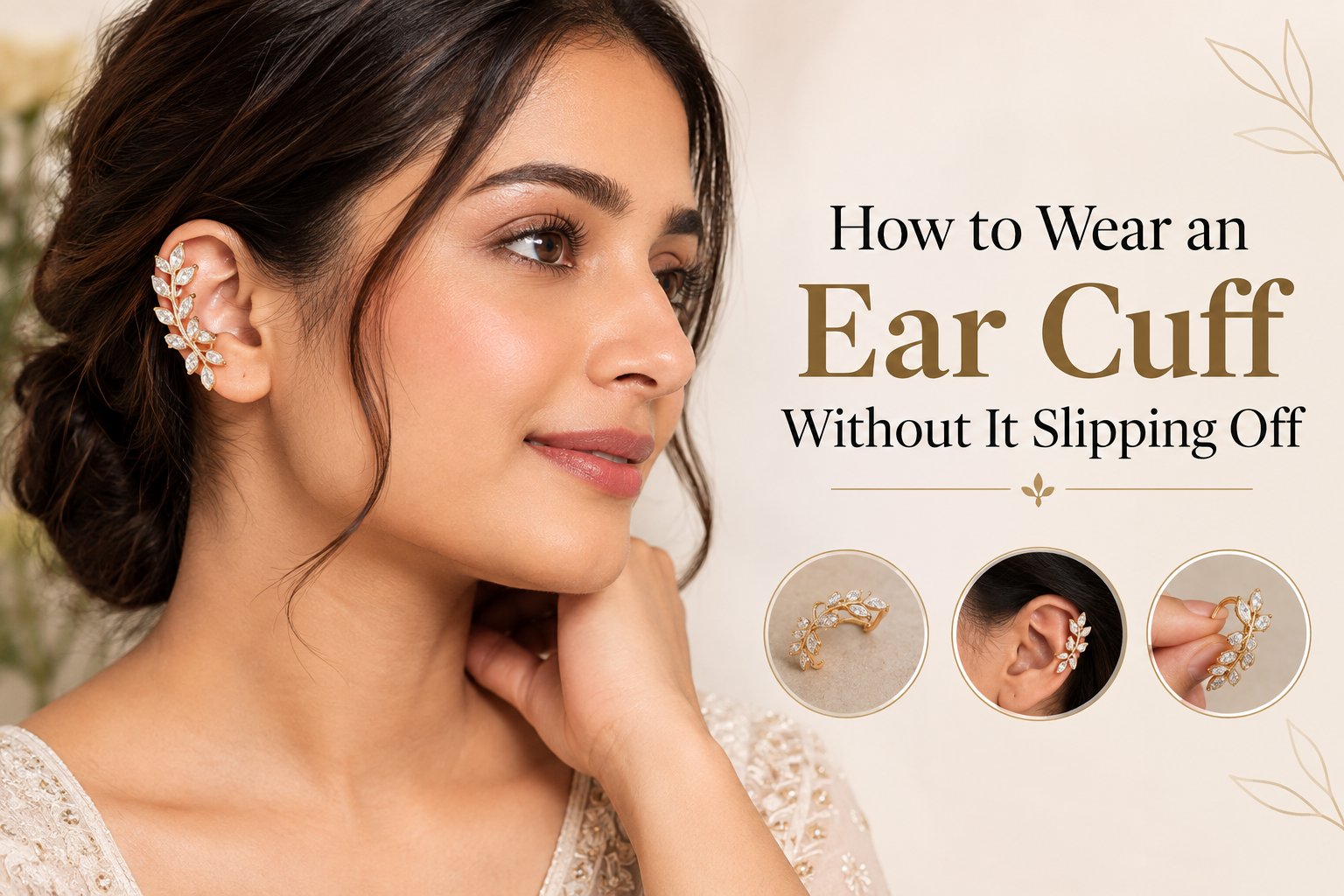
 An ear cuff slips almost always because its band tension doesn't match the thickness of cartilage it's placed on, not because of poor technique. Ear cartilage varies significantly from person to person and even from one point on the same ear to another, so a cuff that grips one person's helix perfectly can feel loose on someone else's, or on a different part of the same ear. Fixing a slipping cuff is mostly a matter of adjusting fit and placement to match your own ear, not repeating the same steps more carefully.
Step-by-Step Placement
-
Find the thinnest section of cartilage, usually near the top-outer edge of the ear (the helix). Thinner cartilage gives an unadjusted cuff its best chance of gripping correctly on the first try.
-
Hold the cuff parallel to your ear in front of a mirror, with the opening facing the direction you'll slide it on from.
-
Slide it into position, then adjust up or down slightly until it sits where you want it — most cuffs can move a short distance along the ear's edge without losing grip.
-
Test with a gentle tug. If it holds without pulling free, the fit is right. If it slides or feels like it's about to come off, the band needs adjusting (see below) before you wear it for the day.
The Pinch Adjustment Technique
If a cuff feels loose, use your thumb and forefinger to gently press the two open ends of the band slightly closer together — this tightens the grip without needing tools. If it feels too tight or pinches, gently widen the gap instead. Make small adjustments and re-test rather than one large change, since it's easier to tighten a slightly loose cuff further than to correct one that's been over-adjusted.
One caution worth noting for gold-plated pieces specifically: repeated wide bending stresses the metal at the same point each time, which can eventually affect the plated finish there. Small, occasional adjustments are fine; avoid reshaping the band significantly on a regular basis.
Placement-Specific Fixes

Different types of ear cuffs fail to stay put for different reasons, so the fix depends on which type you're wearing:
-
Helix or cartilage cuffs slip when placed too high, where the ear's edge is often too thin and angled for the band to grip evenly. Sliding the cuff slightly lower, toward the middle of the helix, usually gives it more surface to hold onto.
-
Conch cuffs are heavier and sit on thicker cartilage, so slipping here is more often a sign the band itself is too large for that part of the ear rather than a placement issue — sizing down is usually the fix.
-
Wrap-around cuffs rely on even pressure along the whole band; if one section sits away from the ear, gently reshape that section to follow the ear's curve more closely rather than just tightening the opening.
-
Chained connector cuffs anchor to an existing lobe piercing, so slipping here is more about the cartilage end than the lobe end — treat the cartilage portion like a standalone helix cuff and adjust it independently of the chain.
Anchoring Techniques for Extra Security
-
Use a stud as a backstop. Placing a cuff just above an existing stud or hoop in the same ear means that if the cuff does slide, it has something to catch on rather than falling off entirely.
-
Stack two cuffs. A second cuff placed just above the first helps hold the lower one in position, since each band restricts how far the other can move — a practical side benefit of the layered "ear party" look covered in what ear cuffs are.
-
Anchor the heavier end first on drop-style cuffs. For any cuff with a hanging charm or chain, position and secure the cuff itself before letting the drop settle, so the added weight doesn't drag the band out of place while you're still adjusting it.

Common Causes of Slipping
|
Symptom |
Likely Cause |
Fix |
|
Cuff slides down through the day |
Placed too high on thin cartilage |
Move slightly lower, or size down |
|
Cuff pinches or feels uncomfortable |
Band too tight for that spot |
Gently widen the opening |
|
Cuff twists out of position |
Uneven pressure along the band |
Reshape to follow the ear's curve |
|
Cuff falls off entirely |
Band too large for that ear's cartilage |
Size down or switch placement |
Maintaining Fit Over Time
A cuff that fit well initially can loosen slightly with regular wear, since the metal experiences small amounts of stress each time it's put on and removed. Handling it by the opening rather than the body of the band when putting it on or taking it off reduces this over time. Oils and skin cells can also build up on the inside of the band and affect grip — a soft cloth wipe after wear, in line with general gold-plated jewellery care, keeps both the fit and the finish in better condition.
Frequently Asked Questions
Why does my ear cuff keep sliding off?
Almost always a fit mismatch between the band's tension and the thickness of cartilage it's placed on — either the band is too loose for that spot, or it's positioned on cartilage that's too thin to hold it.
Should I use pliers to adjust an ear cuff?
For fine or plated pieces, hand adjustment with your fingers is safer — pliers can apply more pressure than needed and risk damaging the band or its finish.
Where should an ear cuff sit for the most secure fit?
Slightly below the very top of the ear, where the cartilage is a little thicker than at the extreme edge, generally holds a standard cuff more securely than the topmost point.
Can wearing a stud earring help keep a cuff in place?
Yes — positioning a cuff just above a stud in the same ear gives it something to catch on if it does start to slide, reducing the chance it falls off entirely.
Styles built for secure, all-day wear are available within the ear cuffs collection.