Cart
0
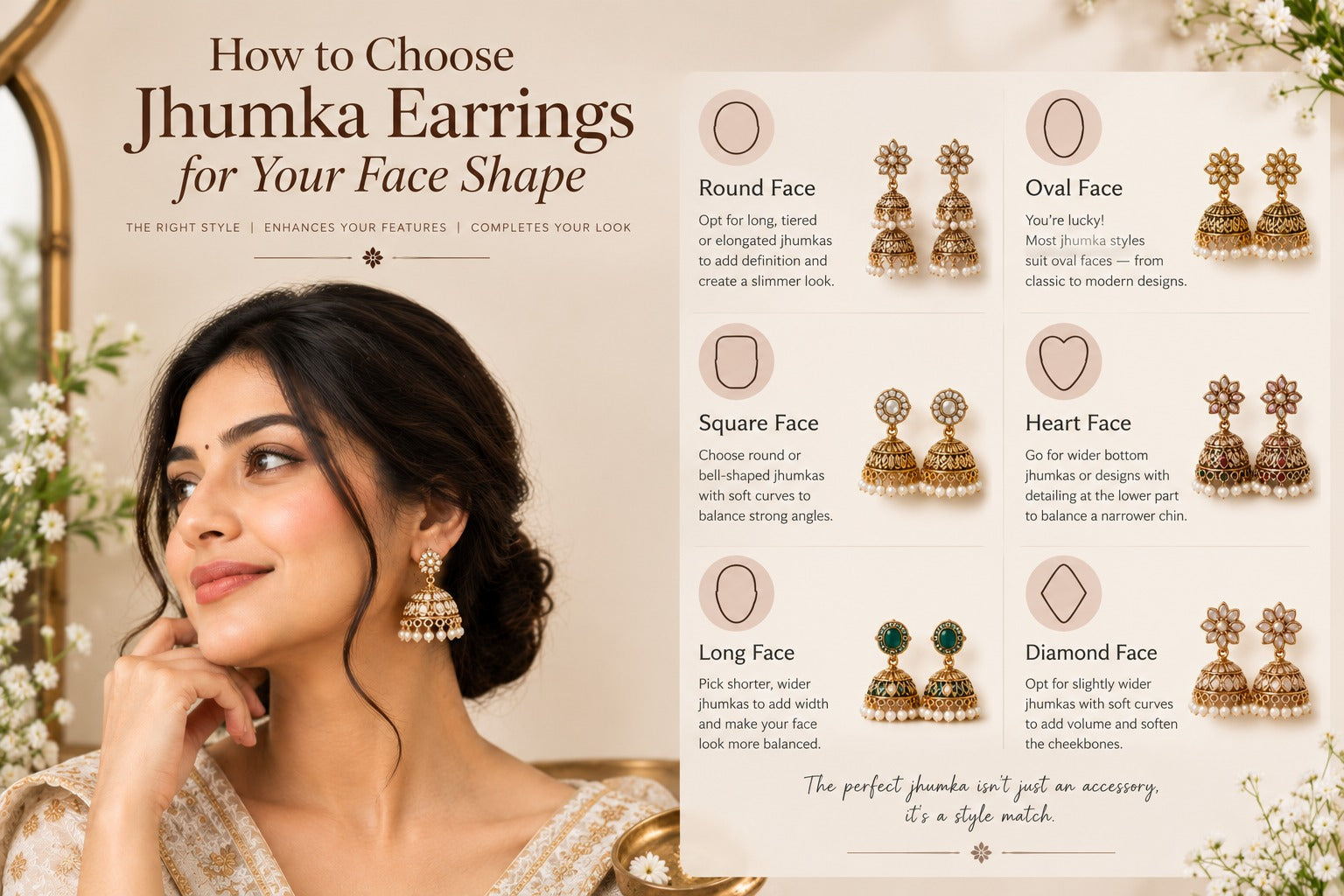
 Jhumkas sit close to the jaw and cheek, so their dome size, drop length, and shape either balance a face's proportions or repeat them. The general rule: choose a jhumka shape that contrasts your face's dominant line — length for width, angles for softness — rather than one that mirrors it.
|
Face Shape |
Best Jhumka Style |
Why It Works |
Generally Avoid |
|
Round |
Elongated, tapered-dome jhumkas with a longer drop |
Vertical line adds length, balancing width |
Wide, fully round domes with no taper |
|
Oval |
Almost any jhumka style, from mini to statement |
Balanced proportions accommodate most shapes |
Nothing specific — oval is the most flexible shape |
|
Square |
Rounded, bell-shaped domes with soft curves |
Softens the jawline's natural angles |
Geometric, boxy, or sharply angular jhumkas |
|
Heart |
Wider-based jhumkas with fuller lower tiers |
Adds width near the jaw to balance a narrower chin |
Long, narrow jhumkas that draw the eye further down |
|
Long / Oblong |
Shorter jhumkas with wider domes |
Introduces horizontal width instead of more length |
Long, straight drop jhumkas that exaggerate length |
|
Diamond |
Medium-drop jhumkas with detail at the widest point |
Adds width at the cheekbone level, balancing a narrow forehead and chin |
Very long, narrow designs that emphasise the taper |
How to Identify Your Face Shape
 Three quick comparisons are usually enough to place a face into one of the six categories above:
-
Length versus width: if your face is close to as wide as it is long, you're likely round or square. If it's noticeably longer than wide, you're likely oval, long, or diamond.
-
Jawline: a soft, curved jawline points to round or oval; a strong, angular jawline points to square; a narrow, tapered jawline points to heart or diamond.
-
Forehead versus cheekbones versus jaw: a wide forehead narrowing to a pointed chin is heart-shaped; wide cheekbones with a narrow forehead and jaw is diamond; roughly equal width throughout is square or rectangular (long).
Round Faces
A round face has width and length that are close to equal, with a soft, curved jawline and full cheeks. Jhumkas with a tapered dome and a longer, single-tier drop introduce a vertical line that offsets the roundness. A jhumka that tapers slightly at the top and sits a little lower on the ear reads as more elongating than one that stays wide from top to bottom. Wide, fully round domes repeat the face's existing shape rather than balancing it, so they tend to be the style to skip. Pulling hair back into a bun or updo helps the earring's length register clearly against the jaw — the same styling principle covered under hoop earrings for face shape for vertical-versus-horizontal balance.
Oval Faces

An oval face is longer than it is wide, with a gently rounded jaw and forehead and no single dominant angle. This is generally considered the most balanced face shape for jewellery, since there's no strong proportion to correct for. Almost any jhumka works here — from a mini jhumki suited to everyday wear to a full statement piece — which makes outfit and occasion, rather than face shape, the deciding factor for oval faces.
Square Faces
A square face has a strong, angular jawline and a broad forehead of similar width. The goal with a jhumka here is softening rather than emphasis: rounded, bell-shaped domes with gentle curves work against the jaw's natural angles, while geometric or boxy earring shapes tend to highlight them instead. This is one of the more forgiving face shapes for classic bell-shaped jhumkas specifically, since the dome's natural curve is already doing the softening work. Loose waves or softer hairstyles reinforce the same effect around the jaw.
Heart-Shaped Faces
A heart-shaped face has a wider forehead that narrows toward a pointed or narrow chin. Jhumkas with a wider base or fuller lower tier add visual width lower on the face, balancing the narrower chin against the broader forehead. Long, narrow jhumkas do the opposite — they draw the eye further down and can make the chin look even narrower by comparison, so they're generally the style to avoid for this shape.
Long or Oblong Faces
A long or oblong face is significantly longer than it is wide, with roughly parallel sides and less curve than an oval. Because length is already the dominant feature, the goal shifts from elongating (as with round faces) to introducing width. Shorter jhumkas with a wider dome, or stud-style jhumkas that sit close to the ear, add horizontal presence without extending the face further. Long, straight-drop jhumkas — often the go-to for round faces — are the style to specifically avoid here, since they compound the existing length rather than balancing it.
Diamond Faces

A diamond face has a narrow forehead and jawline with the widest point at the cheekbones. Jhumkas with detail or width concentrated in the middle of the earring — a medium drop with a fuller or more embellished centre — echo and balance that cheekbone width rather than fighting it. Very long, narrow jhumkas tend to emphasise the taper at the forehead and jaw rather than softening it, making them the less flattering choice for this shape.
Face Shape Is a Starting Point, Not the Whole Decision
Face shape narrows down dome and drop proportions, but outfit, fabric weight, and occasion still shape the final choice — the same factors covered in styling jhumkas with sarees and lehengas and in statement earring sizing more broadly. A round face choosing between a statement and an everyday jhumka, for instance, still applies the same "elongate, don't repeat the shape" principle at either size.
If you're also weighing a jhumka against a structurally different style, jhumkas versus chandbalis breaks down how a chandbali's horizontal, framing shape suits a different set of face shapes than a jhumka's vertical drop.
Frequently Asked Questions
Which face shape suits jhumkas the least?
None are excluded outright — the shape of the jhumka just needs to be chosen deliberately rather than picked at random, especially for round, heart, long, and diamond faces where the wrong proportion can exaggerate rather than balance features.
Do bell-shaped jhumkas suit every face shape?
Classic bell-shaped domes work particularly well for oval and square faces; round, heart, long, and diamond faces generally benefit from adjusting dome width or drop length rather than defaulting to a standard bell shape.
Should I choose jhumkas by face shape or by outfit?
Both matter, but face shape determines proportion (dome size, drop length) while outfit and occasion determine scale and finish — the two work together rather than one overriding the other.
Can the same jhumka style work for more than one face shape?
Yes — oval faces in particular can wear most jhumka styles well, and medium, tapered-dome designs tend to be flattering across several face shapes rather than just one.
Styles matching each proportion above are available within the jhumka earrings collection.