Cart
0
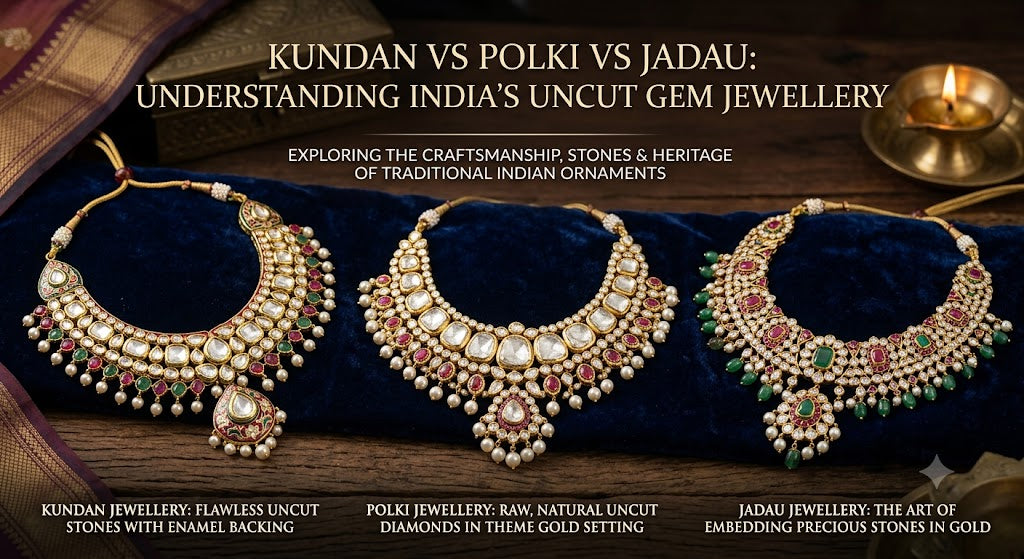
 Ask five jewellers to explain the difference between Kundan, Polki, and Jadau, and there's a fair chance you'll get five slightly different answers — not because any of them are wrong exactly, but because these three words don't actually sit on the same level. One is a type of stone. One is a technique for setting stones. One is the broader craft tradition the other two belong to. Once that hierarchy clicks, the confusion mostly disappears: Polki is what's being set, Kundan is how it's set, and Jadau is the umbrella tradition that encompasses both.
Quick Comparison
|
Polki |
Kundan |
Jadau |
|
|
What it is |
A stone (uncut, natural diamond) |
A setting technique (gold foil, no solder) |
An umbrella craft tradition |
|
Material set |
Natural uncut diamonds |
Glass, coloured gemstones, or polki |
Any stone, set using hand techniques |
|
Can combine with the others? |
Yes — set using Kundan or Jadau technique |
Yes — can set polki or non-polki stones |
Yes — encompasses Kundan and Polki work |
|
Typical cost driver |
Diamond value |
Craftsmanship and gold purity |
Combination of stone, gold, and hand labour |
|
Visual character |
Rustic, irregular sparkle |
Uniform, refined glow |
Varies — reflects whatever stone and setting it uses |
Polki: The Stone, Not a Style
Polki refers specifically to uncut, natural diamonds — stones left in their raw, unfaceted form rather than cut and polished into the symmetrical shapes used in modern diamond jewellery. This is the single most important thing to understand about Polki: it describes what's being set, not a setting technique or design style in its own right. A Polki stone still needs to be set into a piece of jewellery using some method, and that method is usually Kundan or Jadau. Because Polki diamonds are genuine and unaltered beyond basic shaping, they carry real gemstone value, which is why Polki jewellery generally commands the highest price of the three terms discussed here.
Kundan: The Setting Technique
Kundan, as covered in more depth in what Kundan jewellery is, refers to a specific gemstone-setting method: highly refined gold foil, pressed by hand around a stone to secure it without soldering or prongs. Kundan describes how a stone is set, not what the stone itself is. This is why Kundan can be — and frequently is — used to set Polki diamonds, alongside its more common use with glass or polished coloured gemstones. When people describe a piece as "Kundan jewellery" without further detail, they usually mean the gold-foil setting technique applied to glass or coloured stones, since that's the more widely available and more affordable version of the craft — but the technique itself is stone-agnostic.
Jadau: The Umbrella Craft Tradition
Jadau is where most of the confusion actually starts, because it isn't a stone or a single technique in the way Polki and Kundan are — it's the broader traditional craft ecosystem that both belong to. Jadau describes the overall practice of hand-embedding stones into gold without solder or glue, historically developed and refined under Mughal-era court patronage, and it typically encompasses the Kundan setting method, Polki or other stones, and meenakari enamel work on the reverse, all treated as one integrated craft rather than separate add-ons. A piece described as "Jadau" is telling you about the overall hand-craftsmanship tradition behind it; a piece described as "Jadau Polki" or "Jadau Kundan" is telling you which stone that tradition was applied to.
How the Three Actually Combine
This is the part most comparisons skip past too quickly, and it's the part that actually matters when you're shopping:
-
Kundan (glass/coloured stone) work — the most common and accessible version, using the gold-foil setting technique with glass or polished coloured gemstones rather than diamonds.
-
Polki set in Kundan style — genuine uncut diamonds secured using the gold-foil Kundan technique, combining real stone value with the Kundan aesthetic.
-
Jadau Polki — Polki diamonds set within the full Jadau craft tradition, typically including meenakari reverse work, representing one of the more elaborate and valuable combinations.
-
Kundan Meenakari — Kundan-set stones paired specifically with enamel reverse work, a combination close enough to the full Jadau tradition that the terms are sometimes used interchangeably in casual conversation.
In practice, a single bridal piece often combines all three ideas at once: Polki stones (the material), set using Kundan technique (the method), within the broader Jadau tradition (the craft, meenakari included) — which is exactly why the terms get used so loosely in everyday conversation, even though each one technically describes something distinct.
Visual Identification Compared

Because Polki uses natural, unfaceted diamonds, it catches light irregularly — a rustic, uneven sparkle rather than a uniform shine, since the stone's natural surface hasn't been cut to maximise brilliance the way faceted diamonds are. Kundan work using glass or polished coloured stones, by contrast, tends to throw back a more even, uniform glow, since the stones themselves are more symmetrical and consistently cut. This difference in how light behaves is often the fastest way to visually distinguish a Polki piece from a Kundan piece set with non-diamond stones, even before checking materials more closely — a distinction covered further, alongside broader authenticity checks, in how to identify authentic Kundan work.
Price and Value Compared
Polki generally sits at the top of the price range among the three, since genuine uncut diamonds carry real gemstone value regardless of the setting technique used. Kundan work set with glass or coloured stones is typically the most accessible of the three in its traditional fine-jewellery form, since the value lies primarily in the gold and craftsmanship rather than the stones themselves. Jadau pricing varies the most, since it depends entirely on which stones and how much meenakari work went into a specific piece — a simple Jadau Kundan piece can be considerably more affordable than an elaborate Jadau Polki set with extensive enamel detailing.
Occasion Fit Compared

All three are strongly associated with Indian bridal and festive wear, but they aren't perfectly interchangeable in terms of formality. Elaborate Jadau Polki work, given its cost and craftsmanship depth, is typically reserved for the most significant occasions — weddings and major ceremonies. Kundan work, particularly in its more accessible glass-and-coloured-stone form, spans a much wider range of occasions, from full bridal sets down to smaller festive pieces worn well beyond the wedding season.
A Note on Materials
As with Kundan generally, it's worth being direct here: genuine Polki, Kundan, and Jadau work in their traditional forms — real gold, real gemstones or diamonds, hours of hand craftsmanship — sit in the fine jewellery category, priced accordingly. Our own Mughal Kundan collection reflects this design aesthetic in accessible, gold-plated fashion jewellery construction rather than traditional fine-jewellery materials — the look of the tradition, built for everyday and festive wear at a fashion price point rather than a fine-jewellery one.
Frequently Asked Questions
Is Polki the same as diamonds?
Yes, in the sense that Polki refers to genuine diamonds — specifically uncut, natural-form ones, rather than the faceted, polished diamonds used in typical fine jewellery.
Is Kundan fake Polki?
Not accurately, though the confusion is common. Kundan is a setting technique, not an imitation stone — it's most often used with glass or coloured gemstones, but the technique itself can just as easily be used to set genuine Polki diamonds.
Is Jadau better than Kundan?
They aren't directly comparable in that way, since Jadau is the broader craft tradition that Kundan setting typically falls under. A piece described as "Jadau" is usually a more elaborate, fully hand-finished execution of techniques that include Kundan setting rather than a wholly separate, competing style.
Can one piece of jewellery be Polki, Kundan, and Jadau at the same time?
Yes—this is actually the most common combination in fine bridal jewellery: Polki diamonds (the stone) set using Kundan technique (the method) within the broader Jadau craft tradition (meenakari reverse work included).
Pieces reflecting this design tradition are available within the Mughal Kundan collection.