Cart
0
 Every wedding season, a version of the same story plays out in jewellery markets across India: a buyer pays fine-jewellery prices for a "genuine" Kundan set, only to later learn from an independent appraiser that the stones are glass and the gold is a thin wash over brass. It's not always deliberate fraud — sometimes it's a seller who genuinely doesn't know the difference, or vague marketing language doing the misleading for them. Either way, the fix is the same: knowing what authentic Kundan work actually looks and feels like before you hand over money for it.
What "Authentic" Actually Means for Kundan
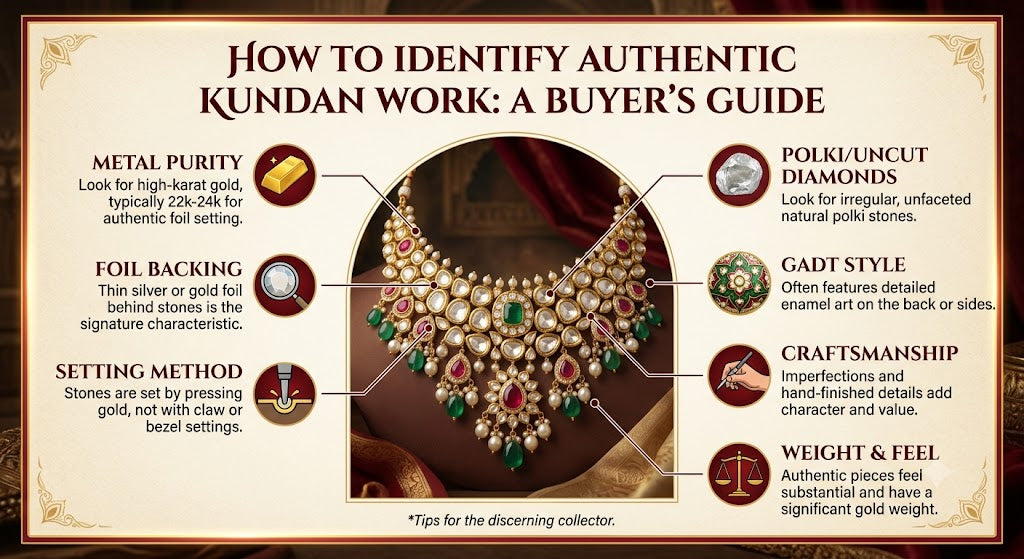
Genuine, traditional Kundan work is defined by a specific combination of materials and process, covered in more depth in what Kundan jewellery is: highly refined gold foil, close to 24 karat, pressed by hand around each gemstone without soldering; genuine gemstones or uncut diamonds rather than glass or synthetic crystal; and, in most pieces, hand-painted meenakari enamel work on the reverse. Every one of these elements takes skilled hand labour, which is precisely why authentic Kundan work commands fine-jewellery prices rather than fashion-jewellery ones.
Visual and Physical Tests
-
Weight. Genuine Kundan work, built around real gold and stones, has noticeable heft compared to imitation pieces made with lightweight base metal and glass. A piece that feels suspiciously light for its size is worth a second look.
-
Stone irregularity. Real gemstones and uncut diamonds vary slightly in shape, size, and clarity from stone to stone — they don't look machine-perfect. Imitation glass stones, by contrast, tend to be uniform, overly uniform in shine, and identical to one another in a way natural stones rarely are.
-
Gold tone. Authentic gold foil has a warm, slightly matte richness rather than a bright, mirror-like shine. A gold tone that looks unusually glossy or artificially bright is often a sign of plating rather than genuine gold foil.
-
Setting quality. In hand-set Kundan work, each stone sits securely with no visible gaps, glue, or uneven pressure points around its edge. Machine-set or poorly finished imitation pieces often show small visible gaps or slightly uneven stone placement under close inspection.
-
Meenakari texture. Genuine hand-painted enamel on the reverse has slight texture and minor variation from piece to piece, since it's painted by hand. A perfectly uniform, flat, printed-looking pattern on the back is more likely a decorative print than real meenakari.
Simple At-Home Checks

Two additional checks are commonly used as quick, informal indicators — useful as one data point among several, not as definitive proof on their own:
-
The magnet test. Genuine gold and silver aren't magnetic, so a small magnet shouldn't visibly attract a piece marketed as real Kundan. If it does, the base metal likely contains iron or another ferromagnetic alloy rather than precious metal.
-
The cool-touch test. Metal conducts heat away from skin faster than plastic or resin, so genuine metal jewellery typically feels cool to the touch initially and warms slowly. A piece that feels warm or slightly plastic-like from the moment you pick it up is worth questioning further.
Neither test replaces a proper appraisal for a significant purchase, but both are quick enough to use while shopping.
Price as a Signal
Genuine, hand-set 24-karat Kundan work is labour-intensive by nature, and that labour shows up in the price. A piece marketed as "authentic Kundan" at a price that seems dramatically below what comparable hand-set fine jewellery typically costs is one of the more reliable red flags available to a buyer — not because low price always means fake, but because the specific combination of real gold, real gemstones, and hours of hand-setting rarely comes cheap.
Seller and Documentation Checks
Buying from an established, reputable jeweller with a track record in genuine Kundan work significantly reduces risk compared to an unfamiliar seller. Ask specifically whether the piece includes documentation of gold purity (hallmarking) and, where relevant, gemstone certification — a seller confident in a piece's authenticity will generally be able to provide this without hesitation. Vague reassurance without documentation is itself worth treating as a caution sign for a significant purchase.
When You're Not Buying "Authentic" at All — and That's Fine
 Everything above applies specifically to shopping for traditional, hand-set fine Kundan jewellery. A large share of what's sold today under the Kundan name is something different: Kundan-style fashion jewellery, built with gold-plated base metal and glass or cubic zirconia stones to replicate the aesthetic at a fraction of the cost, rather than attempting to replicate the genuine materials at all.
Our own Mughal Kundan collection falls into this second category, reflecting the Mughal Kundan design tradition in accessible, gold-plated fashion construction rather than traditional 24-karat gold-foil craftsmanship. None of the authenticity tests above are relevant to that kind of purchase, because the piece was never sold as genuine 24-karat hand-set Kundan in the first place — the right question for fashion jewellery isn't "is this real," it's whether the plating, stone-setting, and finish are good quality for what it actually is. Knowing which category you're shopping in — heritage fine jewellery or Kundan-style fashion jewellery — is what makes either purchase a confident one rather than a confusing one.
Frequently Asked Questions
What's the fastest way to check if Kundan jewellery is real?
Weight and stone irregularity are the two quickest checks: genuine pieces feel noticeably heavier than imitation ones, and real gemstones show natural variation in shape and shine that machine-cut glass stones typically lack.
Does a low price always mean Kundan jewellery is fake?
Not automatically, but genuine 24-karat hand-set Kundan work is inherently labour-intensive and rarely inexpensive — a very low price on a piece marketed as authentic is a reasonable prompt to ask more questions before buying.
Is gold-plated Kundan-style jewellery "fake" Kundan?
Not in a deceptive sense, as long as it's marketed honestly as fashion jewellery rather than claimed to be genuine 24-karat hand-set work. It's a different, more accessible category built to replicate the aesthetic rather than the fine-jewellery materials.
Can meenakari on the back of a piece help confirm authenticity?
Yes, to an extent — genuine hand-painted meenakari shows slight texture and natural variation, while a flat, uniform, printed-looking pattern on the reverse suggests a decorative finish rather than real enamel work.
Kundan-style fashion jewellery reflecting the Mughal aesthetic is available within the Mughal Kundan collection.