Cart
0
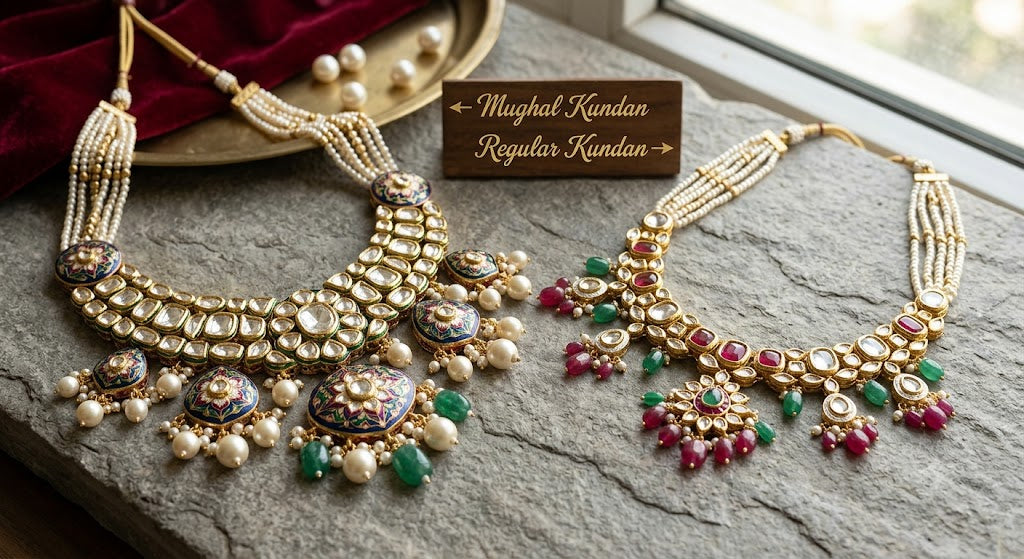

Both Mughal Kundan and regular Kundan jewellery use the same underlying setting technique—gemstones held in place with refined gold foil rather than prongs or solder, covered in full in what Kundan jewellery is. The difference between them is design, not construction: Mughal Kundan refers specifically to pieces built around the ornate design vocabulary that developed under Mughal court patronage, while "regular Kundan" is the broader umbrella covering any Kundan-technique jewellery, including simpler, more minimal, or regionally varied pieces that don't carry those specific Mughal-era design markers.
Why This Distinction Gets Confused
Because Kundan as a technique reached its most documented, most influential form during the Mughal era, a lot of everyday usage treats "Kundan" and "Mughal Kundan" as interchangeable. In practice, they aren't quite the same thing: every Mughal Kundan piece is Kundan, but not every Kundan piece follows the specific Mughal design vocabulary — the floral motifs, openwork gold, and diamond-emerald-ruby pairing covered in what Mughal Kundan jewellery is. A simpler, more geometric or minimal Kundan piece, or one drawing on a different regional design tradition, is still genuinely "Kundan" without necessarily being "Mughal Kundan" in the stylistic sense.
Design Motifs Compared
|
Mughal Kundan |
Regular Kundan |
|
|
Motifs |
Floral and palmette patterns, crescent-and-stem shapes, Persian-influenced symmetry |
Varies widely — can be geometric, minimal, or follow other regional design traditions |
|
Goldwork |
Pierced, lattice-like openwork gold |
Often simpler, more solid gold framework |
|
Reverse detailing |
Meenakari enamel work is a common, near-standard finish |
Present in some pieces, absent in many simpler designs |
|
Stone palette |
Diamonds paired with emeralds and rubies is a recurring signature combination |
Any stone combination the design calls for, with no fixed palette |
|
Visual density |
Typically dense, layered, heavily detailed |
Ranges from equally dense to considerably more restrained |
Goldwork and Craftsmanship
Mughal Kundan pieces tend to favour openwork gold — pierced, lattice-style metalwork that keeps large pieces visually rich without becoming excessively heavy, a technique closely tied to the court workshop tradition. Regular Kundan work can use the same approach but just as often relies on a simpler, more solid gold framework, particularly in smaller or more contemporary pieces where the ornamental goldwork isn't the design's central feature.
Stone Palette and Colour
The pairing of diamonds with emeralds and rubies is one of the more consistently documented signatures of Mughal-era jewellery, reflecting both aesthetic preference and the gemstone trade available to the imperial court at the time. Regular Kundan jewellery isn't bound by this palette at all — it can be set with any combination of coloured stones the design calls for, which is part of why contemporary Kundan pieces come in such a wide range of colourways compared to the more historically consistent Mughal combination.
Meenakari: Common in One, Optional in the Other

Meenakari — enamel work applied to the reverse of a piece — became closely associated with Mughal-era Kundan and remains close to a signature feature of pieces styled in that tradition. Regular Kundan jewellery may or may not include meenakari; simpler or more minimal pieces often skip the reverse enamelling altogether, since it adds a separate craft step that isn't necessary for the front-facing design to read as Kundan.
Occasion and Styling Differences

Because of its visual density and historical association with royal ceremony, Mughal Kundan is generally the choice for full bridal looks and major festive occasions — the same reasoning behind its common pairing with kundan jhumka earrings and kundan maang tikkas as part of a complete set. Regular Kundan, particularly simpler or more restrained designs, works across a wider range of occasions — festive gatherings, smaller functions, or even semi-formal wear — precisely because it isn't tied to the same level of ornamental detail.
A Note on Materials
It's worth being direct here, in the same spirit as our broader guide to Kundan jewellery: genuine, traditional Mughal-style Kundan — 24-karat gold foil, hand-set stones, meenakari enamelling — is a fine jewellery craft, priced and made accordingly. Our Mughal Kundan collection reflects this design tradition in accessible, gold-plated fashion jewellery construction rather than traditional 24-karat gold-foil craftsmanship — the aesthetic, not the fine-jewellery materials. This is the same honest distinction that applies to Kundan-style fashion jewellery generally, and it's worth knowing regardless of which style, Mughal or otherwise, you're shopping for.
Frequently Asked Questions
Is Mughal Kundan a different technique from regular Kundan?
No — both use the same gold-foil setting technique. The difference is in design: Mughal Kundan follows a specific historical aesthetic vocabulary, while regular Kundan is a broader category that includes simpler or differently styled pieces.
Is Mughal Kundan always more expensive than regular Kundan?
In traditional fine jewellery, yes, generally — the additional openwork goldsmithing and meenakari enamelling typically associated with Mughal Kundan add craftsmanship time. In Kundan-style fashion jewellery, price differences come down more to design complexity than to which style is being replicated.
Can regular Kundan jewellery include meenakari too?
Yes — meenakari isn't exclusive to Mughal-style pieces, though it's a more consistent, near-default feature there than in simpler regular Kundan designs.
Which is better for a wedding, Mughal Kundan or regular Kundan?
Mughal Kundan's visual density and historical bridal association make it the more traditional choice for a full wedding look, but simpler regular Kundan pieces suit smaller functions or less formal ethnic occasions well.
Pieces reflecting the Mughal design tradition are available within the Mughal Kundan collection.