Cart
0
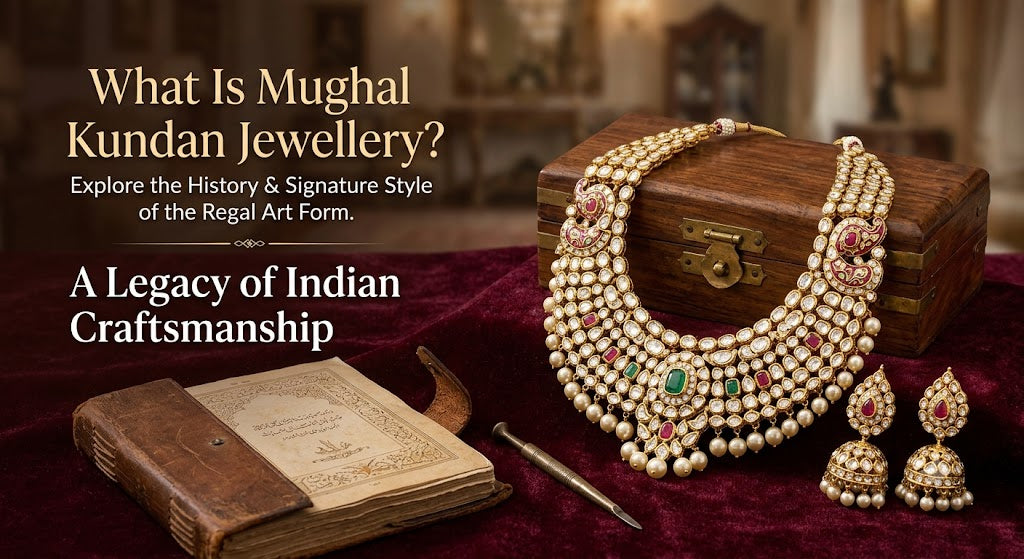
 Mughal Kundan jewellery is the specific historical and aesthetic strand of Kundan jewellery that developed under the patronage of the Mughal court between the late 16th and mid-17th centuries. While Kundan as a gemstone-setting technique predates the Mughal Empire, it was in Mughal court workshops that the craft absorbed Persian design sensibilities — floral and palmette motifs, refined openwork gold, and a particular pairing of diamonds with emeralds and rubies — that still define what people mean today when they describe a piece as "Mughal Kundan" rather than Kundan in general.
Kundan the Technique vs. Mughal Kundan the Style
It's worth separating these two ideas clearly, because they're often used interchangeably in casual conversation but describe different things. Kundan is a gem-setting technique: gemstones are secured into a framework using highly refined gold foil rather than prongs, claws, or solder, a method covered in more depth in what Kundan jewellery is. Mughal Kundan, by contrast, describes a design tradition — a particular aesthetic vocabulary that emerged when this Rajasthani technique met Mughal court taste. Every piece of Mughal Kundan jewellery uses the Kundan setting technique, but not every piece of Kundan jewellery reflects the Mughal design tradition specifically. Regional Kundan work from other parts of India, or contemporary Kundan pieces designed without reference to Mughal-era motifs, are technically Kundan but not "Mughal Kundan" in the stylistic sense.
Where the Technique Came From Before the Mughals
Historical and archaeological evidence places the origins of the Kundan setting technique in the royal courts of Rajasthan and Gujarat, with some scholarship tracing its roots back as far as the 3rd century BCE. Local artisans in these courts had already developed the core method — layering pure, malleable gold foil around gemstones to hold them in place without soldering — long before the Mughal Empire arrived in India. This distinction matters historically: the Mughals didn't invent Kundan, but they became its most influential patrons, and that patronage is what transformed a regional royal craft into one of India's most recognisable jewellery traditions.
The Mughal Court Era: How Patronage Shaped the Style
Art historians generally date the golden age of Mughal jewellery craftsmanship to roughly 1580 to 1650, spanning the reigns of Akbar, Jahangir, and Shah Jahan. Under Akbar, Rajasthani Kundan artisans were drawn into imperial workshops, where the technique began absorbing the visual language the Mughal court had inherited from its Persian and Central Asian roots. By the time of Jahangir and Shah Jahan — the same era that produced the Taj Mahal — Kundan jewellery had become a court art form in its own right, with royal workshops commissioning elaborate pieces for ceremonies, gifting, and daily courtly wear.
Museum collections from this period, including pieces held by institutions like the Victoria and Albert Museum, show gemstones such as rubies and emeralds set into gold using the Kundan technique on objects the quality of craftsmanship suggests were made within Mughal court workshops themselves, with the specific palmette-style ornamentation dating several surviving pieces to the early 17th century — physical evidence of the fusion between Rajasthani technique and Mughal design sensibility.
Signature Design Elements of Mughal Kundan

Several visual and structural features distinguish Mughal Kundan from Kundan work in general:
-
Floral and palmette motifs. Mughal court art drew heavily on Persian floral traditions, and Kundan jewellery from this tradition frequently features stylised flowers, leaves, and palmette (fan-shaped floral) patterns worked into the gold framework itself, not just the stone arrangement.
-
Openwork gold. Rather than solid gold backing, Mughal Kundan pieces often use pierced, lattice-like goldwork, which kept large ceremonial pieces lighter without sacrificing visual density.
-
Diamond, emerald, and ruby pairing. While Kundan can be set with a wide range of gemstones, the specific combination of diamonds with emeralds and rubies became closely associated with Mughal-era jewellery, reflecting both the aesthetic preferences and the gemstone trade routes available to the imperial court.
-
Meenakari on the reverse. Meenakari, the art of enamelling, flourished alongside Kundan during the Mughal era and became a standard finishing technique: the front of a piece carries the gemstone and gold work, while the reverse is enamelled in colour, originally as a way of protecting the gold from contact with skin and later as a decorative feature in its own right.
-
The crescent-and-stem motif. One of the more commonly documented design signatures of Mughal-era gold jewellery, this recurring shape appears across many surviving pieces from the period and continued to influence North Indian jewellery design long after the empire itself declined.
Materials and Craftsmanship
A Mughal Kundan piece is typically built from several materials working together, each with a specific structural role:
-
A lac or resin core, which forms the base structure that gemstones and gold foil are set into — this is what allows Kundan work to hold complex, three-dimensional forms rather than lying flat.
-
Highly refined gold foil, pressed rather than hammered into place around each stone, since the purity of the gold (traditionally close to 24 karat) makes it soft enough to work at room temperature without soldering.
-
Gemstones, historically including uncut polki diamonds alongside emeralds, rubies, and pearls, chosen and arranged according to the piece's design rather than uniform cutting.
-
Meenakari enamel, applied to the reverse side once the front-facing gold and stonework is complete.
This combination of materials is why authentic Mughal-style Kundan work remains labour-intensive even today: each stone is individually set by hand, and the enamelling step alone requires a separate, specialised craft skill passed down independently of the gold-setting technique.
Where the Craft Is Practised Today
Following the decline of the Mughal Empire, the artisan communities who had developed and refined the technique in imperial workshops carried the craft forward, and Rajasthan — particularly Jaipur and Bikaner — remains the recognised centre of Kundan craftsmanship in India today. Jaipur's karigars (artisans) continue to work with the same core techniques — gold foil setting, lac-core construction, and meenakari enamelling — that defined the Mughal court tradition, passed down through generations of family workshops rather than formal industrial training.
Mughal Kundan and Related Craft Terms

Mughal Kundan jewellery is frequently discussed alongside two related terms that describe overlapping but distinct aspects of the same broader tradition: Polki, which refers to the uncut, naturally-shaped diamonds often used within Kundan settings rather than a setting technique itself, and Jadau, a broader term for the tradition of hand-set jewellery that flourished under Mughal-era patronage generally, encompassing Kundan setting, Polki stones, and meenakari work together as a single craft ecosystem rather than three separate categories. A full breakdown of how these three terms relate to and differ from one another deserves its own dedicated comparison rather than a brief summary here.
Mughal Kundan in Bridal and Festive Jewellery Today
Mughal Kundan's association with royal ceremony carried directly into its modern role: it remains one of the most common jewellery styles for Indian weddings and major festive occasions. The same design principles that made it suitable for Mughal court ceremony — intricate detail, substantial visual presence, and gold-and-gemstone richness — are exactly what make it suit modern bridal wear. It's frequently seen in kundan jhumka earrings and in kundan maang tikkas, where the technique's ability to set many stones closely together produces the dense, layered look associated with formal bridal jewellery. As part of a full bridal look, Mughal Kundan pieces are typically coordinated across a complete bridal jewellery set rather than worn as a single standalone piece.
Frequently Asked Questions
Did the Mughals invent Kundan jewellery?
No. The Kundan setting technique originated in the royal courts of Rajasthan and Gujarat before the Mughal Empire, but it was refined and popularised into its most recognisable form under Mughal court patronage, particularly during the reigns of Akbar, Jahangir, and Shah Jahan.
What makes a piece specifically "Mughal Kundan" rather than just Kundan?
The presence of design elements associated with the Mughal court tradition — floral or palmette motifs, openwork gold, the diamond-emerald-ruby combination, and meenakari enamelling on the reverse — rather than the Kundan setting technique alone.
Is Mughal Kundan the same as Jadau?
They overlap significantly. Jadau is the broader term for the Mughal-era tradition of hand-set jewellery, encompassing Kundan setting, Polki stones, and meenakari work together, while Mughal Kundan more specifically emphasises the gold-foil setting technique and its associated Mughal-court design vocabulary.
Where is authentic Mughal-style Kundan jewellery made today?
Jaipur and Bikaner in Rajasthan remain the principal centres, where artisan families continue the same gold foil setting, lac-core construction, and meenakari techniques developed during the Mughal era.
Pieces reflecting this tradition are available within the Mughal Kundan collection.