Cart
0
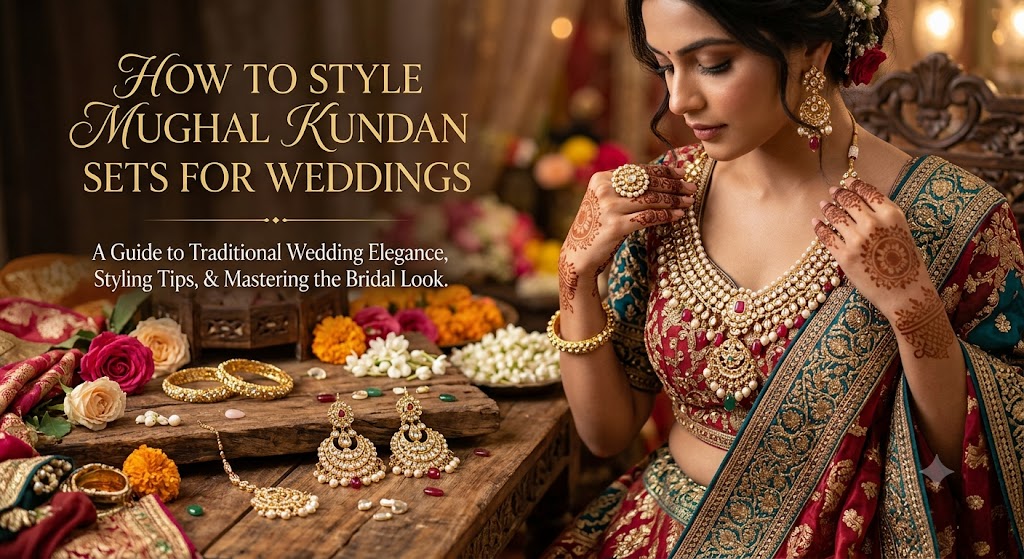
 A bride tries on a heavy Mughal Kundan choker in the store under bright lights, and it looks flawless. Three weeks later, at the actual wedding, that same choker either vanishes under a heavily embroidered blouse neckline or ends up fighting the lehenga's own beadwork for attention. The piece didn't change — the context did. Styling Mughal Kundan for a wedding isn't really about finding a beautiful set; it's about matching that set's visual density to the outfit, the fabric, and the specific function it's being worn to, so the jewellery and the outfit work as one look instead of two competing ones.
The One Rule Behind Every Good Kundan Look
Mughal Kundan is defined by openwork gold, layered stonework, and meenakari detailing — which means it already carries a lot of visual weight before it's even paired with an outfit. The single most reliable styling principle is to match that density to the outfit's own embellishment level: a heavily worked lehenga can carry an equally elaborate Kundan set, while a simpler outfit needs a lighter, more restrained piece to avoid looking either underdressed or overloaded. Get this one match right, and most of the rest of the styling falls into place on its own.
Styling with Sarees
 Silk sarees — Banarasi, Kanjeevaram, and similar heavy weaves — are the classic Mughal Kundan pairing. The density of silk zari work and a rich Kundan choker or rani haar read as a matched pair, each supporting the other rather than competing.
Chiffon, georgette, and lighter sarees call for restraint. A single statement Kundan necklace, or a lighter choker without a full layered set, keeps a soft, fluid fabric from being overwhelmed by heavy goldwork.
Printed sarees generally suit a single strong Kundan piece — one long necklace or one pair of statement earrings — rather than a full matching set, since the print itself is already doing visual work.
Styling with Lehengas
 Lehengas are almost always the setting for the most elaborate Mughal Kundan looks, largely because the silhouette has the surface area — a full bodice, a wide skirt — to visually balance a substantial choker or layered necklace. Two things matter most here:
-
Colour coordination. Matching the ruby, emerald, or coloured stone palette of the Kundan set to the lehenga's dominant colour (or a strong accent within it) is what makes the jewellery feel designed for the outfit rather than added to it afterward.
-
Neckline. A deep or heavily embellished blouse neckline can visually swallow a delicate necklace, while a plainer neckline gives even a restrained Kundan piece room to be the focal point.
Function-by-Function Styling
Indian weddings run across several distinct functions, and a Mughal Kundan set doesn't need to stay identical across all of them — in fact, it usually shouldn't.
|
Function |
Recommended Density |
Notes |
|
Engagement |
Medium, elegant |
Enough presence for photography without competing with outfit detail |
|
Haldi / Mehendi |
Light to medium |
Comfort matters more here; simpler Kundan pieces or a single statement item work best |
|
Sangeet |
Medium to heavy |
Room to be bolder, especially with movement-friendly earrings |
|
Wedding ceremony |
Heaviest, most complete set |
Full choker, earrings, and maang tikka together for the main bridal look |
|
Reception |
Medium, often modernised |
A lighter or more contemporary Kundan piece suits a change of outfit and mood |
Coordinating the Full Set
A complete Mughal Kundan bridal look is rarely just a necklace. Kundan jhumka earrings and a kundan maang tikka are the two pieces most commonly paired with a Kundan necklace to complete a traditional bridal look, and coordinating metal tone and stone colour across all three is what makes the set read as one cohesive look rather than three separate accessories — the same coordination principle covered in more depth in building a bridal jewellery set. It's also entirely acceptable to mix pieces from different sets — a necklace from one design paired with earrings from another — as long as stone colour and gold tone stay consistent across the mix.
Hairstyle and the Neckline
 A heavy Kundan choker or necklace needs a hairstyle that keeps the neck and shoulders visible — an updo or a low bun is the standard choice for exactly this reason, the same logic that applies to showcasing a jhumka's movement when styled with a saree or lehenga. Loose, open hairstyles tend to cover the very jewellery a bride is trying to show off.
Common Styling Mistakes
-
Matching density to the wrong element. Some brides match jewellery weight to the wedding's formality rather than the outfit's actual embellishment level — the two don't always align, and the outfit should win.
-
Ignoring stone colour against skin tone and outfit together. A stone palette that works against the lehenga can still clash with makeup or skin tone; it's worth checking all three together, not just jewellery against outfit.
-
Skipping the trial run. Trying the full set — necklace, earrings, and maang tikka — with the actual outfit before the event is the simplest way to catch a mismatch in density or colour before it matters.
Frequently Asked Questions
Should the same Kundan set be worn for every wedding function?
Not necessarily — many brides use lighter Kundan pieces for haldi and mehendi, and reserve the heaviest, most complete set for the wedding ceremony itself.
How do I know if a Kundan set is too heavy for my outfit?
If the jewellery draws attention away from the outfit's own embroidery or embellishment rather than complementing it, the set is likely too dense for that particular piece.
Can Mughal Kundan be styled with lighter, everyday outfits?
Yes, particularly a single restrained piece — one necklace or one pair of earrings rather than a full set — which works well for smaller festive occasions beyond the wedding functions themselves.
Does the necklace, earrings, and maang tikka need to be from the same set?
Not strictly — mixing pieces from different sets works well as long as metal tone and stone colour stay consistent across everything worn together.
Pieces for building a complete bridal look are available within the Mughal Kundan collection and the wider wedding jewelry range.